Showing posts with label top ten. Show all posts

Monday, November 2, 2009

Every Man for Himself and God Against All

It's a sign of what incredibly bold filmmakers the Coens are that they often state the theme of their movies in such plain terms. At certain times, the first line of the film has been the theme (that's Miller's Crossing, if you're wondering). In A Serious Man, it comes about halfway through, in response to what is seemingly an insignificant subplot (although who's to say what's significant and what isn't, argues the film). A man puts it simply: "Please, accept the mystery."

The film offers a vague answer because no one actually knows the answer (and by "vague answer", I mean "really vague answer"). The Coens aren't interested in arguing in favor of God or a certain view on our Purpose or even pushing their own personal religious beliefs on us, and they're especially not interested in giving us the false answers Hollywood is prone to. They're interested in telling the story of Larry Gopnik.

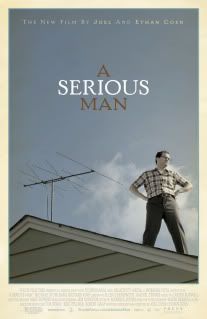
A Serious Man is the tale of Larry Gopnik, a college professor living in a midwestern Jewish community, with all kinds of problems. His wife is leaving him for the well-to-do Sy Ableman, his kids are a wreck (his son is in trouble with the resident high school drug dealer), a student is trying to bribe him for a passing grade and may be writing defamatory letters to the tenure board, and his gambling-addicted brother, who is little more than a man-child, is sleeping on the couch.

All these problems push Larry towards metaphysical crisis and he seeks the help of three different rabbis as his life spirals further and further out of control.

And what a tale! It's so hard to say "The Coens' best/funniest/etc film since..." because only a few of their films can be considered anything less than spectacular. I make no secret of the Coens being my very favorite living American filmmakers by a significant margin. Almost every single one of their films is a masterpiece of some degree, and their assembled crew is a filmmaking super-group.

One of the most peculiar things about this film is its similarity to The Man Who Wasn't There, one of their most underrated films. Both are period pieces about ineffectual men whose wives are unfaithful, and both are stories of those mens' lives as they begin to spiral out of control. Both mine similar thematic territory and if I had to choose a Coen film to compare the tone to, it would be The Man Who Wasn't There.

This is not a slight, but more praise on the Coens' part for taking two similar stories and two similar protagonists (although The Man Who Wasn't There is clearly the more cartoonish and film-ick of the two) and using them for different ends. But these are merely the ramblings of an under-fed Coen enthusiast.

Most of the criticisms I've seen aimed at this film have been "The Coens clearly have no love for their characters and enjoy seeing them tormented", which is inexplicable. That they put Larry through trials and tribulations and have him come out merely confused on the other end is not a sign of hatred. In fact, the honesty with which they approach Larry suggests unrequited love for this character. The Coens are sometimes guilty of being cynical, but I don't know when "cynical" became synonymous with "hating their characters". Similarly, they're considered condescending, which is a word I altogether do not understand; it's just a way for people to be anti-intellectual (something critics should feel victimized by).

The film, like all Coen films, is perfectly cast, down to the smallest role. Michael Stuhlbarg is brilliant in the lead role, and absolutely deserves a Best Actor nomination come Academy Awards time. Similarly, Fred Melamed is loads of fun as Sy Ableman, the man who has swooped in to steal Larry's wife. Despite his gentle, scholarly appearance, he seems to have an air of triumph about him, so as he tactfully and gracefully suggests Larry stay at a local motel, he's gloating just enough to let Larry see.

And of course, the cinematography is second to none. Roger Deakins makes a welcome return, making the film unnecessarily lovely (especially a rather showy shot involving a ladder).

I don't feel like I even have to recommend this film. It's the Coen brothers. It took me a month to see it, despite my best efforts (illness took hold and it requires a 60 mile drive to get to the nearest independent theater), so why haven't you seen it already? It's surely one of the best films of the year, because, well it's the fucking Coens. Do I really need to tell you again?

10/10

Friday, August 21, 2009

Men on a Mission

Several years ago there was a boy. He had a great deal of interest in a great many things, but none of them offered him that intangible something that he wanted. Perhaps a medium that best suited his tastes or something of significant depth that he could really sink his teeth into. One day, the boy fell ill and stayed home from school. There, bored, he rifled through some cabinets looking for something to do. He fell upon his older brother's DVD of Reservoir Dogs. He had little else to do, so he decided to take a gamble on something that his brother clearly liked, which, of course, doesn't always pay off.

But when that movie ended, that boy couldn't bring himself to move a muscle. Completely transfixed by the power of a medium he had never seen harnessed, he knew at that moment that he must start a blog. In four years.

So as you can imagine, Quentin Tarantino has a very, very special place in my heart. I've never regarded him as a truly Great filmmaker.

Until now.

I always though of him as a great writer who also happened to direct his writing, for he transformed the face of cinema and kickstarted the independent movement essentially based on his scripts.

Kill Bill is a great film(s), but it's not as groundbreaking or genre-bending as Pulp Fiction and it's not as gut-wrenching and visceral as Reservoir Dogs. But Death Proof really dampened my faith in the man. Not only was it overlong and terribly boring, but it somehow seemed to isolate all his worst impulses and leave out any of the things that make those bad impulses work in his other films.

If someone were to have told me a week ago, or five hours ago, that Inglorious Basterds would somehow combine the genre-bending and inspired dialogue of Pulp Fiction with the open gut wound that is Reservoir Dogs and wrap it in a flour tortilla of the loving kitsch that makes Kill Bill so unique, I would likely have declared you mad and had you spend the rest of your days having your hair harvested for wig-makers to practice on.

I would have been wrong. I would have falsely imprisoned you, and I would wear your wigs if I ever went bald so that at least one part of you would be able to glimpse the outside world again.

Inglorious Basterds may well be the perfect alignment of the planets otherwise known as Tarantino's body of work (which is very different from it being his best film). It combines everything that is great about him and rolls up his bad impulses in a rug and heaves it into a deep river where it will be retrieved as treasure by 24th century rug pirates.

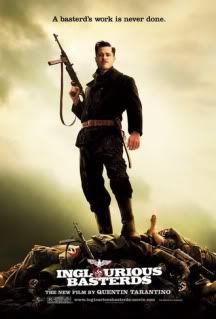
But as is tradition here at Herr Machine, I'm way ahead of myself. Here's the plot for those of you who don't know (for those of you who do know, I'm purposefully insulting your intelligence): Brad Pitt is Lt. Aldo "The Apache" Raine. He is the leader of a squad known as The Basterds, assembled of the finest Jewish-American soldiers and sent deep behind enemy lines to, well, murder the fuck out of the Germans. Why? To strike fear into the hearts of the enemy. When they see the mutilated corpses that they leave in their wake, whether they be scalped, disemboweled or or bludgeoned to death the Germans will talk and fear will spread until the Basterds are the boogieman of the American army. And isn't that just a marvel of anti-history and affectionate kitsch?

Several sub-plots weave in and out of that story, including a famous German actress, a very evil Nazi officer named Hans Landa, a young Jewish woman operating a cinema in Paris and a young Nazi war hero.

The principle actors include Brad Pitt as Aldo the Apache, a role that recalls a seeming phantom of my movie-going history. His cartoonish character is required to smirk at the camera, never deviate from the speech patterns branded to his tongue and blow my mind. If American soldiers were told about a man who kills and scalps hundreds of Nazis and commands a group of soldiers that beat Nazis to death with baseball bats, Brad Pitt's Aldo is exactly the image they would conjure. That doesn't mean he's the least bit realistic, he's every bit as batshit as the mythology and it is a ballsy performance for Pitt, as anyone could easily mistake his performance for a lazy caricature. But the way that Pitt maintains this cartoonish persona at the same time as wrapping his tongue around Tarantino's tricky dialogue every bit as well as the finest actors who have found themselves in front of his lens makes Pitt's performance one of his finest, if not his very finest, performances ever.

But the real stand out is Christoph Waltz as the very evil Col. Hans "The Jew Hunter" Landa. His talent is only something that Tarantino could pull off: he is a wordsmith. Someone who can extract information and get anyone to do anything he wants with his devilish charm. Every second he circles his target, waiting for the exact. Right. Moment. To strike. That doesn't mean that he waits a few minutes, that means he draws his prey in closer and closer for an agonizingly suspenseful period of time, but the deathblow is so quick you could blink and miss it.

Waltz gives a performance so glorious and spectacularly realized, that I may have to call it the best performance ever in a Tarantino film by a significant margin, and let me stress that that includes ALL the great performances in Tarantino's films. Harvey Keitel in Reservoir Dogs. Samuel L. Jackson and John Travolta in Pulp Fiction. Pam Grier and Robert Forster in Jackie Brown. Uma Thurman and David Carradine in Kill Bill. Writing that list of performances, I couldn't help but chortle at how far into the stratosphere Christoph Waltz blows them.

One of the chief pleasures of a Tarantino film is that the man just can't contain himself. His passion is infectious. Passion for film, passion for dialogue, passion for stories. People who complain that his scenes go on too long aren't on the same wavelength and they aren't experiencing the same movie I am. The film I saw was a 150-minute love letter to 100 years of filmmaking tradition. And not just the tradition that the critics fawn over, or even the masses, but the little things. The forgotten films that indulge our basest desires are given more cuddle time than any Citizen Kane, and why not? Tarantino loves the medium unconditionally, and that's why he's a cinephile's director. His films are a greatest-hits compilation of world filmmaking, the kind of greatest hits compilation that makes you proud to watch hundreds of movies a year.

Watch! as Tarantino slowly ratchets up the tension in his dialogue. Watch! as the dialogue sizzles and boils for ten, fifteen, twenty minutes. Watch! as guards go up and tensions rise. Watch! as those tensions catch fire. Watch! as those tensions erupt like a fucking volcano. And let's watch it again. It's a trick I didn't know Tarantino had, and it is glorious. It is glorious for its ballsiness, it is beautiful for its experimental nature. Something this experimental hardly finds its way into 3000 theaters and my pulse quickens at the thought of people seeing something this bold, this sharp, this original, this flippant, this violent, this funny, this complex, this exciting, this visceral, this great.

When I say I love a film, I mean just that. I love the bloody fucking bejeezus out of this movie. I write this only a few hours after having seen the film, and every second that I'm not seeing it again is time wasted. At one point I looked at my phone to check the time and I realized there was only another half hour in the movie. I sighed a sigh of sadness. I could have gone for another two hours of this movie. I loved every frame of this film, every word of dialogue. I fucking loved this movie.

10/10

Monday, August 17, 2009

Love Will Tear Us Apart

Tom is not the victim.

Tom is only a victim of his own sensibilities and romantic outlook on life. It's not to say that Tom's outlook on life is bad, it's that it's idealistic and he leads himself into situations where he can only get hurt. Tom's real fault is that he is shallow. He begins to like Summer because she likes The Smiths, and in his mind, that makes her stand out. A lot of people like The Smiths, and it's nice to find a woman that you have things in common with, but Tom mistakes similar tastes in music with deep compatibility.

This isn't a slight on the writing in the film, it's a bear hug for the writing. I'm not pointing out a mistake, I'm pointing out something that the writers purposefully inserted that nobody I've talked to about this movie seems to understand.

Tom says as much himself towards the end of the film. His real revelation is that he's unassertive; he hasn't been in enough relationships in his life and he's come to romanticize them because the closest thing he has to real experience is movies and music and watching his friends' supposedly happy relationships, and he's so old and inexperienced that those have replaced his actual romantic sensibilities.

As a result, he seems incapable of making a serious assessment about the relationship and seen himself and Summer for what they really are: desperately wrong for each other.

I open with this because everybody on the planet has seen the movie and came away with incorrect conclusions about Tom's character.

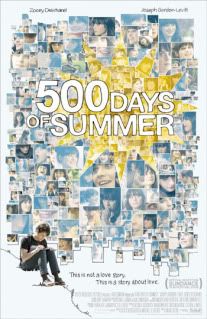
For those of you who don't know (ha ha), 500 Days of Summer follows Tom (Joseph Gordon-Levitt) from his meeting to his breakup with Summer (Zooey Deschanel) and up to his acceptance, in total a tally of 500 days.

Tom is a great protagonist. Like another great protagonist earlier this year, the whole film is filtered through his eyes. That means when we see his relationship with Summer and it seems so perfect and idyllic, it's not because it actually way, but because Tom refuses to remember anything that wasn't perfectly idyllic. Because of this, Tom is the perfect surrogate for the average male who has experienced a similar breakup. He reacts in a way that every man does. Lethargic rage, denying it, absurd fantasies.

The film is so stylized because that's how Tom's brain is functioning, and the essence of every aspect of the relationship is so perfectly captured by director Marc Webb. The morning after they first have sex is a giant dance number, the most perfect dramatization of of the first wave of infatuation.

Marc Webb's bag of tricks is shoulder-deep. Joseph Gordon-Levitt and Zooey Deschanel are marvelous, Deschanel in particular, who plays the ultimate manic pixie dreamgirl. But Deschanel's performance elevates the material out of cliche. She's a realistic human being, likely to remind you of someone you know and make the drama of the film all the more poignant. But while Deschanel brings depth to a certain aspect of the film, the whole film relies on Joseph Gordon-Levitt's performance and he is typically fantastic, which is wholly unsurprising; in the years since I first saw Brick I have followed his career with great interest and he hasn't done anything to disappoint me so far.

The decision to make a romantic comedy from a distinctly male perspective is inspired. So few romances appeal to men, but not because romance doesn't appeal to men at all, but because romances are generally geared toward a feminine sensibility. Men have a completely different set of neuroses when it comes to love and a different way of dealing with a break-up. It's almost violating to see it on the screen because it's something that we've never been exposed to this well before.

This is one of the strongest, most sincere and most realistic films about breaking up I've ever seen. It belongs with the best films on the subject, a pantheon ruled by Annie Hall and Eternal Sunshine of the Spotless Mind.

And comparison to those two films is high praise indeed.

9/10