Thursday, November 5, 2009

Those fucking kids

Patrick Stewart is a man's man. I get such a jolly from watching him perform, and he's the coolest captain the Enterprise ever had. As much as I like watching the bridge crew drag Kirk away from the self-destruct console after he spots a spider near his chair, Picard is beyond badass. Patrick Stewart (and by virtue, Picard) is everything a 21st century man should aspire to be.

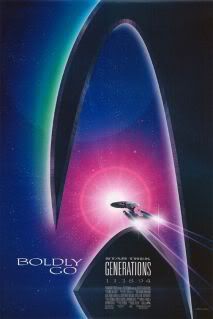
By formulaic, I mean it might cure jaundice and confuse me on my math midterm. But Star Trek: Generations is damn formulaic. So formulaic it doesn't seem to understand the difference between a television show and a theatrical motion picture (wider aspect ratio, FEWER STUPID SUB-PLOTS).

Here we go. We open on Kirk, Scotty and Chekov being shown around the bridge of the newest incarnation of the Enterprise. Kirk is bugging out because Sulu had time to grow some children-trees despite being gay and despite his commitment to Starfleet. They take the Enterprise out for a stroll around the block when they receive a distress signal from a group of transport ships caught in some strange magnetic anomaly. The inexperienced, indecisive new captain struggles with his ill-equipped ship until Kirk takes over, ultimately dying in a freak accident when trying to rig the hull to buy a few extra minutes for the crew.

This is a fitting death for Kirk. It's the sort of end many people have met on the Enterprise but none of the bridge crew have met because so rarely do they venture into the hull.

Flash forward 80 years to the GAYEST possible film introduction to the Next Generation crew we could have POSSIBLY conjured. They're on an 18th century warship, all dressed in French military uniforms and giving Worf a best friend bracelet in a phenomenally gay ceremony. Apparently it's a hologram (whatever), but this hologram machine can't hologram-in-ite them uniforms, so they spend at least a few minutes in front of their crew in French sailor uniforms.

Unfortunately, Data begins to grasp the meaning of cruel irony but without the restraints of remorse. Worried that Data will soon become an efficient killing machine with a tenuous grasp on humor, LaForge stuffs an inhibitor chip inside of him that makes him feel all the shitty emotions like sadness and fear but without the awesome emotions like murderous rage and bottomless greed.

That's when they find Malcolm McDowell who is, surprise, evil. He's going to blow up a star so he can get back into something not unlike the simulator Picard and the Gang were just hanging out in. I'm still not clear on how blowing a star up is necessary, perhaps he just wanted to be on the (very) long list of people who challenge the Federation and the (very) short list of people who don't get vaporized or thrown into a pit of lava for their trouble.

He's struck up a deal with some Klingon lesbians and they stand around and suck just like everything else in this fucking movie.

Let's break down the Next Generation crew, shall we?

Picard is a badass, yeah, I know. But LaForge is a little girl, and blind, and totally incompetent. Data is the emotionless science officer, not unlike Spock, but without Spock's predilection towards kicking tons of ass and generally being an emotionless killing machine/pun dispenser. Also he's the only android I can think of that gains weight.

Worf is...well, what the fuck does he even do on this ship? Scare children? Public relations? I understand that if you're shooting every day in elaborate makeup, it can get tiresome, but it looks like he walks into the makeup trailer every day and just shoves his head into a bucket of brown makeup with some eyebrows carelessly thrown in. Also, he sounds like he's on the run from gambling debts and has half-heartedly tried to change his voice.

Riker looks like a seasoned sexual predator, but not of the rapey variety. Of the "I've got you in the makeup trailer all by yourself and I can already smell the sexual harassment suit coming my way" variety. His uniform is also too damn broad with shoulder pads making his shoulders boxy but his midsection round. I get that most of these actors are pretty old already, but Jesus, don't let people self-conscious about their aging pick out their wardrobe.

The whole film looks cheap, like their budget is lower than it was on the TV show. They couldn't redesign the uniforms? How much could that cost? Forty dollars? But it doesn't even matter, the whole film feels like a season finale. William Shatner is thrown in so that people will have some reason to go see this fucking thing and he's given a death with all the dignity of being punched to death behind a Denver Denny's and left in a dumpster. I'm pretty sure Kirk has crossed bridges before and many times. Was he nervous in front of Picard?

The whole film reeks of a script that could have been very strong in the hands of a better director, or maybe with a few rewrites. There are some interesting things going on, such as the opening that could have been breathless, not unlike the opening for Abrams' Star Trek and there's a scene where Picard is separated from the villain and is trying to talk him out of his plan that could have worked better with some stronger dialogue and some better imagery.

But the thing that endlessly undercuts whatever might be working about the film is Data's subplot. It adds nothing of thematic value to the story and doesn't tie into the main plot at all. It's just a rejected plotline meant to give Bret Spiner and his diamond cream more screen time.

It sucked.

But then again, Patrick Stewart.

3/10

Tuesday, November 3, 2009

Further government-sponsored attempts to find the galaxy's last Bob Evans

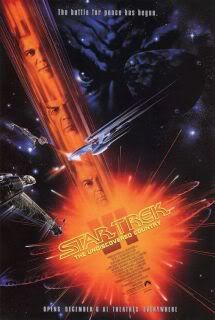
If the Star Trek films were to wrestle, Star Trek VI: The Undiscovered Country would lose because all it would take is fresh crab cakes on the buffet to distract it. If Star Trek VI were to play chess, it would look like this.

Star Trek VI: The Undiscovered Country is a pair of suspenders and a flannel shirt. William Shatner had his ass airbrushed in several scenes. Leonard Nimoy's gut conspires to make him look less alien-like. At this point they had the virile young Next Generation cast to drag mercilessly through the Trek fanbase, who, after viewing this film, I can only assume look like an angry mob or spectators at gladiatorial games. Why they aren't mobbing and using their teeth to tear off their Starfleet uniforms is beyond me; a morbid sense of humor springs to mind, as this is easily the most physically intensive the series has been since it was still a TV show.

On a similar note, the plot of Star Trek VI:

The crew of the Enterprise are set to be decommissioned and ground into meat (?) for the hungry masses. When Kirk is asked to escort a Klingon ambassador to Starfleet Command he responds like anyone would, by loading his racism into his holsters and assembling his grouchy old crew to be cartoonishly ignorant and murderously hostile.

If you haven't guessed already, the Klingons are a pretty obtuse metaphor for the Soviets and the film is a pretty obtuse metaphor for the end of the Cold War.

So they're enjoying the sort of dinner party where everyone is secretly armed and every dish has been so thickly laced with nanobots that it can be passed off as a sauce. Afterward, the Klingon high command beam back to their ship and are greeted with the traditional Klingon lullaby of having their ship blasted with torpedoes and their crew shot at point-blank by men in Starfleet uniforms. Kirk is sent a subpoena in his weekly shipment of alien sex toys and sent to a Klingon court, which is surely based on Texas courtrooms. He and McCoy (who is once again being dragged along because Kirk doesn't feel like being sentenced to death alone) are easily found guilty by Kirk's famous racism and enthusiasm for launching small pox-infected blankets into Klingon teepees. They're sentenced to live out the rest of their lives on a penal mining colony, despite their pleas of innocence.

Meanwhile, Spock has taken control of the Enterprise and is attempting to unravel the mystery of who is responsible for the attack, and it's here where the film really stands out. First of all, Spock makes such a good captain that I can't figure out how Kirk got command in the first place (although if we're going off Abrams' film, he got it by making fun of Spock's dead mom) and it's a crackling, locked-door whodunit.

This is easily the best film in the series since the first one, and the most purely enjoyable. My attention never wavered for a moment, despite the cast's constant looks of confusion or excitement when they realized it was medicine time. It finally incorporates the things that I've said Star Trek has needed for a long time: either a villain with a serious ideological clash with the crew of the Enterprise or a politically-driven narrative, a definitive sense of scale, the compartmentalizing of the crew in order to give them their own moments to shine and independent story arcs, the crew out of their element or dealing with a serious danger that the audience feels is a real threat and some damn adventure, already. None of these things have existed (and if they have, only in spurts) since the Original Series. The Motion Picture offered some 2001-style postulating and some really incredible visuals but generally seemed divorced from the liter tone of the series and it didn't feel like an essentially Trek film; it could have been any cast of characters on that ship. Here, I feel (and I'm no Trek purist, but I have been enjoying the series), we are given the best of Trek lore and the best characterizations any of the films have offered thus far. Also, the pacing isn't all over the place like it's been for several films now, hinting at some more disciplined editing (ie: an editor ready and willing to cut scenes that were included to jerk off the fanbase--one of the serious advantages to hiring a non-fan to helm a film bogged down in lore and fandom).

The actors, despite their age, are in fine form. Specifically DeForest Kelley who's never been in better shape. He gets the best scene of any of the films in this one, when he attempts to resuscitate a dying Klingon despite his inadequate knowledge of Klingon anatomy.

And now that I've softened you up, here's the killing blow. Star Trek VI: The Undiscovered Country suffers from the time it was produced. Commercial filmmaking in the early 90's popularized some goddamn weird stuff. The example I'm about to illustrate is a pretty big spoiler, so look out.

After Kirk and McCoy are sent to the penal colony, the Enterprise crew manages to rescue them, despite a Klingon declaration that any attempt to rescue them will be considered an act of war. After blowing the shit out of a Klingon ship and killing some high-ranking officers in the process, they beam down to a Klingon-Federation peace conference, armed to the fucking teeth and starts killing Klingons.

That's all fine and good (I guess), but the really weird shit hits the fan when Kirk starts giving a speech about tolerance while his boots are inch-deep in alien blood. And then everyone in attendance claps. I don't doubt that the best way to get the floor or end a filibuster in Congress (or Kongress HAHA) is by shooting someone, but I don't imagine there will be much clapping afterward, just terrified urinating. And this sort of thing was standard practice in commercial filmmaking in the 90's! The madness!

When it's all boiled down, I guess it's kind of disposable, but I certainly had a good time watching it. Hell, it's the first film in the series I could imagine being enthusiastic about watching a second time (although I have been curious to revisit Wrath of Khan, if only for Ricardo Montalbon's performance).

I wouldn't recommend it to anyone but Trek fans, but I'm certainly happy to see the original cast sign off with an actual good film.

7/10

Monday, November 2, 2009

Every Man for Himself and God Against All

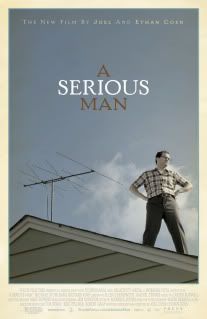
It's a sign of what incredibly bold filmmakers the Coens are that they often state the theme of their movies in such plain terms. At certain times, the first line of the film has been the theme (that's Miller's Crossing, if you're wondering). In A Serious Man, it comes about halfway through, in response to what is seemingly an insignificant subplot (although who's to say what's significant and what isn't, argues the film). A man puts it simply: "Please, accept the mystery."

The film offers a vague answer because no one actually knows the answer (and by "vague answer", I mean "really vague answer"). The Coens aren't interested in arguing in favor of God or a certain view on our Purpose or even pushing their own personal religious beliefs on us, and they're especially not interested in giving us the false answers Hollywood is prone to. They're interested in telling the story of Larry Gopnik.

A Serious Man is the tale of Larry Gopnik, a college professor living in a midwestern Jewish community, with all kinds of problems. His wife is leaving him for the well-to-do Sy Ableman, his kids are a wreck (his son is in trouble with the resident high school drug dealer), a student is trying to bribe him for a passing grade and may be writing defamatory letters to the tenure board, and his gambling-addicted brother, who is little more than a man-child, is sleeping on the couch.

All these problems push Larry towards metaphysical crisis and he seeks the help of three different rabbis as his life spirals further and further out of control.

And what a tale! It's so hard to say "The Coens' best/funniest/etc film since..." because only a few of their films can be considered anything less than spectacular. I make no secret of the Coens being my very favorite living American filmmakers by a significant margin. Almost every single one of their films is a masterpiece of some degree, and their assembled crew is a filmmaking super-group.

One of the most peculiar things about this film is its similarity to The Man Who Wasn't There, one of their most underrated films. Both are period pieces about ineffectual men whose wives are unfaithful, and both are stories of those mens' lives as they begin to spiral out of control. Both mine similar thematic territory and if I had to choose a Coen film to compare the tone to, it would be The Man Who Wasn't There.

This is not a slight, but more praise on the Coens' part for taking two similar stories and two similar protagonists (although The Man Who Wasn't There is clearly the more cartoonish and film-ick of the two) and using them for different ends. But these are merely the ramblings of an under-fed Coen enthusiast.

Most of the criticisms I've seen aimed at this film have been "The Coens clearly have no love for their characters and enjoy seeing them tormented", which is inexplicable. That they put Larry through trials and tribulations and have him come out merely confused on the other end is not a sign of hatred. In fact, the honesty with which they approach Larry suggests unrequited love for this character. The Coens are sometimes guilty of being cynical, but I don't know when "cynical" became synonymous with "hating their characters". Similarly, they're considered condescending, which is a word I altogether do not understand; it's just a way for people to be anti-intellectual (something critics should feel victimized by).

The film, like all Coen films, is perfectly cast, down to the smallest role. Michael Stuhlbarg is brilliant in the lead role, and absolutely deserves a Best Actor nomination come Academy Awards time. Similarly, Fred Melamed is loads of fun as Sy Ableman, the man who has swooped in to steal Larry's wife. Despite his gentle, scholarly appearance, he seems to have an air of triumph about him, so as he tactfully and gracefully suggests Larry stay at a local motel, he's gloating just enough to let Larry see.

And of course, the cinematography is second to none. Roger Deakins makes a welcome return, making the film unnecessarily lovely (especially a rather showy shot involving a ladder).

I don't feel like I even have to recommend this film. It's the Coen brothers. It took me a month to see it, despite my best efforts (illness took hold and it requires a 60 mile drive to get to the nearest independent theater), so why haven't you seen it already? It's surely one of the best films of the year, because, well it's the fucking Coens. Do I really need to tell you again?

10/10