Showing posts with label post-apocalyptia. Show all posts

Thursday, December 10, 2009

Clash of the Titans

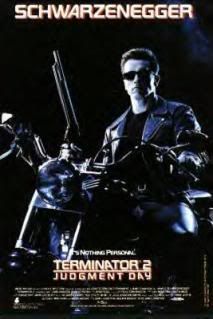
Terminator 2: Judgment Day gets a lot of hyperbole thrown at it and, strangely, most of it is deserved and as a cinephile whose main love in the cinema is action pictures, it's a particularly important set of hyperbole to address. No, it's not the best sequel of all time. That one boggles my mind because I can immediately say "Godfather 2" and everyone in the room will shut up. No, I don't think it's the best action film of all time. That title goes to Raiders of the Lost Ark. It's probably the last great action film to come out of the boom of mostly awful, sometimes brilliant action films in the 80s. No, it's not even James Cameron's best film (I think it's pretty clear that I'm all gooey-eyed over The Terminator). It is, by far, the most important stepping stone between practically filmed movies and the CGI-heavy acid trips we've been getting at the theaters this last decade or so. While it's not the last, or even really close to the last blockbuster filmed mostly with practical effects, it's probably the last Great one and it signifies the point where CGI became a huge selling point, so now people can say "TRANSFORMS II: REVENGE OF HTE FALLEN - 10/10 AWESOME GRAPHICS" and their worth can be determined as more than "would fetch twenty American dollars on Russian skin trade".

Why, you ask? Because this is the first time CGI was used throughout a film in an entirely effective and useful way. After this came out, studios and filmmakers began to realize the possibilities CGI presented, specifically a guy named Steven Spielberg who used them to create some pretty astounding creatures for a mostly overlooked dinosaur project called The Jurassic Themepark. That, too, is a very important stepping stone for the technology, but I can see none of you have seen it and are getting cross-eyed with anger at talk of this confusing dinofilm where I should be talking about Terminator 2.

A decade or so after The Terminator, Kyle Reese remains quite steadfast in his decision to remain dead, Sarah Connor (Linda Hamilton) is in a mental institution and their son, living paradox John Connor (Edward Furlong), is a willful fuck-up of a kid. Somehow, though, this little punk is going to grow up to lead the fight against the machines. Those machines send a second Terminator (Robert Patrick) back in time to kill Connor, this one made of liquid metal and capable of blending seamlessly into its surroundings. The human resistance sends back the T-800 (or T-101 depending on what nerd you're listening to), a model identical to or very similar to (and again played by Arnold Schwarzenegger), the model seen as the antagonist in the first film to protect John.

There's a story I've heard that Cameron's original idea for the T-1000 was to have Michael Biehn play it to more effectively infiltrate the Connors. While you and I both know that in James Cameron's hands that would have turned out a bit trite and sappy, it doesn't change that it's a fucking incredible idea, even if the deliriously strange edges would have inevitably been shaved off. I can still fantasize about the possibilities and lament its loss as being confusing and uncommercial. It's all the more strange that this idea is so appealing to me because I love Robert Patrick as the T-1000 so very much. Essentially building off of Schwarzenegger's performance in the original, the T-1000 is equally emotionless, but not being a huge cyborg and instead being a malleable liquid metal, his movements are all exaggerated just a teensy bit. It's a marvelous little pantomime. He never fails to look menacing, but most of the time he reminds me of various animals. Sometimes his head darts around like a hawk, and in the early mall scenes he always reminds me of a cat, confidently slinking through crowds and observing his prey before launching at it with speed and strength he did not seem capable of just a moment ago.

Schwarzenegger, with his character expanded, is actually a lot less interesting. The whole "machine learns to love" angle is so played out these days it's easy to forget that Schwarzenegger sort of originated it. Still, conveying love and affection through a non-emotional filter just ends up being less interesting than his emotionless psycho bit. It was the mystery of the character that made him so exciting and compelling and with that role delegated to the T-1000, Schwarzenegger seems so bland in comparison.

Hamilton, on the other hand, is superb. Every time I watch these two movies together, it's the jaw-dropping physical transformation of Hamilton that really shocks me. If I had to guess, I'd say every meal for the seven intervening years was three packs of cigarettes and a cereal bowl filled with anabolic steroids. She's become a violent animal in the years since the events of the first film, her eyes sunken by the trauma and her will hardened by the years of preparation. She's almost nothing like her character in the first film, except for those moments where you recognize her for a moment and lament the loss of that nubile young waitress. After this viewing, I'm tempted to call her performance the equal to Sigourney Weaver in Aliens.

Edward Furlong is some kind of a train wreck half the time. His voice is so clearly looped a lot of the time that he's just fucking distracting. Not to mention he plays an unappealing little bastard who makes me never want to have children, and if there's any great crime that Terminator 2 commits, it's the launch of Edward Furlong's career, a career that ends up giving us yet another shitty aspect of that well-loved shitsack, American History X. A lot of the time, though, he's sort of inoffensive.

But the real star of this film is James Cameron. This is the sort of tremendous undertaking that I can imagine driving a director to the brink of sanity. Between his huge star, his enormous budget, the amount of practical effects and set-ups necessary every day and the grueling nine month shoot, I'm shocked that he didn't throw in the towel as soon as this film was finished. These days, most of these sorts of films are delegated to effects teams and are probably easier to shoot than anything else, seeing as they're mostly done in temperature-controlled studios and the only thing you have to worry about is the bright colors of the green screen hurting your eyes. I imagine that they hired fucking green berets to fetch the coffee on this set and most of them were killed by explosions or Robert Patrick trying to get into character.

And praise be to James Cameron for realizing that to retread the success of the first film would be a waste, and instead making it one of the most gigantic action pictures of all time, centered around the battle between the T-800 and the T-1000.

That's one of the major reasons that this film works so brilliantly. When a film this epic in scope and so busy with characters and sub-plots, boiling it down to a heroic hero versus a villainous villain is the most effective way to structure a film like this and to never lose the narrative. I could list a million examples, but the two that come to mind as the best recent examples are No Country for Old Men and, obviously, The Dark Knight. A sympathetic hero and a villain so incredibly evil are those films' greatest, most elemental assets.

I will say this against the film: compared to the first one, it's a much shallower, far more rote affair. But damn it, the first film is one of the best films of the 80s. I hate to compare the two; the sequel is just so different. It's such a great, great action movie that I'll forgive it a lot of things, like a middle section that drags a little bit (the first time anything like this has happened in a Cameron film) and the weird, jarring introduction of narration for a few scenes in the middle.

It's really an extraordinary piece of filmmaking, if the size of a production is taken into account even a little bit. Every few minutes brings yet another set piece, any one of which a large scale production would be jealous of. It really raised the bar in a lot of ways, especially for the size and pace of a film. Every second of Terminator 2 outdoes the climax of similar films, almost making it all climax all the time. But yet more praise deserves to be thrown Cameron's way for making the real climax stand out and keep us on the edge of our seats.

It's probably Cameron's best film, in terms of objective quality. You can't really dislike Terminator 2 for any real reason, it's just too much fun. While the first Terminator is geared more towards my tastes and feels a lot more like an artistic accomplishment, its sequel is really an auteur's piece as much as anything else, which is always exciting to see in a blockbuster. I feel reduced to a little kid when I watch it, and I'm happy to join the ranks of that geek culture who hold this as the preeminent geek film, outside of Star Wars.

10/10

Saturday, November 28, 2009

One Man Army


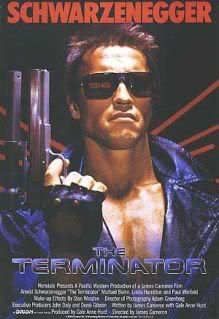
When I started this retrospective I mentioned that there was one film in Cameron's filmography that I held near and dear to my heart. I suppose before we go any further, I should mention that it's The Terminator that I was referring to. I've often held it aloft as a shiny example of what a chase thriller looks like, how it should be done, how it should be cut, scored, shot, staged and helmed. You'll excuse me, then, if every now and then my rhetoric dissolves into a series of gentle but enthusiastic kisses for a film that I value more than the lives of anyone who will ever read this.

I'm sure you all know the plot, but what kind of critic would I be without recounting it? It's the future and despite the fact that we somehow invented and mass-produced energy weapons, it kind of looks like a shitty place to raise your kids. Robots have taken over the world, and not the cuddly R.O.B.-style robots, the Fear Cereal-chewing, red-eyed Battlebot sort of robots. Around 1997 when I was just starting my Final Fantasy phase and you were all enjoying James Cameron's Titanic, super-advanced AI Skynet missed its appointment to take over the world and enslave humanity as prophesised in 1984 by this film. Skynet, with no regard for the prime directive, shoots a naked Austrian robot-man (Arnold Schwarzenegger as the eponymous villain) back in time to kill Sarah Connor (Linda Hamilton) future mother of John Connor, leader of the human resistance. The human resistance send back a single warrior, Kyle Reese (Michael Biehn) to protect her.

Unfortunately for Sarah Connor, Kyle's a bit of a downer. Not only will we not be flying around the galaxy sending space-hippies to their death in fifty years, but he keeps going on about the futility of fighting the Terminator. With the weapons available in 1984, the Terminator is virtually indestructible.

And here's where the film starts getting intriguing. Out of the gate we're introduced to a villain that is unstoppable. He is cold and emotionless and, unlike so many other films that aped its style, The Terminator succeeds in giving the machine absolutely no human qualities. People often wonder about a one ton body builder being cast as a robot that's meant to infiltrate human society, but it lends several degrees of cold, mechanical evil to his character. If he was prancing around just like a normal human, acting precisely like humans do and adopting personality traits and character flaws and all the other things we like to see in our characters he would lose the thing that makes machines scary. Never once in this film do we look at the Terminator and mistake him for human.

Cameron masterfully wrangles Arnold Schwarzenegger's inexperience as an actor and his awkward Austrian screen presence to create a character that is a merciless killer, LOOKS like a merciless killer and has an intangible awkwardness about him as if he was created by machines that have only observed humans from a distance but were quick to dismiss them as dangerous variables.

I have fewer nice things to say about Linda Hamilton and Michael Biehn. Hamilton is a bit bland (although she is written as an every-woman) but I don't think her performance spends any time detracting from the overall impact of the film. Michael Biehn has never been an actor I've liked much. He looks like he was told his father was eaten by wildebeests and never got over being told he lives in a hipster sitcom. I suppose it works well enough when he's playing a soldier who is constantly on edge and was learning to make plastique while we were dancing in demonic little circles to songs about the Black Plague. Furthermore, they have little romantic chemistry. That would be a real complaint if the romance was any more than a simple plot point, but the later scenes could have used the emotional impact a successful romance would have wrought.

If you've noticed, all the things I just listed were "it could have been this, but it remains functional and effective where it is", my point being that despite the criticisms I leveled against it, I'm just pointing out the things it doesn't excel at. Don't let that make you think it doesn't excel like crazy all over the place. First of all, the middle section of the film is as flawless as anything ever put on film. While the climax doesn't hold up to the absolute perfection of the TechNoir shootout and subsequent chase, that's a standard I wouldn't ever hold a film to.

And the early, largely silent scenes with the Terminator are incredibly tense, proving once again how overrated film scores are and how much more effective a film can be when its intentions aren't muddled by manipulative music.

The way James Cameron manipulates the gritty underbelly of LA as a stage for action calls to mind the greatest of classic noirs and is his single greatest accomplishment as a filmmaker as far as I'm concerned. The only way I can think to describe it is to call to mind Taxi Driver. The city itself is almost never directly referenced, but it becomes an indispensable part of the narrative and the visual vocabulary. A series of twisting alleyways strewn with litter and filled with homeless people and greasy dumpsters give way to streets lined with uncaring souls. It's a place where optimism dies. It's almost as apocalyptic as the world Reese grew up in. But every time we think this city can't become more dark and twisted, Cameron jerks us back to Reese's time, where rats are a delicacy and death is almost a relief.

The standoff between the very human, very fragile Kyle Reese and the indestructible, unstoppable Terminator has elemental qualities that make it a timeless formula. Rarely is the contrast between the hero and the villain so harsh, and rarely is an air of hopelessness so effective.

Yeah, it's a fucking bleak film. It's just as bleak as you've heard and probably more bleak than you remember. The whole experience is a bit like being dragged through gravel. It's the sort of thing you walk away from dazed but ready to experience again, hoping that this time the thick atmosphere of oppression will dissolve to allow you to read the story and characters more, but it never does.

The only film I've ever seen that has truly bettered its oft-violated style and formula is No Country for Old Men. That's a goddamn bold statement, but they're two films that I hold in exceptionally high regard, and while James Cameron is one of the most consistent blockbuster filmmakers of all time, he shares one thing with so many great directors of blockbusters. Like Spielberg and like Lucas, his first film will always be his best. If we're not counting that fucking Piranha movie.

11/10

Sunday, October 11, 2009

Car-Fu

I know, I know. "We get it, Oliver. You like fucking action movies. Let's do something else, okay?"

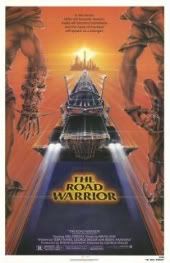
Fuck you, reader I just made up. You're my least favorite reader. Not only have you just insulted me, but you've insulted The Motherfucking Road Warrior, one of the all-time best action movies.

The 1980s were a whirling dervish of pastel colors and Duran Duran, but if we got anything out of it, it's the four great action movies: Raiders of the Lost Ark, Die Hard, The Terminator and The Road Warrior.

Between those four films, The Road Warrior is the one with the most dirt on its knuckles. When I mentioned it to my dad, he said "that shit is nasty", and I've got to hand it to the old man: that's the perfect way to describe the film. Although he'd say it with a grimace and I'd say it with a smile.

I chose to write this review because I watched my copy of it yesterday and when I started trying to talk to people about it, I could barely find a person who had seen it. So, in the interest of enticing you morons to watch one of the best films of the 1980s, the plot:

It's a quarter past the future and some janitor was dusting the big red button on a doomsday device. Now Australia has been turned into a wasteland (waaaakka wakka wakka) ravaged by evil gangs in search of gasoline to continue their dominance. If you have a car, you have life. If you don't have a car, if you can't keep moving and savanging, you die. The rules are very simple and implicit. Like so many mysterious drifters in so many westerns, Max is a man with a past and a grumpy disposition. He doesn't like or have much use for people. He stumbles upon a gasoline-rich community under siege from the brutal gang The Humongous and through a series of escalating events, finds his fate inexorably tied to theirs.

Now, ideally the whole film would be Max battling his way across the wastes, just trying to find enough gasoline to make it to the next gallon, fighting the gangs for it along the way and encountering strange folk. Like The Road but with more nitro-cars.

I came to this conclusion after watching it this last time. The best scene in the film is the opening scene, where Max silently battles the marauders for the gas leaking out of a destroyed car. The high-speed chase shot from a camera on the hood of a car in that lovely widescreen, the tight, breathless editing. That shot of Max drawing his gun, standing off against the raiders as they both desperately eye the gasoline leaking out of the ruined vehicle. Scenes like that is what action movies are all about.

Silence. Let the visuals tell the story. Action speaks louder than words.

And it's those action sequences that are so glorious. The cars aren't just a prop to push the action scenes forward, they're the lifeblood of these characters. If there's one skill you need to master in these wastelands, it's driving stick. In the old west you used a gun to keep yourself alive, but now we have these marvelous ballets of roaring engines and screeching tires.

And George Miller avoids the biggest mistake made by so many car-centric action films: he never makes the cars the combatants. Despite most of the action being fought with cars, they're nothing more than guns with engines. Max always has something dynamic to do in the chases. He never sits there, dead-eyed and sipping his coffee. Whether the doors are being ripped off his car or the raiders are trying to pull him out of the driver's seat, he's never the static center of car-porn.

The Road Warrior is to car chases what The Terminator is to foot chases, what Raiders of the Lost Ark is to fist-fights, what Die Hard is to shootouts, and I can't help but feel like that sells all those films short. It's so marvelous and perfectly paced. It's so exciting and original, it's vision of society after the collapse of civilization so dark and gritty and functional.

Maybe I'm biased. Maybe I'm biased because I can't wait for the bombs to drop and to tie a cowcatcher to the front of my Geo Metro.

11/10

Sunday, October 4, 2009

A Night At the Living Opera

I know what you're thinking: "Oliver, you can't review Zombieland. You were in it! That's a conflict of interest!". But I assure you, that's Woody Harrelson in the movie, not me. And let me say, if I were to have anyone play me in a movie, Woody Harrelson is right up there with Ronald Reagan and Chewbacca.

Normally, though, I would not appreciate having my likeness put in a zombie movie. For many years zombie movies have been lazily chewing on the independent horror mold, trying my patience and giving me plenty of reason to ignore them. Zombies have to be the most boring antagonists. They lumber around and gnaw on things. Oh, no, don't shuffle in my direction, Mr. Zombie, I'll never be able to out-walk you! Second, for whatever reason (possibly that the zombie film was essentially invented as a tool for independent filmmakers when George A. Romero released Night of the Living Dead), zombie films have been like a playground for boring young filmmakers. In recent years, only Zack Snyder's Dawn of the Dead remake, Danny Boyle's 28 Days Later... and Edgar Wright's Shaun of the Dead have been worth watching.

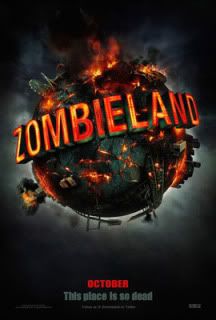
And now Ruben Fleischer's Zombieland. Here's the gist of the movie: take Woody Harrelson and Jesse Eisenberg, give them a population of zombies and try to make it the most fun movie possible. And isn't that almost a novel concept? To just make a movie as fun as possible? No heavy-handed sub-plots, no Shia LaBeouf in robot heaven, Channing Tatum begging the mind-control device puppeteering his long-lost love to let her go. Just two funny guys with guns, a list of awesome ways to kill zombies and a burning desire for the world's last Twinkie.

In fact, this may be the most purely enjoyable movie I've seen all year. It's the sort of movie you go to a midnight showing for and no one gets mad when you yell at the screen.

It's the sort of movie that makes going to the movies feel like an event and makes you wonder why you don't do it more often. Every time the audience erupted in laughter or simultaneously reeled at the gore on screen, I realized that going to a horror film isn't about seeing a movie, it's about the atmosphere. If my mind were weaker, I would compare it to gladiatorial games with its atmosphere of bloodlust, only missing the live children being eaten by live lions for the metaphor to be complete.

Let's discuss the technical aspects before I waste all your patience on ill-conceived metaphors. The performances are essentially flawless. Despite their differences in age, stature, background, style and character, Woody Harrelson and Jesse Eisenberg have a marvelous, easy chemistry that makes every scene that much easier to have fun with. Emma Stone and Abigail Breslin are given considerably less to do, but Breslin stands out in a few key scenes. Ruben Fleischer's direction calls to mind Edgar Wright's manic comic tone, but with more visual flair and fewer sight gags (if that makes sense). He maintains a zany, kinetic tone where everybody seems to be having a great time.

That said, it doesn't break the mold. It's not the best movie of the year, but it is a marvelous counterpoint to all the idiotic summer blockbusters with ten hour running times and budgets large enough to make third-world countries weep. Michael Bay can blow $300 million on the most boring movie of the year, but I'll take Ruben Fleischer's $25 million mini-masterpiece any day.

8/10