Showing posts with label old shit. Show all posts

Thursday, January 7, 2010

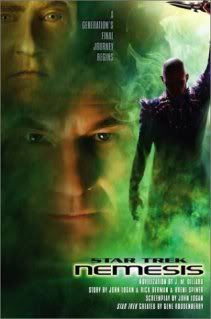
Nemisees, Nemesi

There's a story that the producers of Star Trek: Nemesis wanted Nicholas Meyer, who directed Star Trek: The Wrath of Khan and Star Trek VI: The Undiscovered Country to direct their film. He asked to be allowed to rewrite the script himself, and when the producers refused, he turned down their offer. In that moment, the Star Trek franchise ended and would need to be pumped full of youth and lens flares before it would be suitable for human consumption again.

But you can't really describe Nemesis as being fit for human consumption. It's probably the most frustrating of any of the films, because if Nicholas Meyer had been allowed his rewrite and if he had been behind the camera, I have no doubt it would be the best of the original ten Star Trek films.

I don't mean to talk Nicholas Meyer up so much. After all, I don't have much love for Wrath of Khan, and while I quite liked The Undiscovered Country, it's no masterpiece and has its fair share of flaws. The problem is that up to this point, very few Star Trek filmmakers have had any experience behind the camera before making their film. Really, the only experienced director was Robert Wise, who made what is probably my favorite of the original six films. After that we had Nicholas Meyer make Wrath of Khan, his first movie, and then we had Leonard Nimoy for two films, then William Shatner, then we brought back Meyer. For Generations, we had David Carsons, who had never made a film before, and then First Contact and Insurrection, the first and second films of castmember Jonathon Frakes.

Now we have Stuart Baird, who will now be my go-to associative image for the word "hack". He shoots and stages the movie like his kid's first basketball game. Baird is an editor of some note, notably for his excellent work on Casino Royale, Lethal Weapon and the original Omen. He's got Edge of Darkness coming out soon, which looks like an entertaining, straightforward action film with a really pissed off Mel Gibson and directed by Martin Campbell. I'm sure his work there will be excellent as well, but as a director, he's really an unfortunate choice. He's the entire reason this film fails.

In this space adventure, Picard and the Gang run into a clone of Picard named Shinzon, played by Tom Hardy, one of our finest young actors. He has taken control of the Romulan and Reman (I GET IT) empires and is planning to destroy the Federation by killing their favorite sexagenarian. In other news, Data uncovers an evil clone named B-4 that has next to nothing to do with the plot.

Something I'd like to address. Picard's second-in-command, Riker, is retiring to spend more time with his back hair and Data is being promoted to his position. I get that Data is supposed to be this series' Spock, but Spock was capable, badass and Leonard Nimoy. I wouldn't trust Data to lick stamps. He's always malfunctioning and going kill-crazy, and he comes off like a child. I suppose that's the point, but I wouldn't trust him at the helm of the ship should the captain be taken hostage. How about Worf, whose every command would be "furrow brow angrily"? Or the unnamed helmsman afraid to take much action after what happened to the gay helmsman from First Contact. Or the ship's cook.

So Stuart Baird. I suppose we should get back to him. His action scenes are so by-the-books, so unengaging, so uninteresting that I couldn't imagine that he bent over backwards for this directing job, if the stories are to be believed. There's no flash, there's no panache, there's no passion for the art. For instance, there's a car chase scene. What happens in the car chase? They drive, they shoot, they escape. Shot from the middle distance, most likely while the crew was at lunch. There's a shootout. They let a sixty-year-old man fire two guns at once, one of which is a rifle. He takes cover and takes pot shots while Data deciphers a foreign language to operate the door controls. He doesn't pull much out of this excellent cast, especially Patrick Stewart, who has a script that finally comes within swinging distance of his immense talent, but he seems so disaffected and tired of the role, and the director is so incapable of getting anything out of him, that it might be his saddest work yet.

Worse yet is Tom Hardy, a brilliant actor in a very high-profile role, where he was obviously directed to say things quietly and menacingly, stand in the darkest part of the set and be bald. When I saw that he was in this film, I immediately got excited, thinking that we would at least get a good performance from him. It's such a fucking shame that Baird manages to squander the talents of Tom Hardy, but it's almost a feet of incredible failure. That's like making Chuck E. Cheese boring.

And speaking of Chuck E. Cheese, the script still suffers from the same problems, namely we spend a lot of time focusing on side characters just to appease fans, not because they can be effectively worked into the script. We get to address fun themes, like the nature of self and Picard goes up against a real villain who he has an emotional stake against. It has all the makings for a dark film where the Enterprise crew battles their most dangerous villain yet, but everything about the execution is terrible. There's really not one thing that the crew or actors get right, and it's disheartening. If the producers had given Meyer a few months to rewrite the screenplay, the franchise could have had its biggest hit ever, instead it got its lowest-grossing film ever and killed any notion of a Voyager or Deep Space Nine film.

I just wish the producers could have figured out what the problems were. They've had the same problems this entire series, and they never learn anything from the successes or failures. When the Insurrection script was rushed through development and even the director condemned the film, they didn't learn anything. When they hired Nicholas Meyer a second time and ended up with a good, successful film, they learned nothing.

These films have ignored very simple doctrines of filmmaking that could have saved them. Almost every one of these films, good and bad, seems to lack even basic filmmaking craft. The producers could have mined the independent scene for talented young sci-fi directors, which there were plenty of in the early 90s, especially, given that the Star Wars generation was just making an impact.

What a waste.

4/10

Friday, December 18, 2009

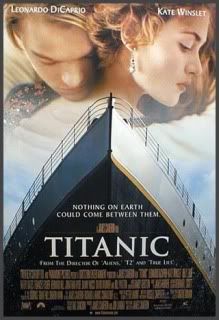
Rich Girl Fucks Bum: A Picture in Motion

As you may or may not know, I'm nineteen. Titanic came out at the very end of 1997 and it played all the way through the summer of '98, when I saw it at eight years old. Even at eight I was aware of the hype, but there was something else about this movie that everyone I knew (remember, we're eight) was talking about: boobs. It was a PG-13 movie that our moms were going clownshit over and would take us to and there were motherfucking boobs in it. It was like your mom giving you a bag full of boobs or chocolate boobs or some sort of metaphor that involves boobs and moms but isn't weird.

And this movie engendered a love of Kate Winslet in me and a great many other young men in my age group for owning the very first pair of boobs we ever saw. To this day, even though her skin gives away that she smokes a dozen packs of cigarettes worth of tobacco directly out of her mouth every day (like a giant bowl, you see) and she looks ten years older than she is, I still want to marry the shit out of her (Titanic isn't the only reason for that - she just so happened to play the quintessential modern romantic archetype in Eternal Sunshine of the Spotless Mind, the kind of woman no man of my generation can't fall in love with). My point is that I'm biased. Especially in this film, before the smoking and aging caught up with her, she is just fucking gorgeous. But you didn't come here to listen to me fantasize about Kate Winslet (unless you got here with an unusually specific Google search), you came here to listen to me bash Titanic to shit.

But that's not going to happen, really. There are a lot of things to smile about, just as much as there are things to frown about.

The tale concerns itself with some diamond that belonged to some old woman. This woman isn't just a little bit old. She is enormously old, like a powerhouse of old. So old, in fact, that when she gets the news that they recovered possessions of hers from the Titanic (!), she's throwing pottery on a wheel (!!). So in order to explain what old-timey porn starring her was doing on the Titanic, she tells the story of her love affair with a young man named Jack Dawson.

So the younger men listening to her tale climb into her brain and ride it back to the year 1912, where a baseball cost a penny and eating a sandwich was a leap of faith. There, the old woman, named Rose DeWitt Bukater, has been replaced by a voluptuous, young Kate Winslet. She's a member of high society and she has been promised to a man named Cal (Billy Zane), a rich coal baron or something who she has but middling feelings for. And that's where she meets Jack Dawson (Leonardo DiCaprio) and their love affair begins.

I suppose I'll begin with Cal. Picking on Billy Zane is like picking on a bowl of fruit, but holy shit he deserves it. As much blame goes on Cameron for what happened here, but we'll get to that in a minute. Cal is a man of such mustache-twirling evil that I half expected them to blame HIM for the sinking of the Titanic. Billy Zane plays the role like he's playing fucking Dracula, and I wouldn't be surprised if there's a deleted scene (wait for the special edition that's sure to come out!) of him floating around, scaring children. There have been a lot of over the top performances in Cameron's filmography, but Zane buys out the bake sale.

Like I said, a lot of it is Cameron's fault. Somehow, Cameron convinced himself that writing this movie wasn't lightyears outside of his particular area of talent, and his long-running handicap of being unable to really define a lot of his characters (especially his supporting characters) becomes some sort of amputation. He's the only credited writer AND director, so I'll give him all the blame I can for writing Cal like some sort of costume drama Skeletor.

Now let's discuss how detrimental he is to the plot. I get that Rose's mother is desperate to marry her off so that they can reclaim the family fortune, but is there a guy who wouldn't list "murder" as one of his interests on an eHarmony profile? That they plan to marry her off and expect her to live through the honeymoon is pretty astounding, and that Rose doesn't say something like "no" when asked to marry No Heart goes to show that maybe she isn't the super tough, girl power girl that James Cameron wrote her to be.

I write all this in half jest. I realize that Rose tries to kill herself early on in the movie and she's pretty quick to take a hobo in over Cal, but still, his performance and character are so over the top it's like he accidentally wandered off the set of a James Bond film.

Leonardo DiCaprio's performance is an example of one of those performances that isn't really a performance. Since this film was aimed squarely at women, and it was a romance, the idea was to get the women to fall in love with DiCaprio. Therefore, the marketing campaign's main goal was to push him as a sex symbol, but a sweet and innocent one. By the time they saw the movie, all the girls will already be in love with him and it hardly matters what happens in the movie, they'll still feel swept away by him. Therefore, his performance can't be too different from his modern persona, and it isn't. It's pretty carefully done to make it fit in with the time period, but he comes across as a turn of the century Backstreet Boy. And he's sort of a blank slate, a recurring theme in James Cameron's leading men. Usually that's because they're an audience surrogate (I was going to say avatar but that would have been JUST IRONIC!), but in this case it's so that too much personality doesn't get in the way of the audience's imaginary love affair.

Kate Winslet fairs much better, obviously, her being a great actress and James Cameron being a great director of women. She's strong but naive and spoiled and blah blah blah, but Winslet brings an intense human edge to the character and a naive joyfulness as she begins to discover the wonders of infatuation.

The first half is romance, the second half is ship sinking.

The second half is pretty good stuff if you're into that sort of thing, but for my money there's a lot of "people running around in circles screaming" on the deck and "flooded hallway" below deck. It works, but it feels a bit stale to me. There are occasional hints of what greatness could have been achieved with this sequence aside from the staggering technical achievement, specifically a handful of shots that make the passenger's quarters look like a haunted house, and a scene with a rather trigger-happy guard. Aside from the technicals, Cameron only succeeds occasionally at creating a sense of chaos. For my money, Cameron has achieved technical brilliance with more successful scenes in the past.

Strangely enough, the scenes that work the best are after the ship has sunk, when the survivors are floating in the water, freezing to death. In spite of its overwrought dialogue, the scene works well because of its strict finality, and Jack's death was pretty shockingly unromanticized. Oh yeah, there were spoilers in that last sentence.

So look at that, another groundbreaking technical achievement gimped by Cameron's own script. This one more so due to some pretty unconvincing performances and the fact that I'm a man with testosterone.

5/10

Monday, December 14, 2009

Lie To Me

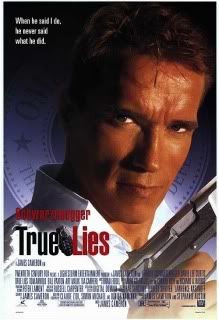
When I mentioned that Cameron's films get lite and poppy after The Abyss, I specifically had True Lies in mind. While it is made with consummate professionalism and has some really swell performances, it's the sort of film that can only disappoint you if you've just watched four films of such high quality as The Terminator, Aliens, The Abyss and Terminator 2. But who could keep that up?

If it weren't for Cameron behind the camera this would be an utterly disposable, forgettable mid-90s Schwarzenegger vehicle, but it's to Cameron's credit that the film works so well. Specifically his rapport with Schwarzenegger and his natural ability to direct women. Frankly, though, it strikes me as the first film since Piranha II that Cameron didn't give his heart and soul to. The action is too similar to Terminator 2's for me to get too worked up over it, featuring lots of car chases with exploding cars and big ol' shootouts, but it lacks the sci-fi angle of T2 that made it so unique and ultimately loses a lot of its value. It just becomes more mundane.

So the story goes something like, Schwarzenegger is Harry Tasker: Secret Agent, but his wife, Helen Tasker (Curtis) thinks he's a boring computer salesman. When their marriage seems to be on the rocks and Helen appears to be having an affair with a used car salesman pretending to be a secret agent, it can only be rescued by some sitcom-style antics and some high-flying adventure.

The angle Cameron seems to have approached this film with is "comedy", which brings me to the movie's biggest fuck-up: Tom Arnold. He plays the comic sidekick and holy shit do I hate Tom Arnold. Tom Arnold is listed as a natural disaster and every time he releases a movie the National Weather Service issues a warning. Tom Arnold can't tie his shoes and every morning has to visit the knot store. The #1 presser of Tom Arnold DVDs are craft rooms at nursing homes. If Tom Arnold were a planet, he would be the sun, expanded to red giant and sucking up Mercury, Venus, Earth and Mars. Tom Arnold is one of history's (and Middle-Earth's) greatest villains.

Phew. Now that we've gotten that out of the way, let me talk about the things that do work. Aside from Tom Arnold raining Hellfire on the film, most of the actors are really funny, and oddly enough, none of them are noted for their comedy work (unlike Tom Arnold, noted for his comic terrorism). Schwarzenegger, Jaimie Lee Curtis and Bill Paxton are great, Paxton in particular giving a performance only topped a few years later by A Simple Plan. These are the only two performances where I don't think his presence is a detriment to the movie. I always laugh when we're first introduced to him in this film, where he's dolled up like a sex offender with his mustache and over-combed hair. He makes a great counterpoint to Schwarzenegger's cartoon secret agent as a cartoon secret agent in the same tradition, but with an added sexual predator and somehow less credibility.

Best in show is clearly Jaimie Lee Curtis, who gives an inspired comic performance. She has the perfect look for a mid-90s, unsexualized, middle-aged office worker and her appearance perfectly encapsulates the word "goofy" for me. She's clumsy and physical without being an inane comic figure and she's snarky and sarcastic without coming off as an insufferable bitch. She's given all the best lines and the best arc, and sometimes she threatens to overshadow Schwarzenegger's domineering screen presence and Tom Arnold's fuckmouth.

And Schwarzenegger himself obviously handles the action in the same way he always does: like he's ordering a sandwich. It rarely works in more serious movies (and your enjoyment of a classic like Commando specifically depends on the sort of mileage you get out of standing behind Schwarzenegger at a Jimmy John's) unless he happens to be playing an emotionless robot. Thanks to Cameron, though, Schwarzenegger pulls off what is easily the best performance of his career where he isn't powered by hamster wheels. He plays a James Bond figure but with that trademark Austrian awkwardness. Look, if Arnold Schwarzenegger wasn't a huge star and was a cook at IHOP or something, he would still sort of catch the eye. He's not exactly inconspicuous and if you needed to quickly hide him it would be hard to find a broom cupboard that he would fit in. He would make a shitty spy, and the movie knows that. He could never pass as a regular family man or a computer salesman - he looks totally out of place at a dinner table. And the movie knows that. I suspect Schwarzenegger doesn't, though, and the entire juxtaposition becomes very funny.

The action is pretty standard 90s fare, making it a bit disappointing that Cameron was behind the camera. There are a few scenes that stand out, usually when the film gives itself over to physical gags that work surprisingly well.

Can I talk about Tom Arnold again for a minute? Of course I can. I don't see any other bloggers around. Imagine if James Bond had a sidekick named Reginald Bagley, whose gut hung out over his pants and none of his teeth faced the same direction. And imagine that he seemed to love that Bond made him look like a blubbering fuck-up by going into space, banging a dozen moonladies and stopping a world-threatening crisis without ever setting down his martini while Reginald sat on his ass and gave him helpful hints from inside an oversized bag of Cheetos. And Reginald has no impact on the plot. And imagine that this character isn't meant to appear totally pathetic and worthless next to Bond, and you'll get a good idea of the character Tom Arnold plays BEFORE Tom Arnold the war criminal even becomes a factor. It's a personal issue that kept me from enjoying large parts of an otherwise highly enjoyable film.

And that's pretty much all there is to say about True Lies. It's fun, well-made, features some great performances and just doesn't hold up to the crazy ambition of Cameron's last four films. I can't help but feel like he's floundering here, even if it's just momentary. It will only take three years for him to release the most expensive movie ever made up to that point, a film of such crazy ambition and such unbelievable success that it begs me to watch it again for the first time since it was released (when I was seven).

8/10

Thursday, December 10, 2009

Clash of the Titans

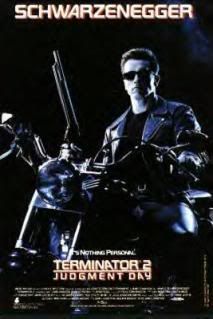
Terminator 2: Judgment Day gets a lot of hyperbole thrown at it and, strangely, most of it is deserved and as a cinephile whose main love in the cinema is action pictures, it's a particularly important set of hyperbole to address. No, it's not the best sequel of all time. That one boggles my mind because I can immediately say "Godfather 2" and everyone in the room will shut up. No, I don't think it's the best action film of all time. That title goes to Raiders of the Lost Ark. It's probably the last great action film to come out of the boom of mostly awful, sometimes brilliant action films in the 80s. No, it's not even James Cameron's best film (I think it's pretty clear that I'm all gooey-eyed over The Terminator). It is, by far, the most important stepping stone between practically filmed movies and the CGI-heavy acid trips we've been getting at the theaters this last decade or so. While it's not the last, or even really close to the last blockbuster filmed mostly with practical effects, it's probably the last Great one and it signifies the point where CGI became a huge selling point, so now people can say "TRANSFORMS II: REVENGE OF HTE FALLEN - 10/10 AWESOME GRAPHICS" and their worth can be determined as more than "would fetch twenty American dollars on Russian skin trade".

Why, you ask? Because this is the first time CGI was used throughout a film in an entirely effective and useful way. After this came out, studios and filmmakers began to realize the possibilities CGI presented, specifically a guy named Steven Spielberg who used them to create some pretty astounding creatures for a mostly overlooked dinosaur project called The Jurassic Themepark. That, too, is a very important stepping stone for the technology, but I can see none of you have seen it and are getting cross-eyed with anger at talk of this confusing dinofilm where I should be talking about Terminator 2.

A decade or so after The Terminator, Kyle Reese remains quite steadfast in his decision to remain dead, Sarah Connor (Linda Hamilton) is in a mental institution and their son, living paradox John Connor (Edward Furlong), is a willful fuck-up of a kid. Somehow, though, this little punk is going to grow up to lead the fight against the machines. Those machines send a second Terminator (Robert Patrick) back in time to kill Connor, this one made of liquid metal and capable of blending seamlessly into its surroundings. The human resistance sends back the T-800 (or T-101 depending on what nerd you're listening to), a model identical to or very similar to (and again played by Arnold Schwarzenegger), the model seen as the antagonist in the first film to protect John.

There's a story I've heard that Cameron's original idea for the T-1000 was to have Michael Biehn play it to more effectively infiltrate the Connors. While you and I both know that in James Cameron's hands that would have turned out a bit trite and sappy, it doesn't change that it's a fucking incredible idea, even if the deliriously strange edges would have inevitably been shaved off. I can still fantasize about the possibilities and lament its loss as being confusing and uncommercial. It's all the more strange that this idea is so appealing to me because I love Robert Patrick as the T-1000 so very much. Essentially building off of Schwarzenegger's performance in the original, the T-1000 is equally emotionless, but not being a huge cyborg and instead being a malleable liquid metal, his movements are all exaggerated just a teensy bit. It's a marvelous little pantomime. He never fails to look menacing, but most of the time he reminds me of various animals. Sometimes his head darts around like a hawk, and in the early mall scenes he always reminds me of a cat, confidently slinking through crowds and observing his prey before launching at it with speed and strength he did not seem capable of just a moment ago.

Schwarzenegger, with his character expanded, is actually a lot less interesting. The whole "machine learns to love" angle is so played out these days it's easy to forget that Schwarzenegger sort of originated it. Still, conveying love and affection through a non-emotional filter just ends up being less interesting than his emotionless psycho bit. It was the mystery of the character that made him so exciting and compelling and with that role delegated to the T-1000, Schwarzenegger seems so bland in comparison.

Hamilton, on the other hand, is superb. Every time I watch these two movies together, it's the jaw-dropping physical transformation of Hamilton that really shocks me. If I had to guess, I'd say every meal for the seven intervening years was three packs of cigarettes and a cereal bowl filled with anabolic steroids. She's become a violent animal in the years since the events of the first film, her eyes sunken by the trauma and her will hardened by the years of preparation. She's almost nothing like her character in the first film, except for those moments where you recognize her for a moment and lament the loss of that nubile young waitress. After this viewing, I'm tempted to call her performance the equal to Sigourney Weaver in Aliens.

Edward Furlong is some kind of a train wreck half the time. His voice is so clearly looped a lot of the time that he's just fucking distracting. Not to mention he plays an unappealing little bastard who makes me never want to have children, and if there's any great crime that Terminator 2 commits, it's the launch of Edward Furlong's career, a career that ends up giving us yet another shitty aspect of that well-loved shitsack, American History X. A lot of the time, though, he's sort of inoffensive.

But the real star of this film is James Cameron. This is the sort of tremendous undertaking that I can imagine driving a director to the brink of sanity. Between his huge star, his enormous budget, the amount of practical effects and set-ups necessary every day and the grueling nine month shoot, I'm shocked that he didn't throw in the towel as soon as this film was finished. These days, most of these sorts of films are delegated to effects teams and are probably easier to shoot than anything else, seeing as they're mostly done in temperature-controlled studios and the only thing you have to worry about is the bright colors of the green screen hurting your eyes. I imagine that they hired fucking green berets to fetch the coffee on this set and most of them were killed by explosions or Robert Patrick trying to get into character.

And praise be to James Cameron for realizing that to retread the success of the first film would be a waste, and instead making it one of the most gigantic action pictures of all time, centered around the battle between the T-800 and the T-1000.

That's one of the major reasons that this film works so brilliantly. When a film this epic in scope and so busy with characters and sub-plots, boiling it down to a heroic hero versus a villainous villain is the most effective way to structure a film like this and to never lose the narrative. I could list a million examples, but the two that come to mind as the best recent examples are No Country for Old Men and, obviously, The Dark Knight. A sympathetic hero and a villain so incredibly evil are those films' greatest, most elemental assets.

I will say this against the film: compared to the first one, it's a much shallower, far more rote affair. But damn it, the first film is one of the best films of the 80s. I hate to compare the two; the sequel is just so different. It's such a great, great action movie that I'll forgive it a lot of things, like a middle section that drags a little bit (the first time anything like this has happened in a Cameron film) and the weird, jarring introduction of narration for a few scenes in the middle.

It's really an extraordinary piece of filmmaking, if the size of a production is taken into account even a little bit. Every few minutes brings yet another set piece, any one of which a large scale production would be jealous of. It really raised the bar in a lot of ways, especially for the size and pace of a film. Every second of Terminator 2 outdoes the climax of similar films, almost making it all climax all the time. But yet more praise deserves to be thrown Cameron's way for making the real climax stand out and keep us on the edge of our seats.

It's probably Cameron's best film, in terms of objective quality. You can't really dislike Terminator 2 for any real reason, it's just too much fun. While the first Terminator is geared more towards my tastes and feels a lot more like an artistic accomplishment, its sequel is really an auteur's piece as much as anything else, which is always exciting to see in a blockbuster. I feel reduced to a little kid when I watch it, and I'm happy to join the ranks of that geek culture who hold this as the preeminent geek film, outside of Star Wars.

10/10

Wednesday, December 9, 2009

Gazing Back

So here we arrive at where James Cameron gives away his sentimentality and the fuzzy teddy bear hiding beneath his human skin. I mentioned in both my Terminator review and my Aliens review that those movies were the grim torments of the movie gods, but in the most deliriously invigorating way possible, like being hit in the face with a Monet. You may be bruised and bleeding by the end of either of those films, but you'll be ready for round two. None of the films we'll be watching in the next week will be anything like those in terms of tone. They'll all be airier and poppier and while of course I do not prefer one style over the other, I do think that James Cameron, at least initially, had a better grasp of the dark and grim. I like feeling like I'm trapped in brightly colored bubble gum as much as the next guy, but I'm sad that Cameron was never able to exercise the same amount of control over tone and deliver a film that leaves me feeling something distinctive, whether it be the rape-victim shakes or polka-dotted fervor (although crazy housewives the world over will argue with me on Titanic).

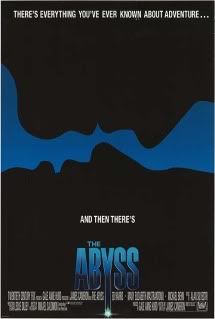
Like all of Cameron's films, I've seen The Abyss before, but for this viewing I opted for the Director's Cut, seeing as this retrospective is a celebration of James Cameron as a director and based on some kind words my brother had for this version.

The Abyss takes place in an underwater oil drilling rig that looks like it could be a summer getaway for Victor Von Doom. There, blue-collar worker Virgil (Ed Harris) and his estranged wife Lindsey (Mary Elizabeth Mastrantonio) are asked to aid a group of navy seals in finding a missing nuclear submarine. Before long they encounter strange, brightly colored creatures zipping around adorably and casually causing adorable mass pandemonium. Evil military man Coffey (Michael Biehn) wants to nuke them, but the compassionate protagonists want to try and make contact with the strange creatures. Paranoia ensues for the viewer does not know: are the creatures benevolent, or are they as devious as they seem?

If you're thinking to yourself "man, that sounds an awful lot like Close Encounters of the Third Kind", then grab a Medal of Honor from the basket. I know that the originality of a story is almost trivial, but damn it, it's like making a movie about the life of a magazine mogul and his disk sled told through flashback and called Citizen Blaine or something. Spielberg kind of staked out this territory in '77 and made a movie that anyone would be hard-pressed to top. I can't decide if James Cameron's decision to put a paper cut-out of Ed Harris in front of Richard Dreyfuss and repackage it as a different film makes him very ballsy or just stupid, but The Abyss has at least one huge thing on its side: it is maddeningly suspenseful.

Really, as much as I bitch about them being exactly the same movie, the similarities are nominal. Close Encounters had a smaller thematic scope (and was more successful for it), while The Abyss is a bit more genre-oriented. And would you look at that! Genre-oriented. Just the sort of thing I like. The Abyss is largely a locked-door thriller with underwater aliens serving more as a macguffin than an integral part of the narrative. Their presence only serves to aggravate the incredibly tense conflict between the rig workers and the military dudes.

And that conflict, so often played out, is given new vitality by Cameron and I have NO idea how. For a 19-year-old I think I'm a pretty observant moviegoer, but I remain absolutely perplexed by this unusually potent thriller for the second time through. Both times I've been driven to the brink of insanity by this film's tense conflicts and both times I've emerged from the other side without my usual look of smug triumph.

Perhaps it's the underwater setting and the very real, very prevalent fear of drowning that, strangely, few films ever exploit. Drowning is #2 on my list of fears, a list that features two items: 1) Dragons and 2) Drowning. But I don't think that one thing can account for the outrageous effectiveness of this film, and it's time to give the other players their due. Despite being nearly three hours, The Abyss is as immaculately paced as any of Cameron's films, using its extra running time for great effect, even managing to keep my pulse up through its roughly 40-minute denouement. The actors, in particular Ed Harris and Mary Elizabeth Mastrantonio, create very sympathetic and real characters, full of life and passion with a clear, but largely unspoken, love and mutual admiration. If James Cameron has never fully received credit for his ability to pull the very best out of his actors, it hasn't been for lack of my chamioning. I wouldn't say it's the best role of Ed Harris' career, for there are so, so many great performances in his career, but it's the best thing I've ever seen Mastrantonio do, by far, even if her filmography is significantly more limited.

And would you believe me if I told you that James Cameron finally found a use for Michael Biehn? Yes, as the jittery, violent and totally illogical SEAL commander sitting around and whittling on his forearm, Michael Biehn has finally found a role that matches his facial features. It's as natural as anything I could fathom Biehn doing; he would probably have a similar reaction if the waiter told him they didn't serve Pepsi products.

Although Coffey's character doesn't make much sense to me. He seems to have the deep sea cabin fever they talk about even before he arrives on the platform, most likely because he's played by Michael "I sleep in an electric chair" Biehn, and his evil plan is to nuke the creatures because "there's no way of warning the surface"? There are so many undocumented plants and animals on Earth not because they're hiding in the bushes or under rocks, but because scientists can't keep up with all of them. If we wanted to document all the creatures in the Amazon rain forest, we'd have to level the trees and wipe them all out all the plants and animals to have enough paper, and then James Cameron would have to make a movie about it, the prick. We have plenty of moral conundrum surrounding the discovery of new creatures without Lt. Tweak trying to nuke anything that can't be found in a K-Mart.

So yeah, Biehn is far more cartoonish and less humanistic than Harris and Mastrantonio, but I can't really pass judgment on his place in the film because the effectiveness of the movie is something that I don't understand AT ALL.

The film's claim to fame is its special effects, specifically the famous water tendril scene, one of the first examples of CGI integrated with live action. One of Cameron's greatest assets as a human being, and the chief reason that I remain wildly, unapologetically excited for Avatar is his ability to always use special effects technology effectively and never overreach the limits of that technology. For 20-year-old CGI it holds up astonishingly well, as do the alien fish monsters and their horrible neon metropolis. It's exactly the sort of thing that you would think of if I said "cutting edge in the late 80s", right after you imagined parachute pants.

I never liked the ending in the theatrical cut. It's one of those movies that makes the viewers feel like they aren't violent, selfish libertines with a stack of bodies that would make John Wayne Gacy look like a ballerina. It reminds me of that little kid who sits on the curb and asks you to sign a petition to end world hunger. I know I love world hunger, but I also know that the poor little guy's heart is in the right place. He doesn't seem to understand why world hunger exists. That was always a footnote in the original film, but dear GOD is it prevalent in the director's cut. We have roughly eight hours of heavy handed message delivery before the merciful end. After watching this movie I ate an entire shipment of Peace Corps brand potato chips out of spite.

So, to recap, we have an exceedingly well-constructed film with great performances and great effects marred by a simplistic message. LET'S GET USED TO IT. There's a lot of that coming up and we'd be wise to brace for impact.

9/10

Saturday, December 5, 2009

Sonic-Electronic Ball-Breaker or: Femnism in Action

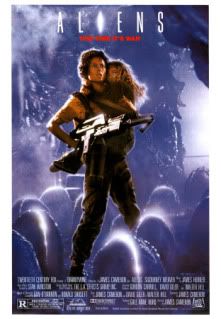
1986 saw James Cameron directing a sequel to what is inarguabley one of the best films ever made: Alien. With its absolutely impeccable mise-en-scene used in every single shot to evoke claustrophobia or dread, its production design full of the Everest of nightmare imagery and a director of commercial fare who, like so many directors before him, made his greatest film his first.

James Cameron's sequel Aliens is widely regarded as one of the greatest sequels of all time, and that's a perfectly fair assessment. While some morons believe Aliens outmatches Alien, I can't even imagine a film as great as Alien having a sequel that lands anywhere near its predecessor. The fact that it actually ends up being a great movie is cause for celebration. It's not the unmitigated masterpiece that Alien is, but it's brilliant in its own right.

For those of you who don't know (and for those of you who don't, get the fuck off my blog), Alien ended with Ripley (Sigourney Weaver) unsympathetically blowing Michael Seymour and H.R. Giger's masterpiece out an airlock and snorting a line of phenobarbitals in celebration before falling asleep for sixty years. That's where Aliens picks up. Ripley is awoken and is immediately handed a pickax despite possibly being the oldest woman on the planet. Before long, a swanky, charming corporate type who only cares about the dollars and cents shows up to convince Ripley to go back to the planet where she first encountered the alien lifeform. It seems that the big corporation has lost contact with the settlers they impulsively let live on a planet overrun with murderous aliens. It's up to Ripley and an ill-equipped, under-manned squad (that means eight soldiers) of space folly to go in and clean up the aliens that seemed to effortlessly wipe out several hundred people.

There Ripley encounters the sole survivor of the alien onslaught, a little girl named Newt for some reason. Ripley robs the cradle and runs off with her shiny new daughter to replace the one whose life she slept through.

So we're off to fight the aliens, and what a fight it is! Essentially highjacking all the brilliant design work of the first film and throwing it into a brilliant action film. Aside from the designs, a general narrative continuation and Ripley, the films aren't that similar. Ripley, like all the characters in the last film, was barely more fleshed out than she had to be. Like most slashers, she exists to be killed by the glorious beast at the center of the film. Cameron gets a lot of mileage out of fleshing out her character and really bringing Sigourney Weaver to the film's fore in a performance that's as great as everything you've ever heard.

And here's where James Cameron's noted femnism works the best. Now, I don't think of myself as a sexist, but I DO think that there are irreconcilable differences between men and women that don't begin and end with penis/vagina. For instance, men are inherently stronger than women. Don't believe me? Arm wrestle a woman. Or, if you're a woman, arm wrestle a man. The man will almost always win. That's not to say that a woman can't win, in fact I've had a woman crush my arm into a bloody powder. I dated a girl that could kick my ass, but that's the exception that prove the rule.

Anyway, I was going somewhere with that. Ripley could easily be the best female action hero ever. Most of the time a female action hero is a woman with a ballsack. She suddenly punches out burly Russian lumberjacks three times their size without breaking a nail, puts on a barrelfull of muscle and becomes the picture of emotionless head-smashing (see: Sarah Conner in Terminator 2). She fails to retain any uniquely feminine characteristics (I consider violence and hot tempers masculine characteristics, although again they're not exclusively masculine characteristics; I just find men more inclined to those traits, generally speaking) and fails to be anything more than a generic action hero. With a vagina. Ripley is strong, intelligent and uniquely feminine, making her the perfect model for female action heroes. In any case, there's usually a REASON we're putting a female lead in a film primarily targeted at adolescent males, right? Why not make it something that defines her character as a strong FEMALE? Her maternal instincts guide her actions, but not in a shitty Hallmark Channel sort of way, in a "grenade launchers and flamethrowers" sort of way.

So if a lot of the thrills of the first film came from the mystery of discovering what the alien was, Aliens derives most of its thrills from seeing the aliens organize and put those traits we discovered in the first film into action in their own environment rather than the "alien" environment of the Nostromo.

As far as Cameron's direction, which, if I'm remembering correctly, is the entire reason I'm watching this movie, it's another action masterpiece. This film has more in common with The Terminator than any of his subsequent films in that afterward you feel like you've been dragged through a field of thorns, mud and cancer. Helping play into that is a billion false endings that never feel gratuitous or cheap because we're invested in the story and characters. Also the razor-sharp editing does a lot to keep the film moving, never lingering on the various plot points and always moving towards the action or the impending sense of doom. It's one film that uses every second of its two and a half hour running time to great effect, despite my frustration at this recent trend of action films outliving your children.

But the best thing he does as a director in this film is that he takes the alien muppets (and make no mistake, they are fucking muppets) and making them absolutely convincing just with his editing and camera work. It's one of the most repeated stories in filmmaking legend that the shark in Jaws became the quintessential unseen menace because Spielberg couldn't get the goddamn animatornic shark to work. This sort of filmmaking is a casualty of the rise of CGI and if there's anything to blame for the fall of horror, it's that. Cameron's lumbering alien muppets were clearly not suited to be convincing antagonists until he teamed up with his virtuoso crew. It's the sort of thing only a truly great director can pull off, and I think James Cameron happens to be a goddamn brilliant director.

It's no Terminator, but it's one hell of a film.

10/10

Saturday, November 28, 2009

One Man Army


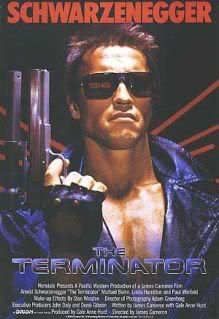
When I started this retrospective I mentioned that there was one film in Cameron's filmography that I held near and dear to my heart. I suppose before we go any further, I should mention that it's The Terminator that I was referring to. I've often held it aloft as a shiny example of what a chase thriller looks like, how it should be done, how it should be cut, scored, shot, staged and helmed. You'll excuse me, then, if every now and then my rhetoric dissolves into a series of gentle but enthusiastic kisses for a film that I value more than the lives of anyone who will ever read this.

I'm sure you all know the plot, but what kind of critic would I be without recounting it? It's the future and despite the fact that we somehow invented and mass-produced energy weapons, it kind of looks like a shitty place to raise your kids. Robots have taken over the world, and not the cuddly R.O.B.-style robots, the Fear Cereal-chewing, red-eyed Battlebot sort of robots. Around 1997 when I was just starting my Final Fantasy phase and you were all enjoying James Cameron's Titanic, super-advanced AI Skynet missed its appointment to take over the world and enslave humanity as prophesised in 1984 by this film. Skynet, with no regard for the prime directive, shoots a naked Austrian robot-man (Arnold Schwarzenegger as the eponymous villain) back in time to kill Sarah Connor (Linda Hamilton) future mother of John Connor, leader of the human resistance. The human resistance send back a single warrior, Kyle Reese (Michael Biehn) to protect her.

Unfortunately for Sarah Connor, Kyle's a bit of a downer. Not only will we not be flying around the galaxy sending space-hippies to their death in fifty years, but he keeps going on about the futility of fighting the Terminator. With the weapons available in 1984, the Terminator is virtually indestructible.

And here's where the film starts getting intriguing. Out of the gate we're introduced to a villain that is unstoppable. He is cold and emotionless and, unlike so many other films that aped its style, The Terminator succeeds in giving the machine absolutely no human qualities. People often wonder about a one ton body builder being cast as a robot that's meant to infiltrate human society, but it lends several degrees of cold, mechanical evil to his character. If he was prancing around just like a normal human, acting precisely like humans do and adopting personality traits and character flaws and all the other things we like to see in our characters he would lose the thing that makes machines scary. Never once in this film do we look at the Terminator and mistake him for human.

Cameron masterfully wrangles Arnold Schwarzenegger's inexperience as an actor and his awkward Austrian screen presence to create a character that is a merciless killer, LOOKS like a merciless killer and has an intangible awkwardness about him as if he was created by machines that have only observed humans from a distance but were quick to dismiss them as dangerous variables.

I have fewer nice things to say about Linda Hamilton and Michael Biehn. Hamilton is a bit bland (although she is written as an every-woman) but I don't think her performance spends any time detracting from the overall impact of the film. Michael Biehn has never been an actor I've liked much. He looks like he was told his father was eaten by wildebeests and never got over being told he lives in a hipster sitcom. I suppose it works well enough when he's playing a soldier who is constantly on edge and was learning to make plastique while we were dancing in demonic little circles to songs about the Black Plague. Furthermore, they have little romantic chemistry. That would be a real complaint if the romance was any more than a simple plot point, but the later scenes could have used the emotional impact a successful romance would have wrought.

If you've noticed, all the things I just listed were "it could have been this, but it remains functional and effective where it is", my point being that despite the criticisms I leveled against it, I'm just pointing out the things it doesn't excel at. Don't let that make you think it doesn't excel like crazy all over the place. First of all, the middle section of the film is as flawless as anything ever put on film. While the climax doesn't hold up to the absolute perfection of the TechNoir shootout and subsequent chase, that's a standard I wouldn't ever hold a film to.

And the early, largely silent scenes with the Terminator are incredibly tense, proving once again how overrated film scores are and how much more effective a film can be when its intentions aren't muddled by manipulative music.

The way James Cameron manipulates the gritty underbelly of LA as a stage for action calls to mind the greatest of classic noirs and is his single greatest accomplishment as a filmmaker as far as I'm concerned. The only way I can think to describe it is to call to mind Taxi Driver. The city itself is almost never directly referenced, but it becomes an indispensable part of the narrative and the visual vocabulary. A series of twisting alleyways strewn with litter and filled with homeless people and greasy dumpsters give way to streets lined with uncaring souls. It's a place where optimism dies. It's almost as apocalyptic as the world Reese grew up in. But every time we think this city can't become more dark and twisted, Cameron jerks us back to Reese's time, where rats are a delicacy and death is almost a relief.

The standoff between the very human, very fragile Kyle Reese and the indestructible, unstoppable Terminator has elemental qualities that make it a timeless formula. Rarely is the contrast between the hero and the villain so harsh, and rarely is an air of hopelessness so effective.

Yeah, it's a fucking bleak film. It's just as bleak as you've heard and probably more bleak than you remember. The whole experience is a bit like being dragged through gravel. It's the sort of thing you walk away from dazed but ready to experience again, hoping that this time the thick atmosphere of oppression will dissolve to allow you to read the story and characters more, but it never does.

The only film I've ever seen that has truly bettered its oft-violated style and formula is No Country for Old Men. That's a goddamn bold statement, but they're two films that I hold in exceptionally high regard, and while James Cameron is one of the most consistent blockbuster filmmakers of all time, he shares one thing with so many great directors of blockbusters. Like Spielberg and like Lucas, his first film will always be his best. If we're not counting that fucking Piranha movie.

11/10

Thursday, November 26, 2009

The Finest Flying Piranha Movie Ever Made


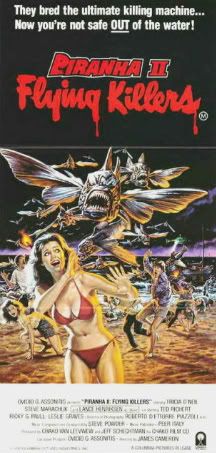
I've never seen the original Piranha, I'm not an authority on horror and James Cameron has renounced this film and repeatedly said he considers his first film The Terminator. Why did I choose to watch it? Because it has motherfucking flying piranhas in it.

When I heard that, my imagination started running around like a little kid, conjuring images that didn't even really have anything to do with flying piranhas.

My hopes for this film were through the roof. It almost got the point where the film had no chance to live up to my expectations. I imagined a huge ensemble of characters being introduced in the first scene, only to be eaten by GODDAMN FLYING PIRANHAS in the second scene.

They sort of do that, too. They introduce a huge host of characters and never go anywhere with them. Some of them die, some of them observe the climax from a distance and shrug, and some of them are last seen in the middle of the movie as if someone just forgot about them. I prefer my idea, though. As usual.

We're introduced to some lame characters who spend a lot of time not skipping rope and playing football with their new flying piranha neighbors. One of them is the android from Aliens and one of them is his son who gets his very own useless subplot.

Then the piranhas start eating houses and cars in a single bite and shooting rainbows from their eyes that make people explode into a bloody mist. Then one of them fuses with some busty, foreign chick so that her boobs can be fused to the piranha's gigantic exoskeleton. And then the piranhas start forming together to create a giant piranha and the US government calls in the Justice League to stop them but the Justice League can't stop them because Superman can fly, but is he a fucking piranha? The film ends when Lance Henriksen is crowned king of piranhas for no reason and they play a benefit concert with Aerosmith and then the piranhas fuse with the entire crowd and become bigger than the Earth.

Or at least I'll give James Cameron credit for maybe thinking that would be an awesome movie. Unfortunately, the stories I've heard have said that James Cameron wasn't terribly involved in production. In fact, I've heard a fellow named Ovidio G. Assonitis did most of the directing. It seems that Cameron (at most) filmed it, but was not involved in pre-production or editing and I can imagine the flying piranha charity drive was the first thing to go.

Sometimes I wonder if I get so bored during bad movies that I substitute entire plots in my head and come up with better movies to watch in my brain, sometimes pretending that what's on screen is part of my glorious brain movie. And that's exactly what happened during Piranha II: The Spawning. I was so busy pretending the piranhas were playing chess that I barely absorbed anything in this movie. And maybe it's because it was a shit movie, but I can imagine it was because I knew the piranhas could fly ahead of time and was heartbroken when all they did was nibble on your mother's Christmas ham.

The only thing that kept jarring me was the musical cues that announced the arrival of the piranhas every time they were on screen. In the future, when everything is digital. When our bicycles are digital. When our playing cards are digital. When our children are digital. And when those digital children clip those digital cards to their digital bikes and they make digital motorcycle noises to make the kids digitally cool. That is what that noise sounded like.

Other than that, the plot was stupid, the formula was stupid, it looks like it was shot in two weeks, the actors are atrocious and I don't want to think about it any more.

stupid/10

Sunday, November 15, 2009

Necronomicon

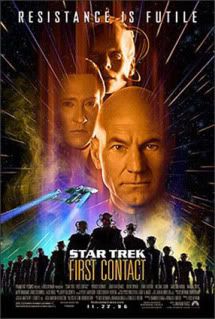
For many reasons I'm tempted to say that Star Trek: First Contact is an extraordinary film, simply because I enjoyed it so much. Fortunately, I have a stronger critical will than that. For everything that this film does right, and it does so much right, there are several things biting at its ankles and seeking to undermine everything about this film that is so exceptional.

But first, let's get this plot banged out. Six years ago, Captain Jean-Luc Picard was abducted by the sinister, nightmarish Borg Collective, assimilated into the collective and connected to the hive mind with machinery running into his organic tissue to augment his human abilities. Through the power of friendship (or something; I don't fucking know), the crew of the Enterprise manage to rescue him. That was back on The Next Generation television show. Cut to "present", Jean-Luc is still haunted by his encounter with the Borg and retains pieces of their machinery in his body.

When the Borg invade Federation space, Picard leads the fight. In the first of many egregiously simple errors the film commits, Worf (who, according to my minimal research, was at this point a regular on Star Trek: Deep Space Nine) is contrived aboard the Enterprise and shanghaied for this next film. It is so fucking contrived. THEN, Picard tells all the ships to focus their fire on a seemingly insignificant area of the Borg starship, which turns out to be critical enough that it destroys the ship. Just like that. Maybe that bit of minutia should have been relayed to Starfleet, eh, Picard? Maybe you should be the one to comfort the families of those who were killed or assimilated by the Borg before you showed up with that little detail.

So as Picard blows the Borg ship to hell in the span of a lunch break, the Borg manage to launch a probe that begins traveling back in time. The Enterprise quickly follows it back the mid-21st century, where the Borg are attempting to eliminate Zephram Cochrane (James Cromwell), the man responsible for inventing warp drive and establishing first contact with an alien race.

Here's where something else goes wrong. When we're first introduced to Cochrane, his research community is under fire from the Borg probe. How exciting! Then, as quickly as it started, the Enterprise blows the probe to Mexico. Then a handful of crew members beam down and help Cochrane accept his destiny and get history on the right track blah blah blah. But without the probe as an imminent threat, the away team subplot loses all its suspense and its connection to the main plot aboard the Enterprise. The fact that the away team is literally getting hammered and partying and meeting their idols while everyone on the Enterprise is having cables shoved down their throats and Borg eggs (?) laid in their stomachs sort of ruins the atmosphere.

And there's an easy solution to that problem, too. Because (oh, yeah, I forgot to mention) aboard the Enterprise the Borg have somehow gotten into the hull, undetected. Only a handful at first, but they slowly start grabbing crew members and assimilating them, slowly start converting the Enterprise's computers to Borg technology and their power slowly grows to rival the remaining crew. They begin to spread like an infection. Every time we're pulled away from this incredibly compelling story it's beyond frustrating. If the away team had a more direct stake in the fate of the Enterprise and vice-versa, that sub-plot would remain useful. As it is, though, they may as well not be connected at all.

The last of the egregious, simple errors the film commits is to make the Borg appear weak in some scenes. As a child, nothing frightened me more than the Borg (if you don't remember, or weren't around for the beginning of this series, my motivation to view all the Star Trek films was my unabashed enthusiasm for the series when I was little). They were essentially unstoppable killing machines. They adapted to your weapons after only a handful of shots, making your guns nothing more than heavy garbage cans full of used tissues that you can lob at your enemy with all the force of a child stricken by muscular dystrophy. And not just the individual. The ENTIRE collective adapted to your weapons (or tissues) after a few shots. As a child, they seemed invincible. I couldn't imagine anything scarier than an entire army of scary cybernetic zombies that you can't hurt. The mistake First Contact makes is to have a handful of scenes where Worf or Data manages to kill them with a single punch. I get it, Worf (being a Klingon) and Data (being an android) have superhuman strength. It makes sense, but again, you're UNDERMINING THE THREAT when they're being killed by simple punches. The easy way around this is to show humans trying to do the same thing out of desperation and showing the violent, cybernetic-probey results. Or to simply make Worf and Data put in a little bit of fucking effort when punching out robotic zombies. They seem to be doing it between bites of their scones and I don't see why Worf and Data have to be stronger than the Borg necessarily, instead of, perhaps equal in strength. That would be beneficial towards every aspect of the film.

If I've made this film sound bad, that was not my intention, I just piled on the negative criticism before I got to the good things, and there are a lot of things to be grateful for in this film.

First of all, my long list of complaints with Generations have almost all been addressed. The cast has new costumes that look decidedly more cinematic, the bridge is less garish and sleeker, readier for the widescreen necessities of cinematic features. Also, Data, who I dismissed as a weak character in the previous film, is given a lot to do and does wonders with it. In fact, the most fascinating portion of the film (from a narrative rather than aesthetic standpoint), is Data's interactions with the Borg Queen, a highly sexualized cybernetic humanoid zombie, who tempts him to join the collective with the promise of the organic skin and the human properties he has so longed for.

It is essentially a long conversation in a cavernous, Gigeresque dungeon that punctuates the action in the main of the ship (I know it's stupid to compare it, or anything, to The Seventh Seal, but that's just what it reminded me of, okay?). How they managed to fuck up the away team sub-plot with such a shining example of how a sub-plot should work in this film is beyond me.

And then there's the action in the main of the ship. As the Borg spread throughout the hull of the ship, Picard attempts to hold them back and evacuate survivors through the alcoves of the ship only the crew know. Here we get to see something that in seven films we never saw Kirk do: lose it. The closest to the edge that we ever saw Kirk get was when his son was killed in Search for Spock, quite possibly Shatner's greatest moment (although that's not saying much, especially in such an abysmal film).

Fuck, even the Holodeck, which I ridiculed endlessly in Generations, gets one of the best scenes in the whole film. Picard's story is rock and roll, action-heavy and exactly the sort of heroin trip the series has needed for a while.

But the best part of the film (and it's hard to choose a best part of a film with so many fine qualities), is Patrick Stewart's performance. Surely he's done better work, but rarely have I seen him at the top of his game physically. Not just the stunt work he does, but watching Picard devolve into an animalistic beast, struggling to maintain his gentile, Shakespearean composure as he is overrun by a guarded, malicious joy, watching the Borg gunned down in front of him. It's the sort of physicality that is often overlooked in acting, and it's a sublime bit of scenery-chewing. Stewart takes it and follows it over the top, using his considerable acting abilities to outdo every other actor, every other effect and every other action sequence in one scene of borderline-psychotic shouting.

Yes, the Next Generation crew finally crawls out of the shadow of the original cast with this film. And thank god. We're finally free of Walter Koenig's toupee and well-documented desire to kill everyone in the Original cast. Even before he loses it, Picard was always a much better character. Kirk was interesting as a counterpoint to Spock, and while that's not to discredit what an excellent character Kirk is, Picard is interesting all his own. A fully fleshed-out man, including the dark edges that Kirk never had, Picard is not only the sort of man that would actually inspire the sort of loyalty Kirk is seen inspiring, he's exactly the sort of person you would never EVER want to fight. He will make your circuits know fear and you will know what a true man sounds like before he snaps your spine over his knee and hangs it on his mantle. He's the sort of man who could walk through Perdition's flames and not feel a thing. He could butter both sides of his toast and not get butter on his fingers or the counter. He could write three metaphors in a row and they would all make equal sense.

As for Jonathon Frakes, yeah, he's untested as a director, but his work here is good. He does a lot to make the film move, and he has created the first Star Trek film that stands apart visually from the other films and the other television series. Some of the more complex scenes suffer from an inexperienced director, but for the most part I'm quite surprised that his directing career didn't go anywhere. The opening shot is easily the best-composed, most ambitious shot in any of the Star Trek films since The Motion Picture.

When the dust settles, though, this is still a very good film, one that I'm prepared to watch many more times in the future. If all this Star Trek retrospective gives me is this film, I will say it was an unprecedented success. I don't know if anyone who isn't as close to the franchise as I am at this very moment will have the same level of appreciation and affection for this film, but I know that I enjoyed the hell out of it.

8/10

Thursday, November 5, 2009

Those fucking kids

Patrick Stewart is a man's man. I get such a jolly from watching him perform, and he's the coolest captain the Enterprise ever had. As much as I like watching the bridge crew drag Kirk away from the self-destruct console after he spots a spider near his chair, Picard is beyond badass. Patrick Stewart (and by virtue, Picard) is everything a 21st century man should aspire to be.

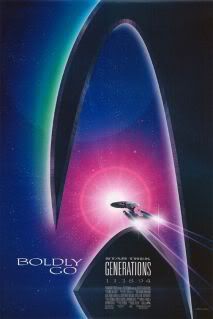
By formulaic, I mean it might cure jaundice and confuse me on my math midterm. But Star Trek: Generations is damn formulaic. So formulaic it doesn't seem to understand the difference between a television show and a theatrical motion picture (wider aspect ratio, FEWER STUPID SUB-PLOTS).

Here we go. We open on Kirk, Scotty and Chekov being shown around the bridge of the newest incarnation of the Enterprise. Kirk is bugging out because Sulu had time to grow some children-trees despite being gay and despite his commitment to Starfleet. They take the Enterprise out for a stroll around the block when they receive a distress signal from a group of transport ships caught in some strange magnetic anomaly. The inexperienced, indecisive new captain struggles with his ill-equipped ship until Kirk takes over, ultimately dying in a freak accident when trying to rig the hull to buy a few extra minutes for the crew.

This is a fitting death for Kirk. It's the sort of end many people have met on the Enterprise but none of the bridge crew have met because so rarely do they venture into the hull.

Flash forward 80 years to the GAYEST possible film introduction to the Next Generation crew we could have POSSIBLY conjured. They're on an 18th century warship, all dressed in French military uniforms and giving Worf a best friend bracelet in a phenomenally gay ceremony. Apparently it's a hologram (whatever), but this hologram machine can't hologram-in-ite them uniforms, so they spend at least a few minutes in front of their crew in French sailor uniforms.

Unfortunately, Data begins to grasp the meaning of cruel irony but without the restraints of remorse. Worried that Data will soon become an efficient killing machine with a tenuous grasp on humor, LaForge stuffs an inhibitor chip inside of him that makes him feel all the shitty emotions like sadness and fear but without the awesome emotions like murderous rage and bottomless greed.

That's when they find Malcolm McDowell who is, surprise, evil. He's going to blow up a star so he can get back into something not unlike the simulator Picard and the Gang were just hanging out in. I'm still not clear on how blowing a star up is necessary, perhaps he just wanted to be on the (very) long list of people who challenge the Federation and the (very) short list of people who don't get vaporized or thrown into a pit of lava for their trouble.

He's struck up a deal with some Klingon lesbians and they stand around and suck just like everything else in this fucking movie.

Let's break down the Next Generation crew, shall we?

Picard is a badass, yeah, I know. But LaForge is a little girl, and blind, and totally incompetent. Data is the emotionless science officer, not unlike Spock, but without Spock's predilection towards kicking tons of ass and generally being an emotionless killing machine/pun dispenser. Also he's the only android I can think of that gains weight.

Worf is...well, what the fuck does he even do on this ship? Scare children? Public relations? I understand that if you're shooting every day in elaborate makeup, it can get tiresome, but it looks like he walks into the makeup trailer every day and just shoves his head into a bucket of brown makeup with some eyebrows carelessly thrown in. Also, he sounds like he's on the run from gambling debts and has half-heartedly tried to change his voice.

Riker looks like a seasoned sexual predator, but not of the rapey variety. Of the "I've got you in the makeup trailer all by yourself and I can already smell the sexual harassment suit coming my way" variety. His uniform is also too damn broad with shoulder pads making his shoulders boxy but his midsection round. I get that most of these actors are pretty old already, but Jesus, don't let people self-conscious about their aging pick out their wardrobe.

The whole film looks cheap, like their budget is lower than it was on the TV show. They couldn't redesign the uniforms? How much could that cost? Forty dollars? But it doesn't even matter, the whole film feels like a season finale. William Shatner is thrown in so that people will have some reason to go see this fucking thing and he's given a death with all the dignity of being punched to death behind a Denver Denny's and left in a dumpster. I'm pretty sure Kirk has crossed bridges before and many times. Was he nervous in front of Picard?

The whole film reeks of a script that could have been very strong in the hands of a better director, or maybe with a few rewrites. There are some interesting things going on, such as the opening that could have been breathless, not unlike the opening for Abrams' Star Trek and there's a scene where Picard is separated from the villain and is trying to talk him out of his plan that could have worked better with some stronger dialogue and some better imagery.

But the thing that endlessly undercuts whatever might be working about the film is Data's subplot. It adds nothing of thematic value to the story and doesn't tie into the main plot at all. It's just a rejected plotline meant to give Bret Spiner and his diamond cream more screen time.

It sucked.

But then again, Patrick Stewart.

3/10

Tuesday, November 3, 2009

Further government-sponsored attempts to find the galaxy's last Bob Evans

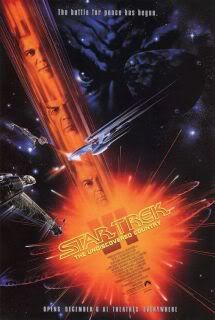
If the Star Trek films were to wrestle, Star Trek VI: The Undiscovered Country would lose because all it would take is fresh crab cakes on the buffet to distract it. If Star Trek VI were to play chess, it would look like this.

Star Trek VI: The Undiscovered Country is a pair of suspenders and a flannel shirt. William Shatner had his ass airbrushed in several scenes. Leonard Nimoy's gut conspires to make him look less alien-like. At this point they had the virile young Next Generation cast to drag mercilessly through the Trek fanbase, who, after viewing this film, I can only assume look like an angry mob or spectators at gladiatorial games. Why they aren't mobbing and using their teeth to tear off their Starfleet uniforms is beyond me; a morbid sense of humor springs to mind, as this is easily the most physically intensive the series has been since it was still a TV show.

On a similar note, the plot of Star Trek VI:

The crew of the Enterprise are set to be decommissioned and ground into meat (?) for the hungry masses. When Kirk is asked to escort a Klingon ambassador to Starfleet Command he responds like anyone would, by loading his racism into his holsters and assembling his grouchy old crew to be cartoonishly ignorant and murderously hostile.

If you haven't guessed already, the Klingons are a pretty obtuse metaphor for the Soviets and the film is a pretty obtuse metaphor for the end of the Cold War.

So they're enjoying the sort of dinner party where everyone is secretly armed and every dish has been so thickly laced with nanobots that it can be passed off as a sauce. Afterward, the Klingon high command beam back to their ship and are greeted with the traditional Klingon lullaby of having their ship blasted with torpedoes and their crew shot at point-blank by men in Starfleet uniforms. Kirk is sent a subpoena in his weekly shipment of alien sex toys and sent to a Klingon court, which is surely based on Texas courtrooms. He and McCoy (who is once again being dragged along because Kirk doesn't feel like being sentenced to death alone) are easily found guilty by Kirk's famous racism and enthusiasm for launching small pox-infected blankets into Klingon teepees. They're sentenced to live out the rest of their lives on a penal mining colony, despite their pleas of innocence.

Meanwhile, Spock has taken control of the Enterprise and is attempting to unravel the mystery of who is responsible for the attack, and it's here where the film really stands out. First of all, Spock makes such a good captain that I can't figure out how Kirk got command in the first place (although if we're going off Abrams' film, he got it by making fun of Spock's dead mom) and it's a crackling, locked-door whodunit.

This is easily the best film in the series since the first one, and the most purely enjoyable. My attention never wavered for a moment, despite the cast's constant looks of confusion or excitement when they realized it was medicine time. It finally incorporates the things that I've said Star Trek has needed for a long time: either a villain with a serious ideological clash with the crew of the Enterprise or a politically-driven narrative, a definitive sense of scale, the compartmentalizing of the crew in order to give them their own moments to shine and independent story arcs, the crew out of their element or dealing with a serious danger that the audience feels is a real threat and some damn adventure, already. None of these things have existed (and if they have, only in spurts) since the Original Series. The Motion Picture offered some 2001-style postulating and some really incredible visuals but generally seemed divorced from the liter tone of the series and it didn't feel like an essentially Trek film; it could have been any cast of characters on that ship. Here, I feel (and I'm no Trek purist, but I have been enjoying the series), we are given the best of Trek lore and the best characterizations any of the films have offered thus far. Also, the pacing isn't all over the place like it's been for several films now, hinting at some more disciplined editing (ie: an editor ready and willing to cut scenes that were included to jerk off the fanbase--one of the serious advantages to hiring a non-fan to helm a film bogged down in lore and fandom).

The actors, despite their age, are in fine form. Specifically DeForest Kelley who's never been in better shape. He gets the best scene of any of the films in this one, when he attempts to resuscitate a dying Klingon despite his inadequate knowledge of Klingon anatomy.

And now that I've softened you up, here's the killing blow. Star Trek VI: The Undiscovered Country suffers from the time it was produced. Commercial filmmaking in the early 90's popularized some goddamn weird stuff. The example I'm about to illustrate is a pretty big spoiler, so look out.

After Kirk and McCoy are sent to the penal colony, the Enterprise crew manages to rescue them, despite a Klingon declaration that any attempt to rescue them will be considered an act of war. After blowing the shit out of a Klingon ship and killing some high-ranking officers in the process, they beam down to a Klingon-Federation peace conference, armed to the fucking teeth and starts killing Klingons.

That's all fine and good (I guess), but the really weird shit hits the fan when Kirk starts giving a speech about tolerance while his boots are inch-deep in alien blood. And then everyone in attendance claps. I don't doubt that the best way to get the floor or end a filibuster in Congress (or Kongress HAHA) is by shooting someone, but I don't imagine there will be much clapping afterward, just terrified urinating. And this sort of thing was standard practice in commercial filmmaking in the 90's! The madness!

When it's all boiled down, I guess it's kind of disposable, but I certainly had a good time watching it. Hell, it's the first film in the series I could imagine being enthusiastic about watching a second time (although I have been curious to revisit Wrath of Khan, if only for Ricardo Montalbon's performance).

I wouldn't recommend it to anyone but Trek fans, but I'm certainly happy to see the original cast sign off with an actual good film.

7/10

Friday, September 25, 2009

A Comedy of Errors

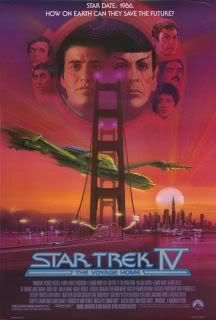
In my critical analysis of Star Trek III: The Search for Spock, I noted that the Star Trek franchise had become a pale shadow of a movie franchise, the last two barely even registering as films. Like a backwoods town attempting to build a restaurant like dem big city folk and ending up with a shack that sells watermelons on Tuesdays. Today we observe Star Trek IV: The Voyage Home, and I have similar things to say about it. The "space epic" thing not working for you? Well, what's popular with the kids? Fish-out-of-water comedies? Great, send the cast back to present day and watch all the wacky hijinks they get into. What will they think of next.

Here we go. The plot:

Picking up where Search for Spock left off, Kirk and co. are on Vulcan with the newly reborn Spock, preparing their Klingon vessel (long story) to travel back to Earth and stand trial for Kirk's latest batch of impulsive murders. The preliminary trial (where, in the future, a bunch of dudes stand around in a courtroom talking about how they're going to hang the defendant who isn't even present) features some surprisingly apt discussions of Kirk's anti-Klingon sentiments and desire to kill everything that moves, but presented as the Klingon council's machinations to further their agenda to kill everything that moves. But we're interrupted by the Giant Floating Plot Device that's evaporating Earth's oceans until SOMEONE GETS ME SOME FUCKING WHALES. Naturally, Kirk and co. travel back in time to San Francisco of 1986 (of course you'd say "Ah, San Francisco", Sulu). There, Kirk and Spock plan to abduct some whales from an overprotective marine biologist and do things like not know what money is. Wacky hijinks ensue.

I feel like I'm selling the comedy bit short. Sure, they're all stock jokes that we've heard a million times (Spock can't get the hang of cussing!), but it's nice to watch the cast loosen up a bit. The series has been in desperate need of some pie-throwing for a while, and the cast has an easy chemistry that makes the film pleasant enough to watch.

In fact, the scene where they go to a 20th century hospital allows DeForest Kelley, the funniest member of the original cast, some really great comic moments.

Leonard Nimoy is back in the director's chair for this one, and his helmsmanship has tightened up considerably. The whole film is far breezier and more fun to watch than Search for Spock (although that's not saying much). But this brings up a question: should Star Trek be this breezy? Personally, I don't think it's a good fit. I really got the feeling that the cast was sort of being dragged around haphazardly in this one in a desperate plea to keep the franchise alive. Between the comedy that makes this feel like only a sort-of-a Star Trek movie to the topical message about saving the whales, the producers really pulled out all the stops to try and make this one relevant.

And the cast is beginning to look very, very old. Obviously they've been old for a while now, but I'm just now beginning to see it, especially considering how many of them look like old lesbians (3). It's almost sad to watch. No one would allow a group of septuagenarians a state-of-the-art vessel like this, they're liable to all go into a diabetic coma and crash into the Bob Evans they were flying to.

And let's not forget the marvelously stupid Giant Floating Plot Device. The thing arrives with no explanation. It just shows up and starts evaporating it some oceans until a whale sings at it. Why is it so angry at all water that doesn't house humpback whales? Will the water more effectively house humpback whales when it's been evaporated? What are its origins? Why is any of this shit happening? No one seems especially concerned with this. They make it seem like they do this every week. Some probe comes and starts evaporating their oceans or disintegrating their rain forests until someone goes back in time and gets it the animal du jour. How strange that would seem to an outsider!

I'd rather the president just call Kirk up and send him to San Fransisco of 1986 on a mission to get into wacky hijinks. At least then you're being honest about how lazy you are.

To wrap things up, I'd say that it's nice to see the cast loosen up, but the story needed to be more Trek-esque. Instead it's a fish-out-of-water story about saving whales in 1986 that really doesn't even feel like it belongs in Trek canon. I actually prefer the thematic and visual ambition of Search for Spock, even if that was arguably a bigger failure. This film isn't as much of a failure because it sticks to such a rigid formula.

5/10

Wednesday, September 9, 2009

Cops!

One movie in and I'm ready to just agree with everything everyone has said about Michael Bay. Not out of anger, or because I really hated Bad Boys, but because I can't remember anything about the movie and I watched it two hours ago.

Let's see if I can recount the plot. Will Smith is Mike something, and Martin Lawrence is someone else. Mike and ? are narcotics officers in Miami (I think) and best buds. Every day they get into some wacky predicament that they have to shoot their way out of, because due process is for squares.

Actually, while I'm here, I'd like to comment on a scene that could have been really cool. Why is Mike such a loose-cannon cop who doesn't play by the rules? Because he has a trust fund and, thus, nothing to lose. I'm just joking, the film doesn't make that connection. They just use it as a device to show how dedicated Mike is, but it would have been more interesting if he really WAS an adrenalline junkie who got off on violence and didn't have to play by the rules because if he got fired, whatever. No, that would have been too interesting.

Anyway, one day the Miami (I think) police department has a Mt. Fuji of heroin stolen out of the evidence room and Mike & ? are brought in to get it back. Do they shuffle out of bed, take twelve Asprins and a shot of Jack Daniels, pin their badge to their bathrobe and hop on the city bus? No, they hop into their stylish sports cars and have their clothing robots put on their designer suits, speed on down to the police station where the no-nonsense police chief wags his finger at them for being too stylish and sexually desirable.

Argh, fuck. I keep forgetting what I was talking about. So a bunch of heroin gets stolen. Yawn. There's nothing more boring than a villain who's just trying to make a deal and get paid. There are no fucking stakes. No one gives a shit about some dude selling some heroin, he just wants to be as stylish as the main characters. I sympathized with the guy. He's trying to scrape together a living, and here come the cops with their gold-plated Ferraris and diamond-encrusted handguns to bust a silver bullet in his ass for selling something that shouldn't be illegal in the first place. Not to mention he's characterized as a villain because he's European, clearly having had his world domination plot ignored by James Bond and sulking off to sell some heroin and buy a new Moon Laser.

Shit, what was I talking about? Some guy gets shot, I think he's a cop. Some hookers see it, one of them gets shot, the other gets away. ? has to pretend he's Mike so that the girl will talk to him for some convoluted reason (a simple explanation would have cleared the whole situation up in about fourteen seconds, but then we wouldn't get to see an episode of Family Matters where Carl Winslow shoots forty people). There's some sexual tension between ? and the Hooker Witness, but oh no! ? is married!

So the whole plot makes no sense, is boring as shit and then they drive around shooting stuff and talking jive. Every thing about this film is pre-packaged and boring. Every joke is a joke you've heard before. This is at least half comedy and I didn't crack a smile once. The villain is the same as every Bond villain in the 80's. The score sounds like ever score from the 1980's. Even the formula was a joke by then. Maybe it's because my heart is a little black hole of despair, but I derived next to no pleasure from watching this film. It's a thin, dated retread of things we've seen a million times before, and it belongs on cable TV, not on a DVD.

3/10

Saturday, August 22, 2009

Here's some money. Make me a Star War.


You have two characters as great as Kirk and Spock. You have a villain played by Ricardo "Fantasy Island" Montalban. You gave him fucking super strength and gave him a bunch of genetically engineered super soldiers to follow him around doing his evil bidding. Collect your money.

Right?

RIGHT?

Here's my impression of one of the Wrath of Khan script meetings:

WRITER #1: So we decided to use the genetically engineered superhuman Khan for the villain. He was in the Original Series episode Space Seed...

WRITER #2: Wait, whoa, whoa whoa. You said he's genetically engineered?

WRITER #1: Yeah...

WRITER #2: A superhuman? As in super strength?

WRITER #1: Yeah, that's what he's like in the original episode.

WRITER #2: It's just...

WRITER #1: What?

WRITER #2: It's nothing.

WRITER #1: No, tell me.

WRITER #2: Well, it's just that... I always thought that if you were super-strong, you'd also get super-tired and also do a lot of super-resting when you used your super-strength.

This movie could have been called "SITTING: The Motion Picture" and had the same effect. For a movie that boasts exploration of strange new worlds and a villain as great as Khan, we spend an awful lot of time sitting in the bridge. Ricardo Montalban is an intimidating guy, but he never stands up. Not to get a cup of fucking coffee and not to exact his revenge.

That poster makes a million promises of adventure and excitement, with Khan standing, as if to say "I might walk somewhere at some point", and Kirk with his phaser as if to say "I might get into a close-quarters confrontation where I have a conversation with someone", and some dudes in hoods in the background as if to say "we might do something dynamic, like put tape over the cracked hull in a ship or repair the broken air conditioning on the USS Reliant" and some words exploding as if to say "nobody does anything boring like read in this movie, because every time they try, the words fucking EXPLODE".

Nah. The whole movie is sort of aimless wandering, and nothing ever seems like it's at stake because no one even bothers to stand.

Montalban plays the supervillain Khan Noonien Singh, fifteen years ago exiled by the crew of the Enterprise to the dying planet Ceti Alpha 5. There, Khan has spent a lot of time reading, playing with giant insects and doing push-ups. When the USS Reliant docks nearby, Khan and his race of genetically engineered super-soldiers kill the entire crew and take over in the best scene that they don't show.

Kirk and Khan sitting in their chairs chatting it up over the view screens is not particularly exciting. It was the first time, but after a while I was just really crossing my fingers that they would get a face-to-face confrontation. The dude has super-strength and Kirk is, well, motherfucking Kirk. He'd probably blow up Earth if it meant he took out a handful of his enemies, and he's probably blow up a star system if he came face-to-face with someone as excellently evil as Khan.

And let me underline that Montalban totally deserves his legacy as a great villain. Is he a fantastic villain, even if he sits the entire fucking movie? Yeah. Can I imagine the Trek universe doing better? Absolutely. Maybe if Matthew McConaughey played a man that fused with the moon, and he grew anthropomorphic features like eyes and a mouth and a little stubby, nightmare-inducing torso and floated around the galaxy fusing himself with other planets. Man, I wish I had $40 million for these things.

Instead, the whole film feels rather lethargic. The special effects are nowhere near as impressive as they were in The Motion Picture and the space battles are staged with very little flair or suspense. Again, rather lethargically. They seem to move at a crawl.

I loved Ricardo Montalban's performance just as much as everyone else who sees this movie does, but I can't get over how lazy this film feels. When I see a Star Trek film I want to see great special effects and alien worlds and Kirk and Spock using their whiles against a superior threat. Instead what I got was Kirk and Spock with the infinite resources of Starfleet blowing the holy fuck out of a small insurgence of impoverished rebels using stolen Starfleet technology to try and appeal their sentence. For the record, I don't think trying to steal a spaceship is worth spending an eternity on an inhospitable, god-forsake planet.

I rooted for Khan from start to finish. Kirk was just being an asshole.

4/10

Sunday, August 16, 2009

Made in His Image

As a child, I was fixated on Star Trek. There are scores of home videos of me, around the age of four, where my parents desperately try to engage me over my trance-like state. One video in particular features me at three years old, sitting in the hospital after my sister is born. I don't give a shit about my new sister as long as Patrick Stewart's glistening head is within my field of vision, and I only acknowledge my father once he threatens to turn off the TV if I don't give him some sort of sign of life.

Eventually Star Trek and I grew apart. I have vague memories of watching Deep Space Nine with my mother when I was five or six, but around that time the outlet for my elementary nerddom became Star Wars.

Also around this time I remember my parents renting Star Trek: First Contact, which scared the CHRIST out of me. I spent the majority of that film's running time running into the next room and hiding my eyes on the staircase. I have particularly traumatic memories of Patrick Stewart snapping the Borg Queen's spine over his knee and hanging it up on his mantle.

But that's about it for my knowledge of Star Trek. I remember very, very little from my time as a kindergarten Trekkie outside of Patrick Stewart's sun-reflecting scalp and I don't think any amount of Star Trekking is going to pull me away from my beloved Star Wars.

But I was recently compelled to do a retrospective of the entire series for two reasons. One was that as I gave more and more thought to J.J. Abrams' recent Star Trek reboot, I realized that it was god damn brilliant and it was the most fun I'd had at the theater since The Dark Knight. I fully regret not giving it a 10/10 and must make amends. The other was a large stack of photographs my grandmother gave to my mother recently contained this:


So with that, I dive into a film with a largely negative reputation. Often referred to as "The Motionless Picture" by the dirty Trekkie scum, the serious, deliberate pace was very well-suited to the story.

As for the story, I'll give you a quick rundown. Kirk is doing what he always does, being an impulsive, selfish asshole and letting everyone else clean up the mess, only this time he's doing it as admiral of Starfleet. He essentially strong-arms Starfleet Command into giving him the Enterprise to handle an apocalyptic astro-threat over the far more qualified Captain Decker. What's this astro-threat, you ask? A giant cloud, about as threatening as a bit of morning fog. Perhaps Starfleet was worried about unsafe traveling conditions, but the more likely scenario was that every now and then they tell Kirk to go blow up a cloud or something, just to see if he will, and just to see how many of his crew he manages to get killed in the process (spoiler warning: 2).

According to Starfleet, the cloud is incredibly dangerous, and as the Enterprise gets closer to it, they realize it's also sentient. It would be a shame for me to go any further, but it's an interesting, if not exactly perfectly logical story.

The film came out ten years after the original series had been canceled and my first impression upon finishing the film was that it was Gene Roddenberry's ultimate vision of the Star Trek universe. Free from the pressure to have explosive climaxes, Roddenberry was free to use the film as a conduit to explore more hard sci-fi territory. This is surprising, because I tend to think of any science fiction film to come out between 1978-1983 to be mere cash-ins on the success of Star Wars. Good for Star Trek: The Motion Picture for holding on to its original vision and providing a stark contrast to the more shallow fare filling the theaters at the time (by God, though, shallow doesn't necessarily mean bad; we got Alien out of the post-Star Wars sci-fi boom, so I never have any intention of speaking negatively about it).

The real star of this film, though, are the visual effects. I've never liked the look of CGI and have always admired filmmakers like Christopher Nolan who avoid using it when an alternative is possible, and Star Trek: The Motion Picture is just further proof that I'm always fucking right. The model work in this film is second only to 2001: A Space Odyssey, and while the film catches a lot of flak for lingering on these shots too much, I couldn't get enough of them. The design of the ships were positively epic, and you can practically hear the 1979-oids gasping as some of the more ambitious shots come on the screen. The only thing that didn't look magnificent was the animated bits, which are the pieces that CGI can fill in for these days.

As for the acting, this is a film headlined by William Shatner, which is all you need to know about the acting.

Additionally, it IS a slow-moving film tat doesn't always justify its existence with a story that makes complete sense. At times it reeks of a script that was re-written several times during the shoot.

It's a strong film thematically, and I was engaged throughout. I'm not terribly familiar with Roddenberry's original series, but from what I gather this is exactly the sort of thing he was going for. For a film without a single shootout or spaceship blowing another spaceship to hell, it was surprisingly rousing and exciting in the only way that hard sci-fi can be rousing or exciting.

It's not perfect or great, but it is good, and I enjoyed my time with it more than I thought I might.

I gather that this experience may be less punishing than I had originally thought, and I'm looking forward to The Wrath of Khan.

7/10