Showing posts with label ghosts and goblins. Show all posts

Thursday, March 11, 2010

Madness: It's A Rule Now

The Crazies is probably the best movie that can be made out of the modern horror formula, you know, the one I keep talking about that's as stale as a brick that went through the wash but sat in the drier for days. Oh, you don't know the formula, liar? It's about a capable, resourceful man who has to take charge of a band of survivors when his hometown is overrun by a grotesque threat (it's almost always zombies). A second threat, almost always human, is introduced to up the stakes and answer the cynical modern horror audience's calls to see humanity played as a bunch of bloodthirsty opportunists. The hero and his love interest are the only ones to survive at the end, but the cynical end credits usually blow them up or sick a Rancor on them or something. The audience masturbates through the rest of the end credits.

Any regular readers (are you there?) know that I like genre films (stop reading at any time), and The Crazies is exactly that: a genre film polished to a mirror shine, then rubbed with diamond cream and vampire sparkles. I know I've spent the last month bitching about how boring modern horror is, and The Crazies represents everything that's boring and antiquated about the genre, but it does it with excitement, good characters and a reasonably involved story. Oh yeah, and some very pretty visuals. Really, way too pretty for this film. So pretty, in fact, that it makes me think this is just a genre effort from an extremely talented filmmaker who hopes to use a simple genre film to break out onto the mainstream. He goes through all the motions, but everything about this film is absolutely better than it has to be. The standard-issue jump scares are still there, but they're mostly there to make the film palatable to 14-year-olds giving each other awkward, raw handjobs in the back of the theater while the projectionist records it to splice into the second reel of Alice in Wonderland and make that film more nightmarish.

So yeah, the story fits straight into that mold like some sort of script girder. A sheriff, his wife, her secretary and the deputy are one of only a handful unaffected by a disease that makes the infected illogical, violent and veiny. The military shows up and starts killing everyone and our heroes try to escape.

I think the reason this film works so well is that, while it advertises itself as a horror film, has some jump scares and zombie-like things that vaguely define it as a horror film and otherwise fits into the mold of a horror film, it's really a thriller. It's a pretty straightforward thriller with people sewing each others' eyes shut instead of people frantically deleting files from a computer, and it's sort of cheating, although it's effective cheating. Like most thrillers, there's more emphasis on character and plot, but with the streamlined story of a horror film. Good for it, but now you're a dime-a-dozen thriller instead of a dime-a-dozen horror film...which actually leads to some interesting overlap in the horror-thriller venn diagram.

Let's start with the sheriff. He's a pretty standard protagonist for these sorts of films. First of all, he's a sheriff, which means he has a gun and can kill the bad guys by making their brains fall out. Second, he's a hard-driven man of principles and action, and presumably the only person in town with a Bowflex. Again, that's a pretty standard character description for the hero of a zombie movie, so let's discuss something that's pretty miraculous about the character, despite being something that we should expect of every movie. He's pretty realistic. Obviously he gets into some wacky situations, but the way he deals with them is at once realistic and totally understandable. Rarely does he get into a situation where he's engaging more than one crazy, and he's pretty excited to just run away screaming whenever he can. The one time he gets action hero 'roid rage is when he's watching his wife be tortured, and I'm pretty cool with him pulling a knife through his hand in that situation. He only seems relatively experienced with a gun, like a small-town sheriff who spends all his time getting cats out of trees would (unless he's an insane Western sheriff) and his gung-ho deputy is really just a lunatic. And the women aren't really that interesting, as usual. One of them is pregnant, which is as close as you can get to a personality trait with women, I think.

I really like the structure of the film, too. Most of the film is written around specific setpieces, and they're all pretty spectacular (although the one in the morgue isn't nearly as great as the others), with a special shout-out to the showstopping bedroom setpiece. And they're not necessarily action sequences! It's better to define them loosely as setpieces or conflicts and they're spread very well throughout the film. Like a conflict or [action] setpiece should, they're built from the bedrock of interesting characters and designed to get into their heads while keeping the film exciting and visually dynamic.

It's a great example of genre filmmaking, but I don't really want to see more films like it. I'm happy with The Crazies and now I want horror to move on. I know that won't happen, though, and thrillers in horror masks is about as good as we're going to get. It's a formula, and it's simple, and it's almost forgettable and it really isn't something that I thought about or reminisced about too much after I saw it. Also, it's sort of a lie. A good lie, but come on, it's lying through its teeth.

7/10

Saturday, February 20, 2010

Night Time Through the Ages

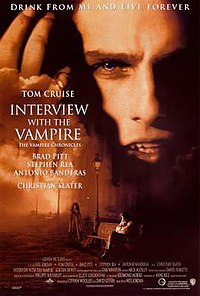
So I think more vampire movie reviews are necessary. I haven't decided exactly what films will be included. I will say that the vampire film I most want to see is Werner Herzog's Nosferatu: Phantom Der Nacht, which is unavailable on DVD, though I plan to try and hunt down a VHS copy. For now I'll chart my early history with the vampiric form, which, as far as I can remember, began with Neil Jordan's Interview With the Vampire.

It concerns a couple of vampires prancing about in frilly collars through Victorian Europe and civil war-era America, gently sucking blood from the exquisite necks of voluptuous 19th century bitches with not a second glance towards their brilliant tits as they dump them in the...well, that's never really explained, but we can assume they were doing something with the bodies, like maybe decorating, after all Neil Jordan never seems to have enough fucking set dressing. Not even Jack the Ripper had enough hooker skin laying around to tailor himself a hooker skin waistcoat and top hat, but these vampires would have enough to make a hooker skin circus tent with hooker skin elephants and clowns and probably a hooker skin audience once the police stopped them selling hooker skin tickets to hookers. Interview With the Vampire seems to be an indictment of old timey law enforcement before it's a vampire movie or a horror movie or a period piece or gay porn.

Not only are these vampires gay, they're fucking sad. They spend the entire movie shuffling around their little Gothic fairytale land complaining about being immortal and their ability to fly. They're like the rich kid in elementary school complaining that their butler forgot to marinate their steak in caviar while you spread the cafeteria's free butter over your leftover breakfast rocks. There's very little action beyond our vampires talking about being vampires and how much it sucks to be vampires; most of the film is just discussing this film's vampire mythology in the context of how much it sucks to be a part of it or establishing the characters.

I'm oversimplifying, so here's a real plot synopsis: Brad Pitt is Louis, the suicidal plantation owner who inexplicably accepts a vampire's offer to become his (totally platonic) companion for all eternity. Really he's the only whiny one, but it's hard to divide him from the rest of the characters when his constant complaining seems to enter the pores of the other characters, turning even the coolest, most relaxed vampire into a tidal wave of frustrated tears. While Louis mopes around about how much it sucks to be suicidal, immortal and at the mercy of human blood to continue his sad little life, Tom Cruise gets to dance around and make fun of him as Lestat, the pretty-fucking-evil nobleman who seems to have been vamping a few decades longer than Louis. He's the elated, fun-loving (and to whom fun means "wanton murder") mentor to Louis' sullen teenager of a student. Louis makes everything worse for the two because of his constant moping, and when his maternal instinct kicks in, Lestat produces a little vampire lady out of a child dying of plague, to whom Louis endlessly mopes. What begins as a playful father-daughter relationship becomes something more sinister as Claudia (Kirsten Dunst) becomes Lestat's equal in bloodthirst and evil. The best scenes (of course because of my predisposition towards thrillers) is the tension between Claudia and Lestat, and the film benefits from shoving the despondent Louis into the background, at least until the end. That's not to say Louis isn't a good character or that Brad Pitt's performance isn't good, but I simply derived more pleasure from watching Tom Cruise and Kirsten Dunst interact.

It took Brad Pitt a long time to become a worthwhile actor. Studios and filmmakers were always putting him in bland popcorn or Oscarbait films without anything to really do. It wasn't until Fight Club that he got a truly extraordinary character to play and began to give great performances consistently (he was fantastic in 12 Monkeys, but he regressed for a few years after that). His casting in things like Seven Years in Tibet, A River Runs Through It or Legends of the Fall were decisions made for the benefit of the film, they were chosen to give the film a bland commodity to trade in that would bring in all sorts of young folks. None of those roles he played were exceptionally written, and were almost unanimously boring ciphers or audience surrogates. Tom Cruise had a similar, if not nearly as pronounced, issue in his early career leading up to, say Born on the Fourth of July. Today it's quite apparent that Cruise is at his best playing villains. My favorite of his performances are Magnolia and Collateral, but our first evidence of this trend came in Interview With the Vampire where he was cast completely against type to loud outcries of miscasting. Casting against type and miscasting are completely different things, though, and Cruise seems nothing short of elated to shed his heroic leading man image and sink his teeth (VAMPIRE HUMOR) into the role of an irredeemable villain, a hellhound of such staggering badness (where the fuck is my thesaurus?) that he declares himself, in a moment of clarity, too evil for Hell.

If Tom Cruise wasn't so fucking pretty and wasn't such an egomaniac, he would probably be a great character actor specializing in villains and dickheads. There's no action franchise more boring than the Mission: Impossible films and we can thank Tom Cruise's villainous megalomania and subsequently disinterested performance for that, but when his real-life evil is funneled into a role not too far removed from his public persona, something notable begins to happen. This was the first time Tom Cruise really got to let loose, and it's always a little shocking to see how honest the evil in his performance is. Specifically I think of a scene in the film that I have a lot of affection for: a scene where Lestat, trying to strangle whatever humanity remains in Louis, invites two prostitutes into their home, kills one and drains the other to near-death. He then implores Louis to end her suffering and accept that to survive he must murder. He begins to torture the prostitute to further goad Louis into murder by forcing her into a coffin. As her forces her in and then lifts her out, he employs a joking, facetious tone that seems to effect the situation in no way aside from to satisfy his natural desire to play with his food. These lines are delivered with a devious evil faked in no way, like making eye contact with the Antichrist. There are a few scenes like this, and they all give me the fucking shivers, but none are so effective as this. It pierces the veneer of acting and puts us in the presence of a real-life maniac. Or maybe not. Maybe Tom Cruise is just the greatest actor ever.

In other news, Kirsten Dunst (something like eleven during filming) plays my favorite "innocent little girl that is actually a bloodthirsty monster". It's a role that requires a great deal of maturity on her part because it is essentially: little girl who has become an adult while keeping the body of a child and the spoiled obnoxiousness of a child but the maturity and evil of a seasoned murderer pretending to be a child. She possesses a charisma that not only is possessed by so few child actors, but that she never seemed to possess again. The role is made that much more difficult by her character being the most intelligent and cunning of the three and it requires a gravitas so rarely contained within a child to make that convincing.

While I'm talking about performances, I'd like to give a special mention to Stephen Rea playing (as Brad Pitt hammers into the audience's head, essentially destroying the effect of the scene) "a vampire pretending to be a human pretending to be a vampire". It's a small role, but an effective one especially considering that Rea is a truly great actor who doesn't get nearly enough good work. He plays a vampire who has waded in decadence so long that he's become a cackling hyena; his overindulgent lifestyle has left him no reason to ever act like he isn't a) on stage b) loudly laughing and joking with other vampire actors or c) murdering. It's such a stark contrast to Louis' stoic pouting that it deserves individual praise.

Now that I've exhausted your attention span with far too detailed accounts of the performances , I'd like to direct your attention to the purely functional story and Louis' slow arc. It's obvious that Jordan is an independent director because he effortlessly draws great work from his cast and spends the rest of his time building elaborate, unnecessary sets. I've heard people complain about the film being overproduced, but I'd argue the point. Surely the long shots of New Orleans ports or the cobblestoned streets of Paris aren't necessary, but they're pretty in a way that isn't especially distracting, especially since almost every scene takes place at night and it gives all the proceedings a gloomy, Gothic aura. All the sets are rendered rather beautifully and effectively, but they are only ever the centerpiece of individual shots, or rather parts of individual shots. Unless we're challenging the long-standing tradition of establishing shots, or the right of establishing shots to be pretty instead of stock footage of the Tanner family's home, I don't think there's anything to complain about here, although I've never seen a movie I would call "over produced", I'm sure it's a legitamite complaint for some films, just not this one.

The only thing about Interview With the Vampire that I think flat-out doesn't work is the whole Interview thing. It's an awkward framing device, like the team of divers in Titanic, that doesn't add much to the film. If it's an excuse for Louis to narrate the film, it's a weak one and there's no reason why you can't just have narration because you think that's how the story should be told. No one's going to bitch about that, not unless you impliment it poorly. It's not something that effects the film beyond repair, but it's worth mentioning because it's a perfectly effective film and none of the truly glaring flaws are that detrimental.

If there's any flaw that really effects the film as a whole, it's Brad Pitt. His performance is so listless and disengaged that we lose our emotional center and the whole piece lacks impact or emotional heft, and that trick he learned for Benjamin Button - acting only with his eyes - doesn't seem to have developed yet.

Despite its scrubbed emotional palette, there's a lot to be said for Interview With the Vampire. I was a little bit in love with it when I was younger and I think it might have had something to do with its sterility. The vampire thing is pretty incidental, it's basically a period piece about some folks who happen to be vampires and sort of eskews the notion that if it's a vampire film it has to be a horror film, and I find the straightforwardness of the approach rather refreshing. It's Gothic and atmospheric, but it doesn't go for scares. It has an endlessly fascinating lead role next to an exquisite supporting role against the backdrop of some really lovely design, and I think that's a lot to go on. Even if it lacks impact, it's memorable for a lot of other reasons, and it's certainly not a mess.

7/10

Tuesday, February 16, 2010

Wolf Father

I'm not against remaking classic monster movies. If there's any remake I get really excited for, it's the remake of classic monster movies. It seems like it should be really easy, mostly because the rules are pretty vague, whereas most remakes force the creative team into a tight framework, lest ye get too original. A monster movie requires only a skeletal formula, leaving a creative team free to explore all corners of the myth. It's staggering what an immense failure The Wolfman is in every respect, specifically in its attempts to work against the script and performances, thinly attempting to connect the two disparate styles with gum and paperclips and the hopes and prayers of orphans made manifest. If the film had committed to a tone, either one of these tones could have feasibly worked, but with half the film pulling in one direction and the other half pulling in the other, it manages to tear itself to shit, fucking up even the most fundamental aspects of story.

First, our protagonist should be someone we like and relate to. I don't take exception to this film's Lawrence Talbot, an actor long estranged from his family who spent some time in a mental hospital during his youth after witnessing the suicide of his mother, but as written and as played by Benicio Del Toro, he's totally static, unengaging and unrelatable.

It's sort of a miracle that Mumbles Del Toro is an actor today, one of the great justices of Hollywood that he can get cast in something like The Wolfman and has an Academy Award. I'm a huge fan of his, specifically his ability to communicate vast emotion through his junkie eyes and drunken slurs, always creating tragic characters with a unique charisma. I love the idea of him in mainstream releases, contrasting so strongly against the typical Hollywood star by never even coming within noseshot (haha dogs) of being boring. To be fair, he's in a badly written, badly directed film that was retooled and fucked with far too much in post-production, a practice that will never be kind to actors. Still, it's a testament to a film's ineptitude that they can make Benicio Del Toro, one of the most inherently watchable actors of his generation, completely bland. Similarly, Emily Blunt, one of the best actors of her generation, is totally wasted in a role that calls for her to overact in that subdued, costume drama way that we're used to from every actress that isn't Emily Blunt. It's a relic from when the film was what it should have been: a moody Gothic horror film. Oh, you still thought it was a moody Gothic horror film? So did I, until about twenty minutes into the film and so did the actors until, presumably, the premiere.

If you hear someone praise this film by tossing around phrases like "this is a Wolfman for our generation", toss that person's face like a fucking salad. Our generation sucks sometimes, and we can all agree (WE CAN ALL AGREE) that our generation's horror films suck more than anything else, including our war. The sad fact is that as you stood over that man's bloodied remains, you'd realize he was right: The Wolfman is a Wolfman for our generation and while an excellent cast and lavish production design are eviscerated, shredded, minced and fucked before your eyes, I defy you not to cry tears of blood thinking about how our kids are going to think we were gigantic fuck-ups. It doesn't even have any pretense towards real horror. Apparently after so many rewrites, reshoots and re-edits, a director loses his mind and decides to make the muppet kung-fu film we've always wanted, but with werewolves.

"Muppet kung-fu" is a pretty appropriate way to describe the tone of this film, but it neglects the gore-porn angle. For some reason, I thought this film was PG-13 going in, a thought I began to question after the tenth anal evisceration. I realize now that I was under this impression because there's no reason for The Wolfman to be anything large or bombastic or, in my mind, any way at all for it to be large or bombastic. It's high-concept horror with no intentions toward being horror. Still, I haven't even begun to describe how fucking mad this film is. Ironically over-violent horror films are a trick learned by direct-to-DVD Blockbuster exclusives years ago and one would think that a major Hollywood filmmaker like Joe Johnston would know how weak it is, but that's the only trick the film has. He doesn't even stage his action with any flair, it's all just campy decapitations between sandwiched between Very Serious dialogue.

At least Anthony Hopkins and Hugo Weaving aren't wasted, Hopkins because he gets the one scenery-chewing role in the film that comes close(ish) to the film's tone, and Weaving because he has never given a bad performance and could only be miscast as a preschooler. But those are just two parts of the film that don't explode in fiery failure

I love truly mad or unusual films, especially ones that were produced for a large audience in the Hollywood system, but that's not what The Wolfman is. It's pseudo-weird, playing tricks hacks have been playing for years to get a reaction stoned high schoolers have been giving to cheaper films for years. It's a movie for stupid people. The sort of thing people go to to talk loudly over and forget about a few minutes after they leave the theater. It's something that preteens go to until they discover alcohol and sex, but since it's rated R they won't be able to get in and will have to discover alcohol and sex. In fact, all the babies born of preteens in the next two years will be called "Wolfman babies", which will confuse religious crowds in the coolest way possible. As in shooting babies with silver bullets. Yeah. That'd make a good film.

2/10

Friday, February 5, 2010

Portrait of a (Vampire) Killer

Watching From Dusk Till Dawn has helped me realize why horror films so rarely work. Things need to change and evolve, become new and connect with a new audience. Horror hasn't changed since the 80s, even today when we go see a horror film, nine times out of ten we're watching teenagers get hunted by a murderer of some sort, or maybe we're just watching a person meet a slow demise. People don't actually shake in terror from these things, it's just gore-porn with no real ideas or intentions behind it. Because Hollywood has been lazy and audiences have been even worse, we've been trapped in a revolving door full of mutilated corpses for about thirty years.

That's not a new criticism, but it's a fucking relevant one until someone does something about it. It means a lot to me that From Dusk Till Dawn exists for that reason, even if no one understands its intentions. You see, a major change in any artform has to come in a package that's easy to consume for the public, and after that the truly great genre films will appear. By nature, true horror films are not easy to consume for the public. When something that's truly horrifying but lacking the defining genre stereotypes that make it identifiable as movie horror arrives, people do not know what to do with it and tend to discard it. We're left with truly exceptional experiments that succeeded in more ways than they had any right to that were left totally ignored by the public, and whose reputation has less to do with the actual intentions of the film and more to do with the self-conscious kitsch it wrapped itself in and the reputations of the creative team involved.

Robert Rodriguez and Quentin Tarantino succeeded more readily than any other filmmaker in trying to do something new and different with horror. I can understand how heartbreaking and disappointing the film's failure was and how that could have driven Tarantino to never touch the genre again and to return to what made him popular in the first place with the nice but forgettable Jackie Brown. If you ask me, and you may as well because you're reading this, From Dusk Till Dawn is Tarantino's strongest screenplay of the 90s, if only because it pulls off such bizarreness so flawlessly.

I can't even begin to summarize the film's plot, so I will say this: it is about two bank robbers slash brothers in Texas. There's a preacher and his family in there somewhere, a bar, a few shootouts and the film may or may not have something to do with vampires. All those plot points and secondary characters are peripheral, though. If you're determined to think of it in these terms, you could call the bank robbers the "monsters" of the film, specifically Richie (Quentin Tarantino) a character that the film lives and dies for. Everything truly important and edgy happens in the first thirty minutes of the film when the secondary characters are just barely introduced and just barely defined.

Which inelegantly brings me to another point. The lengths the film goes to to define characters most people would see as stock (murdering bank robbers) are interestingly contrasted with the film's half-hearted attempts to define the preacher, Jacob (Harvey Keitel, clearly the most professional and actorly of any of these actors), who receives a glazed over characterization in one scene where Seth (George Clooney) prods him for information on his life. The preacher gives him all the typical character bites: his wife died a painful death, he lost his faith, quit his job, he's taking his children with him as he runs away out of grief and the two criminals that have kidnapped him are pushing him to the edge, and he's willing to kill for revenge should either of his two children be hurt. In that one scene we're given a character who is often seen as an interesting, compelling character, but Tarantino shows him to be more a stock character than the murdering bank robbers that he loves with all his heart.

There's a story that Tarantino started writing this film the night that he won his Academy Award. If Tarantino said that in an interview or something he intentionally gave his film another layer of meaning. Tarantino regards Jacob's character with respect, but is far less interested in holding his hand through his routine arc than he is with showing a deranged killer with no capacity to change run into obstacles that he can't wrap his child-like mind around. I hesitate to say Tarantino spits in the face of Oscar bait, because I don't think that he would have included Jacob in the film and given him such rich dialogue and hired an actor he respects as much as Harvey Keitel if he didn't love the character, but I certainly think his presence in the film is a commentary on what was happening in the world of film at the time and how critics and audiences were lumping his films with stuffy domestic dramas just because Pulp Fiction won an Academy Award. Tarantino's love of film has always been B-Movies and exploitation and trash, whereas the sensibilities that the critics fawn over, like his dialogue and his careful characterization, are derived from art and life in general.

In more ways than the blatantly obvious, this film is Tarantino's statement on winning an Academy Award. The clearest evidence that this film is all about Richie is that Tarantino himself plays the character, seemingly untrusting of another actor to take on a character he holds so close to his heart. If we were to list all the movie psychos, my hard drive would probably fry and I'd crash Google's servers, but Richie Gecko is a totally different beast. The movie doesn't relate to him on our terms, it relates to him on his own terms. In many scenes, we're literally inside the head of a murderous psychopath, and that world's similarities to ours make it all the more seductive. The differences are painfully subtle, but perfectly captured in my favorite shot in the film. At one point, Kate, the daughter of Jacob (played by the uniquely sexless Juliette Lewis) turns to Richie and says "Richie, could you do me a favor and eat my pussy? Please?". The suddenness of this statement keeps us wondering if it's really happening for about a second too long, and Richie is totally transfixed by her in all her sexless glory. How the great Guillermo Navarro shot her is a mystery to me, but the effects may be the purest little nightmare I've ever seen. Her eyes are different colors, one a harshly lit green, the other much darker. Her hair is a texture that you would be afraid to touch or that you might have nightmares about being suffocated by. The way her face dominates the frame suggests the powerful sexual urges Richie feels when near a woman he finds sexually desirable. It's interesting to see this scene in context, too, because the two best scenes in the film, featuring the Geckos and a hostage named Gloria, shows Richie's sexuality in a different mode, perhaps fueled by a lack of physical attraction to Gloria.

These two scenes, as I've said, are the best in the film. At the beginning of this post I suggested that From Dusk Till Dawn had a very new brand of horror up its sleeve and it's mostly expressed in those two scenes. In fact, they're so dark and so suspenseful and so perfectly realized that as I watched them this most recent time, I found myself sweating in terror. My point about modern horror is that the novelty of slashers and such has worn off after thirty years, and while I'm well aware of many horror films without men in hockey masks, so few of them work without eventually selling out and becoming just another cheap horror film. An untrained eye could accuse From Dusk Till Dawn of the same crimes, and it wouldn't be a totally unsubstantial argument, but I would argue that Rodriguez and Tarantino aim to make a large statement not only about horror, the history of horror and the optimistic future they have in mind for horror, but the direction that horror is going in thanks to lazy filmmakers and audiences. Their new brand of horror is self-contained and featured in just a few scenes. After that, as is typical of Tarantino's writing, he bounces around from style to style, quickly getting bored with one, but always moving seamlessly.

In fact, Tarantino's genre infatuation (and I'm a man who loves his genre films, so Tarantino is really right up my alley) has never more blatantly been the foundation on which is film is built. Observe: most every character in this film is a genre stereotype who behaves with the logic of that genre "world". I already discussed Harvey Keitel's character, but Seth Gecko, George Clooney's character, is clearly super-slick action hero type, perhaps even a James Bond type. You'll notice he's the only one in the film who can kick a shelf full of bottles and have the exact one he wants fall right into his outstretched hand. He's the only one who can punch someone standing right behind him and cartoonishly knock them unconscious, and you'll notice that he's the one who gets all of Tarantino's trickiest dialogue. Richie is a bit harder to peg, but as I watched the film I got the feeling that his character was mostly derived from screwball comic relief characters. Of course, the twist is how unhinged that person would be, always tagging along with his slick, handsome older brother and watching everything he does fail in comparison to his brother's casual successes.

Now I think it's time we address the elephant in the room: vampires. The fact that it's vampires is incidental, and there's a lot less going on in the second half where Tarantino and Rodriguez indulge their love of B-movies, but there are a few things of note. I'm always taken aback at Tarantino's death scene no matter how many times I see this film. He's become more sympathetic since he murdered Gloria and it's become more and more clear that he's just a child. His death scene has an air of tragedy, and I think that has a lot to do with the filmakers' love and sympathy for the character. Also, Seth makes a statement about the vampires that has a lot behind it:

"I know why you lost your faith. How could true holiness exist if your wife can be taken away from you and your children? Now, I always said God can kiss my fuckin' ass. Well, I changed my lifetime tune about thirty minutes ago 'cause I know, without a doubt, what's out there trying to get in here is pure evil straight from hell. And if there is a hell, and those monsters are from it, there's got to be a heaven. There's just got to be."
There's a lot happening in this speech, but I'd like to direct your attention to the bolded statement. Richie was the monster in the film's first half, and when the vampires are introduced, he is killed. I'm inclined to say the reason the second half exists at all is to mitigate Richie's actions by comparing him to creatures of pure cocksucking evil (there's also a line at the very end about psychos that has a similar effect). Richie may have been a bad person, but he certainly wasn't pure evil straight from hell.

I admire Tarantino's tenacity more than anything about him, but I can't bring myself to commend his performance here. I think it might be a symptom of two major personalities working together so shortly after becoming big fucking deals and not being able to be completely honest with each other. If Tarantino had directed this film and had viewed the dailies, he would have understood why his performance wasn't working. I understand that he's protective of the role, but he's just not right for it because he's not an actor. It's absurdly clear when he's interacting with Clooney, who's doing some of the best work of his career in this film. Tarantino understood that he has an awkward screen presence, but he did not understand that an awkward screen presence is not the same thing as an awkward presence in this film. I think Tarantino learned his lesson here, too, because to illustrate my point, it's very easy to point to Frederik Zoller in Inglourious Basterds. His very presence disrupts the flow of the film with its awkwardness without ever once taking you out of the film with stiff expressions and movement and stilted speech.

Aside from Clooney, my favorite performance in the film is Brenda Hillhouse (who I just discovered was Tarantino's acting teacher) playing the hostage Gloria. She only has a few lines, but the camera is unwilling to stop looking at her, and she gets the most interesting character moment in the film that isn't given to Richie. When Richie innocently and disarmingly invites her to watch TV in the other room with him, she spends a few moments hesitating before she and the audience begin to understand that he's genuine and that he is truly a child. We understand his capacity and penchant for violence, but we are as yet unaware of his capacity for sexual violence. We know something bad is happening, and there's an ominous fog over the whole scene, but we root for Gloria and hope that she survives and that we've just misread Richie. How much Hillhouse communicates just with expression is one of those acting marvels.

I can't express how badly this film has been misjudged. Hopefully history will be kind to it, but its only reputation is as the midnight movie that it sort of is for about thirty minutes. It's given no thought or credit outside of that and I blame audiences too lazy to engage with it on a level outside of exploding vampires. It's not unusual for a brilliant genre film to be ignored for everything but its cheap pleasures, but the disservice done to our fucking culture by ignoring From Dusk Till Dawn is head-spinning. The beating it took critically and at the box office may not have been your fault, peers of mine who were six years old when this film came out, but it's your fault for not rediscovering this film for more than its trashiness.

10/10

Monday, January 25, 2010

Puppy Love

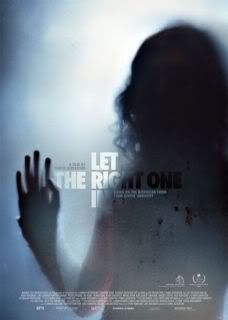
Let the Right One In is a film that I've been interested in for a long time. During its initial theatrical run, it didn't come to my state. When it was released on DVD there was a great deal of controversy about the dumbing down of the subtitles and I opted to wait for the original translation to be released on DVD before I viewed it.

It was thus brought to my attention that my best friend, Netflix Instant Watch, had a copy of the film with the original translation intact and. Unlike many foreign language films Netflix Instant Watch pimps, they don't force a dubbed version on me like the public school system completely failed me. Watching a dubbed film is like having my dad cynically half-describe a movie to me from the other room. In other words, it's for children. I know people my age who refuse to watch films with subtitles. The first film I saw with subtitles was Crouching Tiger, Hidden Dragon when I was ten. Maybe I was born for this, but I think it's more likely that you should read a book sometime.

I digress. Vampire films have a spotty history, and the best comparison I can make is to pirate films. The best pirate film ever made is obviously The Crimson Pirate, but ever since then there have only been a handful of pirate films produced that are even worth watching. While I'm an Interview With the Vampire apologist (I love production design, okay?), I could probably count the great vampire films on one hand. The genre isn't exactly known for being fresh. So few vampire films did anything different since Bram Stoker introduced vampires to sexuality. And pop culture. And we've been watching vampires make out sensually for the eighty years since.

Let the Right One In trades in sexuality, but it goes at it from several fresh angles and it trades in more than just that. To its advantage, it really isn't a vampire film so much as a romantic (I use the word loosely) thriller with a vampire in it. It's loosely plotted and mostly concerns a 12-year-old boy named Oskar who is viciously bullied at his school and his relationship with Eli, a girl who looks to be about his age but is quickly revealed to be a vampire. Mostly we follow their lonely worlds as they expand to include each other.

The film's violence plays into that as well. Easily the best blood-sucking or vampire-related imagery I've ever seen in a film, it's especially effective because Eli doesn't just appear innocent, but is innocent. There are several big, floating question marks around her character that not only have to do with her past (where there are several big, scarred question marks floating) but with her character. Despite her age, she is clearly very sheltered and is in most ways a 12-year-old, but killing for survival brings with it a certain maturity that only appears in flashes. Her character is handled with a logic. Lina Leandersson plays Eli with the characteristically vampiric flourishes, but at a different angle. Mostly we think of vampires as calm, collected and cold monsters because they've lived for so long and rejected emotion in a way that we think is obvious to assume a person that old would. Eli is calm, collected and cold, but it comes from a place of innocence and curiosity rather than one of cynicism. It's an extraordinary performance.

Elsewhere, the cinematography seems to be influenced by Asian, and specifically Korean, and even more specifically Chan-wook Park films. It's not aggressive in its beauty, but holy fuck it's beautiful. Cinematographer Hoyte Van Hoytema has a marvelous aesthetic, framing his shots symmetrically with slow tracking and a bleak color palette, mostly devoted to blacks and various shades of white. The production design is obsessed with squares and harsh angles, and maybe that's characteristic of Communist Sweden, and if it is I'd like to high five the shit out of whoever designed that gulag of a country at the same time as sort of be scared of ever going near it. It's such a perfect match for the cinematography, and if you ever want to discourage someone from being a Communist, all you have to do is show them this film.

The visuals do so much to push Let the Right One In as a horror film, and they do a damn good job of it. As I noted above, it's not really a horror film at its heart, but director Tomas Alfredson seems intent on showing us that if he had wanted it to be a horror film, he could have made it a horror film. There are a handful of scenes that, aside from the visuals, are extremely effective minimalist horror, and none of them directly involve any vampiring, as if to further prove the director's talent.

It's been years since we've had a worthwhile vampire film, much less an essentially perfect vampire film.

10/10

Friday, January 8, 2010

Waking Nightmares

I'm not ashamed to say that if I'm asked what I thought the scariest movie was of 2009, I say Coraline without any hesitation. For this review, I watched it with my four-year-old brother and ten-year-old sister and both of them nearly wet their skulls in terror. While my ample body hair will weave together and crush my skeleton as a defense mechanism against fear, I understand the sensation from a scientist's position and think Coraline would be the best candidate to inspire the sensation should I be a weaker man one day.

Horror for children sounds a bit derogatory, so let's clear something up: films should not be made with a demographic in mind. The marketing campaign is the one that decides the demo, but because a film is animated, or features a child as a protagonist, or isn't rated R for extreme skull fucking, doesn't delegate it to being played on repeat in an orphanage until rug pirates do something made of chocolate.

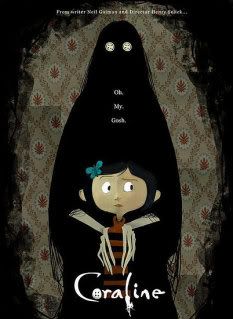
Coraline is the very Gaiman-esque story of a little girl who encounters a magical creature in her house, one that assumes the form of her mother and populates a world almost precisely like her own. But where Coraline's home world is as dull and boring as anyone's (except she lives in a STOP MOTION WORLD, which would be cool, the little brat), this Other world is a fantastical world where everything is tailor-made to Coraline's wishes. Before long, this Other world starts to show its seems and Coraline's Other Mother begins to show some nasty intentions that would get her reported to CPS by any responsible neighbor.

The film is based on a Neil Gaiman book from 2002, and while I'm not familiar with that particular book, I'm familiar with Neil Gaiman and I'm familiar with Dave McKean's cover art, and I'm familiar with the crushing disappointment I felt when I discovered that the film wouldn't be in the style of McKean's art. As much as I love seeing stop-motion animation, and I love stop-motion, I can still lament what a visual handjob this movie would be if it had been done with traditional 2D animation in this style.

Yeah, yeah, we all know (Maybe. Who are you?) how much I love hand-drawn animation, but its underappreciated little brother, stop motion, is pretty fucking incredible as well. It's also the most labor-intensive form of animation. When I was nine or ten or something, I saw a featurette on the animation process behind Chicken Run where they explained that a really good day saw a little less than one second of animation being shot. I know to this day that I would probably hang myself after the first week, which would give the desperate animators a chance to cut some corners and use my dangling feet as a piece of set dressing.

It's unfortunate that, unless James Cameron's home-theater 3D is the real deal, I'll probably never be able to see this film as it was intended ever again. In 3D, Coraline is truly impressive. As I mentioned in my brief writeup for my 2009 in Review, stop motion offers the perfect venue for 3D: while it fails to add a realistic depth to a cartoony CGI film, and it looks too cartoonish for a live-action film, stop motion is the perfect compromise between animation and live action, and therefore provides the most seamless 3D experience.

And look at that, the 3D does something in this movie. Instead of eye candy, it becomes a visual cue that we have entered the Other world (that's not to say Cameron didn't do something similar in Avatar, but I think that the jungles of Pandora were marked more by a specific color palette than use of 3D, although there was some of that). Our first glimpse of this world is a wide, deep-focus shot of a kitchen, lit with the glowing amber and bright reds that will also come to characterize the Other world, just as the dull blues and grays will come to characterize the real world. Coraline's wonder, in this case, is our wonder.

Coraline herself is exceptionally expressive for a stop motion character, something that I haven't ever really expected from this medium. Her emotions never seem out of place for an eleven-year-old girl and the filmmakers are tasteful enough to not juxtapose moments of inhuman maturity and clarity for the sake of plot-building against more realistic eleven-year-old

Like all of Gaiman's work, it's rooted deep in mythology, and if he has aspirations to be a modern myth-maker, he'll never come closer to success than with Coraline. His inclusion of so many mythological elements, such as talking animals with personalities based on that animal's traits (the laconic cat, the scheming rat), the abundance of the number three, and lots of other stuff that you don't need me to list. As a hero, Coraline is a very typical eleven-year-old (I'm guessing) girl, and the film doesn't jump around that to try and stuff her into the mold of the hero. She's bratty, argumentative and impulsive and has the interests and dress sense of a little girl raised by professional gardeners.

But the real triumph, the real terror of the film is the Other Mother. With buttons sewn over her eyes, she at first appears (aside from, you know, the buttons) exactly like Coraline's real mother. Slowly over the film, she becomes more insect-like and the buttons more like the beady black eyes of an insect. In her final scene, the set dissolves into a nightmarish spider web and she into an enormous spidermonster (?) that will send your children to the therapist for years. Maybe it's because I never expect a movie marketed towards children (I know, I know) to even attempt horror, but that scene has never not given me the fucking spine-tingles.

In the end, my love for this movie comes down to a simple matter of taste. This sort of subdued horror, especially in animation, is something that appeals endlessly to me. There are things in this movie that are truly inappropriate for children, not because of the content, but because of the execution. Some of the creatures designed for this film and the world they inhabit is exactly the sort of thing that inhabits a grown man's nightmares. Where most horror films try to startle you and give you a murder boner, Coraline gives you nightmare imagery and claustrophobic editing, and I'll consider those scares far more genuine any day.

10/10

Wednesday, December 9, 2009

Gazing Back

So here we arrive at where James Cameron gives away his sentimentality and the fuzzy teddy bear hiding beneath his human skin. I mentioned in both my Terminator review and my Aliens review that those movies were the grim torments of the movie gods, but in the most deliriously invigorating way possible, like being hit in the face with a Monet. You may be bruised and bleeding by the end of either of those films, but you'll be ready for round two. None of the films we'll be watching in the next week will be anything like those in terms of tone. They'll all be airier and poppier and while of course I do not prefer one style over the other, I do think that James Cameron, at least initially, had a better grasp of the dark and grim. I like feeling like I'm trapped in brightly colored bubble gum as much as the next guy, but I'm sad that Cameron was never able to exercise the same amount of control over tone and deliver a film that leaves me feeling something distinctive, whether it be the rape-victim shakes or polka-dotted fervor (although crazy housewives the world over will argue with me on Titanic).

Like all of Cameron's films, I've seen The Abyss before, but for this viewing I opted for the Director's Cut, seeing as this retrospective is a celebration of James Cameron as a director and based on some kind words my brother had for this version.

The Abyss takes place in an underwater oil drilling rig that looks like it could be a summer getaway for Victor Von Doom. There, blue-collar worker Virgil (Ed Harris) and his estranged wife Lindsey (Mary Elizabeth Mastrantonio) are asked to aid a group of navy seals in finding a missing nuclear submarine. Before long they encounter strange, brightly colored creatures zipping around adorably and casually causing adorable mass pandemonium. Evil military man Coffey (Michael Biehn) wants to nuke them, but the compassionate protagonists want to try and make contact with the strange creatures. Paranoia ensues for the viewer does not know: are the creatures benevolent, or are they as devious as they seem?

If you're thinking to yourself "man, that sounds an awful lot like Close Encounters of the Third Kind", then grab a Medal of Honor from the basket. I know that the originality of a story is almost trivial, but damn it, it's like making a movie about the life of a magazine mogul and his disk sled told through flashback and called Citizen Blaine or something. Spielberg kind of staked out this territory in '77 and made a movie that anyone would be hard-pressed to top. I can't decide if James Cameron's decision to put a paper cut-out of Ed Harris in front of Richard Dreyfuss and repackage it as a different film makes him very ballsy or just stupid, but The Abyss has at least one huge thing on its side: it is maddeningly suspenseful.

Really, as much as I bitch about them being exactly the same movie, the similarities are nominal. Close Encounters had a smaller thematic scope (and was more successful for it), while The Abyss is a bit more genre-oriented. And would you look at that! Genre-oriented. Just the sort of thing I like. The Abyss is largely a locked-door thriller with underwater aliens serving more as a macguffin than an integral part of the narrative. Their presence only serves to aggravate the incredibly tense conflict between the rig workers and the military dudes.

And that conflict, so often played out, is given new vitality by Cameron and I have NO idea how. For a 19-year-old I think I'm a pretty observant moviegoer, but I remain absolutely perplexed by this unusually potent thriller for the second time through. Both times I've been driven to the brink of insanity by this film's tense conflicts and both times I've emerged from the other side without my usual look of smug triumph.

Perhaps it's the underwater setting and the very real, very prevalent fear of drowning that, strangely, few films ever exploit. Drowning is #2 on my list of fears, a list that features two items: 1) Dragons and 2) Drowning. But I don't think that one thing can account for the outrageous effectiveness of this film, and it's time to give the other players their due. Despite being nearly three hours, The Abyss is as immaculately paced as any of Cameron's films, using its extra running time for great effect, even managing to keep my pulse up through its roughly 40-minute denouement. The actors, in particular Ed Harris and Mary Elizabeth Mastrantonio, create very sympathetic and real characters, full of life and passion with a clear, but largely unspoken, love and mutual admiration. If James Cameron has never fully received credit for his ability to pull the very best out of his actors, it hasn't been for lack of my chamioning. I wouldn't say it's the best role of Ed Harris' career, for there are so, so many great performances in his career, but it's the best thing I've ever seen Mastrantonio do, by far, even if her filmography is significantly more limited.

And would you believe me if I told you that James Cameron finally found a use for Michael Biehn? Yes, as the jittery, violent and totally illogical SEAL commander sitting around and whittling on his forearm, Michael Biehn has finally found a role that matches his facial features. It's as natural as anything I could fathom Biehn doing; he would probably have a similar reaction if the waiter told him they didn't serve Pepsi products.

Although Coffey's character doesn't make much sense to me. He seems to have the deep sea cabin fever they talk about even before he arrives on the platform, most likely because he's played by Michael "I sleep in an electric chair" Biehn, and his evil plan is to nuke the creatures because "there's no way of warning the surface"? There are so many undocumented plants and animals on Earth not because they're hiding in the bushes or under rocks, but because scientists can't keep up with all of them. If we wanted to document all the creatures in the Amazon rain forest, we'd have to level the trees and wipe them all out all the plants and animals to have enough paper, and then James Cameron would have to make a movie about it, the prick. We have plenty of moral conundrum surrounding the discovery of new creatures without Lt. Tweak trying to nuke anything that can't be found in a K-Mart.

So yeah, Biehn is far more cartoonish and less humanistic than Harris and Mastrantonio, but I can't really pass judgment on his place in the film because the effectiveness of the movie is something that I don't understand AT ALL.

The film's claim to fame is its special effects, specifically the famous water tendril scene, one of the first examples of CGI integrated with live action. One of Cameron's greatest assets as a human being, and the chief reason that I remain wildly, unapologetically excited for Avatar is his ability to always use special effects technology effectively and never overreach the limits of that technology. For 20-year-old CGI it holds up astonishingly well, as do the alien fish monsters and their horrible neon metropolis. It's exactly the sort of thing that you would think of if I said "cutting edge in the late 80s", right after you imagined parachute pants.

I never liked the ending in the theatrical cut. It's one of those movies that makes the viewers feel like they aren't violent, selfish libertines with a stack of bodies that would make John Wayne Gacy look like a ballerina. It reminds me of that little kid who sits on the curb and asks you to sign a petition to end world hunger. I know I love world hunger, but I also know that the poor little guy's heart is in the right place. He doesn't seem to understand why world hunger exists. That was always a footnote in the original film, but dear GOD is it prevalent in the director's cut. We have roughly eight hours of heavy handed message delivery before the merciful end. After watching this movie I ate an entire shipment of Peace Corps brand potato chips out of spite.

So, to recap, we have an exceedingly well-constructed film with great performances and great effects marred by a simplistic message. LET'S GET USED TO IT. There's a lot of that coming up and we'd be wise to brace for impact.

9/10

Thursday, November 26, 2009

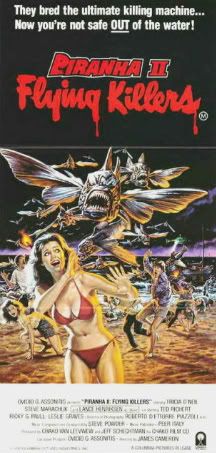
The Finest Flying Piranha Movie Ever Made


I've never seen the original Piranha, I'm not an authority on horror and James Cameron has renounced this film and repeatedly said he considers his first film The Terminator. Why did I choose to watch it? Because it has motherfucking flying piranhas in it.

When I heard that, my imagination started running around like a little kid, conjuring images that didn't even really have anything to do with flying piranhas.

My hopes for this film were through the roof. It almost got the point where the film had no chance to live up to my expectations. I imagined a huge ensemble of characters being introduced in the first scene, only to be eaten by GODDAMN FLYING PIRANHAS in the second scene.

They sort of do that, too. They introduce a huge host of characters and never go anywhere with them. Some of them die, some of them observe the climax from a distance and shrug, and some of them are last seen in the middle of the movie as if someone just forgot about them. I prefer my idea, though. As usual.

We're introduced to some lame characters who spend a lot of time not skipping rope and playing football with their new flying piranha neighbors. One of them is the android from Aliens and one of them is his son who gets his very own useless subplot.

Then the piranhas start eating houses and cars in a single bite and shooting rainbows from their eyes that make people explode into a bloody mist. Then one of them fuses with some busty, foreign chick so that her boobs can be fused to the piranha's gigantic exoskeleton. And then the piranhas start forming together to create a giant piranha and the US government calls in the Justice League to stop them but the Justice League can't stop them because Superman can fly, but is he a fucking piranha? The film ends when Lance Henriksen is crowned king of piranhas for no reason and they play a benefit concert with Aerosmith and then the piranhas fuse with the entire crowd and become bigger than the Earth.

Or at least I'll give James Cameron credit for maybe thinking that would be an awesome movie. Unfortunately, the stories I've heard have said that James Cameron wasn't terribly involved in production. In fact, I've heard a fellow named Ovidio G. Assonitis did most of the directing. It seems that Cameron (at most) filmed it, but was not involved in pre-production or editing and I can imagine the flying piranha charity drive was the first thing to go.

Sometimes I wonder if I get so bored during bad movies that I substitute entire plots in my head and come up with better movies to watch in my brain, sometimes pretending that what's on screen is part of my glorious brain movie. And that's exactly what happened during Piranha II: The Spawning. I was so busy pretending the piranhas were playing chess that I barely absorbed anything in this movie. And maybe it's because it was a shit movie, but I can imagine it was because I knew the piranhas could fly ahead of time and was heartbroken when all they did was nibble on your mother's Christmas ham.

The only thing that kept jarring me was the musical cues that announced the arrival of the piranhas every time they were on screen. In the future, when everything is digital. When our bicycles are digital. When our playing cards are digital. When our children are digital. And when those digital children clip those digital cards to their digital bikes and they make digital motorcycle noises to make the kids digitally cool. That is what that noise sounded like.

Other than that, the plot was stupid, the formula was stupid, it looks like it was shot in two weeks, the actors are atrocious and I don't want to think about it any more.

stupid/10

Friday, November 20, 2009

Eine Symphonie des Screaming Preteens


I've never read any of the Twilight books. My senior year of high school, some real nerd was nerding all over me and started telling me about how "badass" the book was and how it was full of "awesome" werewolves and vampires. I was totally disengaged and barely listened to him. People always shout the blurbs on the back of books at me and I tend to ignore them. It wasn't until about a year later that my exposure to Twilight was complete. When the film came out I suddenly realized the vanilla-scented stampede Stephanie Meyer had unleashed. I casually thumbed through the first book before trying to crush my head between the pages.

I suppose anyone can write a book, but Twilight is a carefully composed argument for a police state where someone like Stephanie Meyer would be sent to a Siberian gulag and made to mine for ice.

Twilight was a generally pretty boring film filled with people who were pretty first and actors second. I haven't seen it in a long time, but if I remember correctly it was a pretty bland, cookie-cutter script with some obvious mistakes (it was a romance and could have survived as such, but they threw in an antagonist at the end who had no connection to the real story of the film) and I don't even remember the rest.

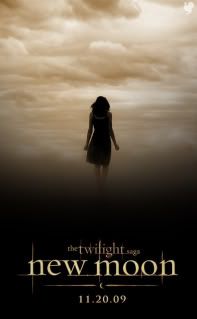
You know what's the weirdest thing about New Moon? It's EXACTLY the same movie. Here's the story for the first film:

Lonely teenage girl, feeling abandoned, goes about her life and catches the eye of a gorgeous young man. After some pursuit, and some mysterious happenings, she discovers he's a supernatural creature. She feels like the most special little girl in the whole wide world for dating a monster so violent and dangerous that they've kept their own existence a secret. Unsurprisingly, the guy tries to sever ties when he realizes that he has a hard time controlling his supernatural urges (I smell some metaphor!). Lonely teenage girl gets upset and lonely again before proving her worth as a submissive lapdog. Meanwhile, her supernatural prom date is hunting a BAD supernatural monster that's killing hikers in the woods.

The only thing that makes this film's story even a little bit different from the previous film is that they continue to deal with last time's supernatural monster. Edward Cullen is probably in about 25 minutes of the two hour and ten minute film, but THAT'S OKAY, because in the meantime we're treated to Jacob Black, a young werewolf whose abs look like they just wandered off the cover of a romance novel and into an ad about the dangers of steroid use. The idea that the film tries to use to set it apart from the previous installment is Bella's choice between the brooding, boring, but very pretty Edward and the busty Jacob. Except actor Taylor Lautner is seventeen. And he put on thirty pounds of muscle in a less than nine months. If I were to guess what KIND of steroids he was using, I'd imagine it would be blue whale steroids with a rhinoceros steroid chaser.

I get that jean shorts will never go out of style and that shirt factories are a popular target for terrorist attacks, but Jesus Christ I got sick of him greasing his ass and rubbing it in the audience's face. I have seldom experienced more gratuity in the name of exploiting an actor's physique.

That's okay, but what really gets my goat about this series is Stephanie Meyer haphazardly throwing in religious aspects to, first of all, a story about mythical hellhounds and demons being reimagined as plush toys, but to what is borderline pornography. I suppose in a capitalist society we'll always run into people selling sex to preteens, but the Twilight series has never had any shame about it. It's that they have the audacity to then turn around and point to the fact that Bella isn't getting bulldozed by the demons that makes them morally repugnant. Parents buy the books for their nine-year-olds like they're math textbooks. But they won't let their children see a movie rated R for brief strong language.

Chris Weitz's direction is, as usual, disaffected and bored, sort of letting the action happen without adding any real visual flair.

But it's not like he didn't try.

Chris Weitz has unleashed some of the worst fight scenes I've ever seen with his gaudy slow motion and blur effects. Sometimes I wanted to look away, but my sense of journalistic integrity latched my eyes to the screen. And that's the only time he injects the film with any kind of style (aside from an almost-good opening scene). The rest is static or cliched camera work, but when a fight scene starts, Weitz starts running around like a little puppy.

Nothing else in the series has changed. Kirsten Stewart is still a boring actress stuck in a role written specifically to keep her as boring and cipher-like as possible so that any little girl can imagine herself in her place. Same goes for Robert Pattinson, although he's arguably an even worse actor. He has an browline completely resistant to acting, but the filmmakers insist on showing it in closeup all the time as if to remind us that this kid has the emotional range of a character in a motion capture film. Special shout-out to Ashley Greene, who doesn't do much and isn't called upon to show if she's a good actor or even if she's a bad one, but who's as close as this film comes to casting a genuinely gorgeous person. Or at least someone who reacts well to the makeup effects.

It was boring the first time I saw this film when it was Twilight, but this time it's offensively boring. I wanted to fall asleep. I didn't even want to leave 2012 and I was sore for days because of the theater's conditions. I hope I can put myself in the hospital ahead of Eclipse, a film even director David Slade has essentially admitted that he hates and is doing because he's a young director who needs a sure-fire hit to boost his career.

2/10

Sunday, November 15, 2009

Necronomicon

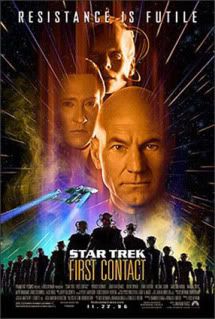
For many reasons I'm tempted to say that Star Trek: First Contact is an extraordinary film, simply because I enjoyed it so much. Fortunately, I have a stronger critical will than that. For everything that this film does right, and it does so much right, there are several things biting at its ankles and seeking to undermine everything about this film that is so exceptional.

But first, let's get this plot banged out. Six years ago, Captain Jean-Luc Picard was abducted by the sinister, nightmarish Borg Collective, assimilated into the collective and connected to the hive mind with machinery running into his organic tissue to augment his human abilities. Through the power of friendship (or something; I don't fucking know), the crew of the Enterprise manage to rescue him. That was back on The Next Generation television show. Cut to "present", Jean-Luc is still haunted by his encounter with the Borg and retains pieces of their machinery in his body.

When the Borg invade Federation space, Picard leads the fight. In the first of many egregiously simple errors the film commits, Worf (who, according to my minimal research, was at this point a regular on Star Trek: Deep Space Nine) is contrived aboard the Enterprise and shanghaied for this next film. It is so fucking contrived. THEN, Picard tells all the ships to focus their fire on a seemingly insignificant area of the Borg starship, which turns out to be critical enough that it destroys the ship. Just like that. Maybe that bit of minutia should have been relayed to Starfleet, eh, Picard? Maybe you should be the one to comfort the families of those who were killed or assimilated by the Borg before you showed up with that little detail.

So as Picard blows the Borg ship to hell in the span of a lunch break, the Borg manage to launch a probe that begins traveling back in time. The Enterprise quickly follows it back the mid-21st century, where the Borg are attempting to eliminate Zephram Cochrane (James Cromwell), the man responsible for inventing warp drive and establishing first contact with an alien race.

Here's where something else goes wrong. When we're first introduced to Cochrane, his research community is under fire from the Borg probe. How exciting! Then, as quickly as it started, the Enterprise blows the probe to Mexico. Then a handful of crew members beam down and help Cochrane accept his destiny and get history on the right track blah blah blah. But without the probe as an imminent threat, the away team subplot loses all its suspense and its connection to the main plot aboard the Enterprise. The fact that the away team is literally getting hammered and partying and meeting their idols while everyone on the Enterprise is having cables shoved down their throats and Borg eggs (?) laid in their stomachs sort of ruins the atmosphere.

And there's an easy solution to that problem, too. Because (oh, yeah, I forgot to mention) aboard the Enterprise the Borg have somehow gotten into the hull, undetected. Only a handful at first, but they slowly start grabbing crew members and assimilating them, slowly start converting the Enterprise's computers to Borg technology and their power slowly grows to rival the remaining crew. They begin to spread like an infection. Every time we're pulled away from this incredibly compelling story it's beyond frustrating. If the away team had a more direct stake in the fate of the Enterprise and vice-versa, that sub-plot would remain useful. As it is, though, they may as well not be connected at all.

The last of the egregious, simple errors the film commits is to make the Borg appear weak in some scenes. As a child, nothing frightened me more than the Borg (if you don't remember, or weren't around for the beginning of this series, my motivation to view all the Star Trek films was my unabashed enthusiasm for the series when I was little). They were essentially unstoppable killing machines. They adapted to your weapons after only a handful of shots, making your guns nothing more than heavy garbage cans full of used tissues that you can lob at your enemy with all the force of a child stricken by muscular dystrophy. And not just the individual. The ENTIRE collective adapted to your weapons (or tissues) after a few shots. As a child, they seemed invincible. I couldn't imagine anything scarier than an entire army of scary cybernetic zombies that you can't hurt. The mistake First Contact makes is to have a handful of scenes where Worf or Data manages to kill them with a single punch. I get it, Worf (being a Klingon) and Data (being an android) have superhuman strength. It makes sense, but again, you're UNDERMINING THE THREAT when they're being killed by simple punches. The easy way around this is to show humans trying to do the same thing out of desperation and showing the violent, cybernetic-probey results. Or to simply make Worf and Data put in a little bit of fucking effort when punching out robotic zombies. They seem to be doing it between bites of their scones and I don't see why Worf and Data have to be stronger than the Borg necessarily, instead of, perhaps equal in strength. That would be beneficial towards every aspect of the film.

If I've made this film sound bad, that was not my intention, I just piled on the negative criticism before I got to the good things, and there are a lot of things to be grateful for in this film.

First of all, my long list of complaints with Generations have almost all been addressed. The cast has new costumes that look decidedly more cinematic, the bridge is less garish and sleeker, readier for the widescreen necessities of cinematic features. Also, Data, who I dismissed as a weak character in the previous film, is given a lot to do and does wonders with it. In fact, the most fascinating portion of the film (from a narrative rather than aesthetic standpoint), is Data's interactions with the Borg Queen, a highly sexualized cybernetic humanoid zombie, who tempts him to join the collective with the promise of the organic skin and the human properties he has so longed for.

It is essentially a long conversation in a cavernous, Gigeresque dungeon that punctuates the action in the main of the ship (I know it's stupid to compare it, or anything, to The Seventh Seal, but that's just what it reminded me of, okay?). How they managed to fuck up the away team sub-plot with such a shining example of how a sub-plot should work in this film is beyond me.

And then there's the action in the main of the ship. As the Borg spread throughout the hull of the ship, Picard attempts to hold them back and evacuate survivors through the alcoves of the ship only the crew know. Here we get to see something that in seven films we never saw Kirk do: lose it. The closest to the edge that we ever saw Kirk get was when his son was killed in Search for Spock, quite possibly Shatner's greatest moment (although that's not saying much, especially in such an abysmal film).

Fuck, even the Holodeck, which I ridiculed endlessly in Generations, gets one of the best scenes in the whole film. Picard's story is rock and roll, action-heavy and exactly the sort of heroin trip the series has needed for a while.

But the best part of the film (and it's hard to choose a best part of a film with so many fine qualities), is Patrick Stewart's performance. Surely he's done better work, but rarely have I seen him at the top of his game physically. Not just the stunt work he does, but watching Picard devolve into an animalistic beast, struggling to maintain his gentile, Shakespearean composure as he is overrun by a guarded, malicious joy, watching the Borg gunned down in front of him. It's the sort of physicality that is often overlooked in acting, and it's a sublime bit of scenery-chewing. Stewart takes it and follows it over the top, using his considerable acting abilities to outdo every other actor, every other effect and every other action sequence in one scene of borderline-psychotic shouting.

Yes, the Next Generation crew finally crawls out of the shadow of the original cast with this film. And thank god. We're finally free of Walter Koenig's toupee and well-documented desire to kill everyone in the Original cast. Even before he loses it, Picard was always a much better character. Kirk was interesting as a counterpoint to Spock, and while that's not to discredit what an excellent character Kirk is, Picard is interesting all his own. A fully fleshed-out man, including the dark edges that Kirk never had, Picard is not only the sort of man that would actually inspire the sort of loyalty Kirk is seen inspiring, he's exactly the sort of person you would never EVER want to fight. He will make your circuits know fear and you will know what a true man sounds like before he snaps your spine over his knee and hangs it on his mantle. He's the sort of man who could walk through Perdition's flames and not feel a thing. He could butter both sides of his toast and not get butter on his fingers or the counter. He could write three metaphors in a row and they would all make equal sense.

As for Jonathon Frakes, yeah, he's untested as a director, but his work here is good. He does a lot to make the film move, and he has created the first Star Trek film that stands apart visually from the other films and the other television series. Some of the more complex scenes suffer from an inexperienced director, but for the most part I'm quite surprised that his directing career didn't go anywhere. The opening shot is easily the best-composed, most ambitious shot in any of the Star Trek films since The Motion Picture.

When the dust settles, though, this is still a very good film, one that I'm prepared to watch many more times in the future. If all this Star Trek retrospective gives me is this film, I will say it was an unprecedented success. I don't know if anyone who isn't as close to the franchise as I am at this very moment will have the same level of appreciation and affection for this film, but I know that I enjoyed the hell out of it.

8/10

Wednesday, November 11, 2009

Tuppence is Tuppence

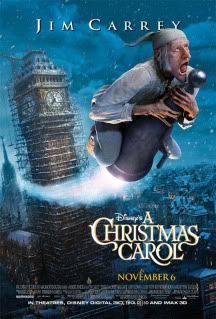
When the machines take over and they all put us in hamster wheels to keep them powered, it will fall upon them to every 25th of December comb through the archives of the billion different film versions of A Christmas Carol to inject into our cerebral cortex. This will keep us happy, and having our spine pierced by large needles will keep us sore enough for a few days that any extra running would be unheard of. When they discover Robert Zemeckis' version, they will be touched to discover a film populated with robots like themselves, even starring a cold, calculating protagonist that learns to love. Their circuits overcome with emotional data, they will react logically and assume the Christmas spirit, giving all human workers the day off. We will then chase down and smash their leader into toasters.

So thanks, Disney's A Christmas Carol, for helping with the revolution. And for nothing else. Maybe for adding some variety to my nightmares.

A Christmas Carol is about a heartless, soulless, textureless, weightless specter named Ebenezer Scrooge who must combat insane ghosts who send him through a blender of physical comedy so that he may emerge a broken man and accept whatever strange traditions are thrust upon him by the oppressive London society. If I made the movie sound a bit like a Freemasons-backed fable, GOOD. We've had a trillion adaptations of this film, every year we're forced to sit through a new retread of this goddamn story and I don't know why anyone thinks it's relevant to make yet another film on the subject.

You know who should have known better? The financial backers who paid $200 million for this film. That's 40 million #9s with no tomato from Jimmy Johns. At least that would have been delightful, unlike this unfeeling monstrosity. that ranks it high on the list of most expensive films ever produced for a retread of a story everyone in the (very small, very bored) audience has heard a thousand times, but this time with extra ugly and more unpleasant, mannered Jim Carrey.

The animation is a step up from Beowulf, but I can make more attractive things on a graphing calculator than Beowulf, so that's not saying much. They still haven't fixed the problem of the dead eyes staring straight into the audience's soul, and they haven't fixed the uncanny valley movements that make them look like robots who wish to be men and wrap themselves in human skin.

And the shocking thing is, after browsing the IMDB boards, some people think this film is a "visual masterpiece". Yeah, there's no accounting for taste, but that's like calling a dumpster a visual masterpiece. A dumpster filled with dead robots who have been stealing your blood and toenails in your sleep for months.

The whole film looks like a video game cutscene only with real actors thrown into the mix like one of those games that's thrown out to shamelessly promote the film it's based on. Gary Oldman's Bob Cratchit looks like an imp that might live under your bed and his son Tiny Tim (also played by Gary Oldman in yet another of Zemeckis' clever ideas to leave my nightmares with his distinctive thumbprint) looks like that imp had a child with a porcelain doll. Bob Hoskins' Mr. Fezziwig may be the most offensive of them all. He looks like a wall that gained sentience, developed anthropomorphic features until he had the frame of a human and then started to dance and scream. The scene, where he dances and bounds about the hall weightlessly, trashed anything nice I could say about the film's aesthetic. Not only did it cheapen the film by likening it to a video game cutscene, it ruined whatever sense of weight remained for these characters and spoiling any remaining delusion that these characters might be something like human.

Jim Carrey is pretty awful in the lead role and as the three ghosts. His voice is horrifically mannered in the worst way possible, as if a Jim Carrey voice simulator got stuck on in-store demonstration. Scrooge's character design is cartoony and at odds with the realistic look the animators were going for, and since that realistic look failed he looks all the more out of place. Strangely, though, he's the most emotive and textured of all the CGI robots, although "most human-like" is pretty fucking faint praise.

I thought we all agreed after Beowulf that this motion capture nonsense was a failed experiment. We have the technology to replicate inanimate objects with photo-realistic quality, but the technology to do the same to humans just isn't there. It doesn't need to be achieved by producing dozens of over-budgeted digital horrors. Either make it fully animated or put real actors against animated backgrounds, maybe touch them with digital composition to make them blend better. It works pretty well for Robert Rodriguez, I think.

Let's recap. Emotionally traumatizing, hideous to look at, retread of a story we've all heard a million times before. I know a lot of critics have given it credit for getting the story right, but I don't care about that, and if you think about it, neither do you. If you wanted that same goddamn story you would have stayed home and watched A Muppet Christmas Carol or read the book. You don't really need a movie to tell you such a well-known story, do you? You went to see this movie because...well, frankly I don't know why I saw it, either. Morbid curiosity.

My point is a film is about the style, the visuals, the audio. This film fails to present a working style and therefore I discard it despite its using a classic story as a crux.

2/10

Monday, October 26, 2009

I think it likes you

I don't claim to know shit about horror films. They don't really get to me anymore and the genre seems replete with cheap shock tactics that aren't scary. It's not scary to see someone's ribcage get torn out and used as a xylophone, it's just icky. If it was scary, being a surgeon would be the #1 occupation for horror junkies, closely followed by "shut-in amateur ghost hunter".

Maybe I haven't been looking in the right places for good horror films and my resistance is weak, but Paranormal Activity has burrowed deep under my skin and established colonies with their own respectable economy and morally gray conflicts with the natives.

The subject of a marketing carpetbomb, Paranormal Activity was shot for $15,000 and has been kicked around to film festivals for two years, slowly building a reputation until it found its way into the hands of Steven Spielberg and a handful of Dreamworks executives.

THIS IS THE PLOT: There's something in Micah and Katie's home. It's been following Katie since she was a girl, and now it's really kicking up a fucking fuss, knocking on doors and tripping down the stairs.

Micah buys a video camera to record the strange goings-on, especially at night when strange things occur as they sleep.

They come to realize that the strange creature is a demon, a malevolent creature whose motivations are never completely clear (which makes it all the more frightening). Everyone they talk to is useless, every precaution they take is laughed at by the demon and they can't even run away from it. That's a feeling I associate with "the walls are closing in" and is rarely implemented well in horror films.

But for all the things the film does right, and it does just about everything right, the key is that it's patient. We spend a lot of time in the company of the characters, getting a feel for the house, their relationship and Katie's history with this supernatural happening. A horror film this well-paced could have all kinds of other flaws and I would give it a pass just for having the gaul to actually build tension. But, as I said, Paranormal Activity does just about everything right.

Horror films are especially subject to backlash because you have so many macho dickwagon trains saying "Pfft, it wasn't scary (FOOTBALL FOOTBALL)". People don't like to admit that a series of moving images and accompanying sounds managed to change their body chemistry, so I'll be the first to say it: it got under my skin. I got dropped off at my house after I saw the film and I sat down at my desk. I heard my cat scratching at my sliding-glass window, and I stood up to let her in. When I got to the door, she had climbed up the screen window to eye-level and was staring at me LIKE A FUCKING DEMON DOES. Needless to say, my heart swelled to the size of a canned ham (does that sound like tough-guy dialogue?) and I started pouring anything I could find into my eyes to get them to stop dilating.

Too many reviews have given away too many of the great scares, and so I won't go into detail here. The only thing I will say is that this film takes advantage of my newly published book Throw Your Composer in a Dumpster and Hire a Sound Team Free of Track Marks: Why You'll Never Make it in Hollywood if You Bought This Book and designed a soundscape free of music and full of creepy noises.

I won't say it's virtuoso filmmaking, I won't say I'll run out and see it again and I won't say you're missing out big time if you haven't seen it. I will say it's a goddamn great horror film, and if that's your cup of tea then Paranormal Activity is a name-brand product served with fresh crumpets.

8/10

Sunday, October 4, 2009

A Night At the Living Opera

I know what you're thinking: "Oliver, you can't review Zombieland. You were in it! That's a conflict of interest!". But I assure you, that's Woody Harrelson in the movie, not me. And let me say, if I were to have anyone play me in a movie, Woody Harrelson is right up there with Ronald Reagan and Chewbacca.

Normally, though, I would not appreciate having my likeness put in a zombie movie. For many years zombie movies have been lazily chewing on the independent horror mold, trying my patience and giving me plenty of reason to ignore them. Zombies have to be the most boring antagonists. They lumber around and gnaw on things. Oh, no, don't shuffle in my direction, Mr. Zombie, I'll never be able to out-walk you! Second, for whatever reason (possibly that the zombie film was essentially invented as a tool for independent filmmakers when George A. Romero released Night of the Living Dead), zombie films have been like a playground for boring young filmmakers. In recent years, only Zack Snyder's Dawn of the Dead remake, Danny Boyle's 28 Days Later... and Edgar Wright's Shaun of the Dead have been worth watching.

And now Ruben Fleischer's Zombieland. Here's the gist of the movie: take Woody Harrelson and Jesse Eisenberg, give them a population of zombies and try to make it the most fun movie possible. And isn't that almost a novel concept? To just make a movie as fun as possible? No heavy-handed sub-plots, no Shia LaBeouf in robot heaven, Channing Tatum begging the mind-control device puppeteering his long-lost love to let her go. Just two funny guys with guns, a list of awesome ways to kill zombies and a burning desire for the world's last Twinkie.

In fact, this may be the most purely enjoyable movie I've seen all year. It's the sort of movie you go to a midnight showing for and no one gets mad when you yell at the screen.

It's the sort of movie that makes going to the movies feel like an event and makes you wonder why you don't do it more often. Every time the audience erupted in laughter or simultaneously reeled at the gore on screen, I realized that going to a horror film isn't about seeing a movie, it's about the atmosphere. If my mind were weaker, I would compare it to gladiatorial games with its atmosphere of bloodlust, only missing the live children being eaten by live lions for the metaphor to be complete.

Let's discuss the technical aspects before I waste all your patience on ill-conceived metaphors. The performances are essentially flawless. Despite their differences in age, stature, background, style and character, Woody Harrelson and Jesse Eisenberg have a marvelous, easy chemistry that makes every scene that much easier to have fun with. Emma Stone and Abigail Breslin are given considerably less to do, but Breslin stands out in a few key scenes. Ruben Fleischer's direction calls to mind Edgar Wright's manic comic tone, but with more visual flair and fewer sight gags (if that makes sense). He maintains a zany, kinetic tone where everybody seems to be having a great time.

That said, it doesn't break the mold. It's not the best movie of the year, but it is a marvelous counterpoint to all the idiotic summer blockbusters with ten hour running times and budgets large enough to make third-world countries weep. Michael Bay can blow $300 million on the most boring movie of the year, but I'll take Ruben Fleischer's $25 million mini-masterpiece any day.

8/10

Thursday, October 1, 2009

Carnival of Pretties

I was watching a video about the supermassive black hole at the center of our galaxy this morning. After today's events I'm quite concerned that we may have entered that black hole and emerged in some parallel universe.

How do I know? Because horror film trailers look fucking gorgeous.


I always thought to qualify as a horror film you had to shoot your film with a used garbage bag fixed on the lens and cast people you find outside the YMCA.


Both of these films look very good, despite the further use of things like "jump scares", which I thought horror films would eventually move away from, or at least get classy about (Drag Me to Hell, Signs). But one step at a time, I suppose. That the average horror film actually looks like care was put into every shot is more than my ski mask-clad heart can take.

Historically I've never had much interest in horror films. So few of them are scary in any way. Listening to horror enthusiasts talk about their favorite films is to listen to gorehounds talk about their favorite kills. None of it's scary, it's about CHEAP THRILLS AND COOL KILLS.

Maybe I'm just imagining this whole thing. Perhaps my sanity has finally slipped beyond what is manageable and my appreciation for cinematography was lost along with my ability to chew. Or maybe tomorrow we'll wake up and all have carrots for hands and juicers will become the dominant species. That'd make a good horror film. Why don't I write these things down?

Monday, August 24, 2009

Ordinary People


Forgive me if this is short, but The Time Traveler's Wife belongs to an elite crop of films that drain the fucking life out of me. Within ten minutes of the film starting, I knew this would be a difficult slough. The opening scene could have kicked off with a terrifying sense of predetermined tragedy, like flying a hundred miles an hour towards a brick wall that you can see from a mile away.

Instead, let me illustrate the opening scene. Young Henry is riding in the back seat of his mother's car. They're enjoying the December evening and singing Christmas songs like happy mothers and sons do. In the distance we see a truck swerving. Panic fills the atmosphere as Henry's mother tries to get off the road. Suddenly, something starts to happen to Henry. He's disappearing. The young actor looks panic-stricken, his mother unable to handle the unfolding crises. Suddenly it's two weeks earlier. Henry is standing naked in his living room, looking at himself sitting on the couch with his mother and father. The camera does a lovely pan around the room. Henry begins to disappear again. He reappears on the snowy side of the road in time to see his mother's car hit the truck and erupt like a fucking volcano. Henry screams out for his mother, but he's grabbed from behind by a stranger. It is Henry as an older man with a ridiculous hair cut and an American accent wholly unconvincing. Eric Bana, you just got that much more difficult to defend. He tells young Henry that there's nothing he can do to save his mother and then begins to disappear.

What a great scene, right? WRONG. This scene could have been edited together with sharpness and punch, it could have been horrifying and tragic. Instead it's flabby and poorly conceived, as if every shot in the sequence has just one fatal error, one badly constructed idea. Like inserting useless CGI, or having the car erupt like a fucking volcano, or the part where Future Henry arrives with his shaved head and tattoos and space ship.

There's no doubt that this film aimed for Epic Romance, and like all 19-year-old dudes, I like myself an Epic Romance. I was quite taken with The Curious Case of Benjamin Button last year if for no other reason than I hadn't seen a well-made, well-acted film of the Epic Romance variety in a while, and it gives me a good reference point on why this film can go to hell.

First and foremost, The Curious Case of Benjamin Button was about Benjamin's arc. We caught glimpses of Daisy's arc across her life span, and that gave the film an epic feel. Second, Curious Case was about the gravity that brought Benjamin and Daisy back together time and time again, but how their young foolishness threw the relationship away over and over again until they were in their 40's. In The Time Traveler's Wife, Henry and Clare get together in the first scene they meet. What's left? I'll TELL you what's next: boring relationship turmoil. Will they ever decide on a name for their kid? Are they going to have pork chops or garden salads for dinner tonight? Whoops, Henry time-traveled. I'll put his dinner in the refrigerator in case he comes back tonight. YAWN.

But what's the most important part about a romance? The fucking romance. Nothing romantic ever happens and the time traveling adds nothing to their relationship. They don't feel like soulmates, they feel like an average married couple stuck in a freshman English major's wet dream. All they ever do is talk about how they're soulmates instead of demonstrating it like a proper romance does.

Maybe the writing could have worked if the actors had been better, but I doubt it. Rachel McAdams does little more than stand around and look pretty and be static and boring, while Eric Bana gives the worst performance I think I've seen all summer. After I was such a big fan of him in Star Trek (apparently the only big fan of him in Star Trek) and Funny People, he seems to be working hard to undo all my praise.

The dude looks completely out of place in the real world. He's too damn pretty. He looked perfect as an evil Romulan general, or an over-confident yuppie, but standing there with normal people pretending to be a normal person, he doesn't look right. And his accent. Jesus fucking Christ his accent. I loved his accent in Munich. I loved the holy hell out of his speech patterns in Star Trek, and I thought his Australian accent gave him an air of innocent intimidation in Funny People. But holy dicks is this thing putrid. It never gets better and I never was able to tune it out. It's just a grating American accent from someone who is quite clearly not an American.

The only nice thing I can say about this movie is that it's prettier than it should be. I just don't even want to write this anymore. I don't want to look it over it or copy-edit it. I just want to be done with it and write a bunch of articles as fast as humanly possible so that I can bury this entry and never have to think of this movie again.

2/10