Showing posts with label pretty sets and costumes. Show all posts

Monday, February 22, 2010

One Man as an Island

It's only February and I'm already done with movies for 2010. I'm declaring Shutter Island the best movie of the year and buggering off to an opium pipe until next year.

As some of you may know, Taxi Driver is one of my very favorite films. I'll always hold it aloft as the best example of a film using a heavy amount of style to convey a character. I love style, I love characters, so that's kind of up my alley. Shutter Island is Scorsese's update of that method, this time putting his protagonist through a meat grinder of events and depositing his ground up brain in a metal bowl for everyone to poke.

I can already tell you that Shutter Island is not likely the film you imagine it is, and if that last paragraph didn't give it away, I'm giving it away now. I'm not inclined to blame this on the marketing campaign, because the film engages in the same sorts of trickery that the advertisements do, but declare the marketing a natural extension of the film and a unique tool in preparing the audience for the emotional gauntlet they will be dragged face-first through. I say this not as criticism or warning, but as an observation that, for once, the marketing campaign enhances the impact of a film instead of drowns it out and I wonder if the film will maintain certain elements of its impact when removed from its advertisements, for Shutter Island is all about raw emotion. In the same way that a mad man is driven by nothing but raw, teeming emotion, Shutter Island beats the audience into a bloody, crippled coma with emotion like nothing I've ever seen before. It's not the Gothic horror you think it is, and it's not the exciting detective story that you might think it is if you're five. It does, however, still contain the twist that you think it does and that Scorsese can't possibly be less interested in.

There's a dance I could do to keep from revealing the twist, but it's pointless since you've already guessed it. If you don't want to know, don't read any further, but if you have seen the film, you know that our hero, Teddy Daniels, is a patient in the Ashecliffe mental hospital located on Shutter Island. I have now seen this film twice. The first time I saw a hallucinatory, experimental dramatic thriller thing with all the contrivances and self-importance that goes with that genre that I just made up. The second time I saw it, I saw a very sad portrait of a clearly insane person who, despite all the ridicule and disinterest the people around him can bathe in, he remains unaware of his own delusions. I would be just as happy to have Teddy declared insane in the first scene and leave the rest of the film exactly the same, but this way we're offered two completely different readings of one film. Personally I think people who shout about having guessed the twist before setting foot in the theater are giant douchebags; anyone who doesn't give the film a chance to tell the story on its own terms is probably a fifteen-year-old girl and is texting the entire fucking film anyway. If I were to tell you the plot synopsis of The Sixth Sense ("there's this little boy who can see ghosts and talk to them and he hangs out with his psychiatrist all the time!") you'd guess the fucking twist. If I were to tell you about The Usual Suspects ("this dude is telling this cop who caught him at a destroyed ship full of dead bodies about how the crime was perpetrated by an enigmatic crime lord that no one has ever seen!") you'd guess the fucking twist. The Usual Suspects in particular works because of the way Bryan Singer and Christopher McQuarrie misdirect the audience, especially towards the end. Similarly, there's a lot of excellent misdirection in Shutter Island (although it's hard to hide a twist as momentous as "the main character is insane and a lot of this may be occurring in his head" sometimes) that threw me off the scent, although I did sigh a sigh of disappointment when my initial suspicions were confirmed. I think, though, that Scorsese doesn't really give a fuck about the twist and is only using it to give the film some mass appeal (we've been going through a lot of plot synopseez here and "dude goes crazy for two and a half hours" won't look very good on promotional Burger King cups) and that the twist was really only a detail of the film he hoped to make. I think my suspicions are confirmed by how untrusting he is of the "big reveal" scene to be interesting on its own, so he couples it with what is absolutely the best scene in the film: a flashback to the day his character well and truly snapped. If there is a twist in this film that isn't totally routine, and I say that there is, it's that scene, so I will say no more of it.

All I've done so far is make excuses for the film, so let me tell you what it's really about, and that's the emotional gauntlet I referred to a while back. Every scene seems to be saturated in a different emotion, sometimes going so far as to have an abrupt, distracting change in color palettes (that's not the only jaw-droppingly bad cut from an editor who should know better, but has never really been concerned with continuity; The Departed is full of continuity errors, too) and the supporting cast, almost all of whom are given just one scene, seem to be in on this and play their parts with but a single emotion: Jackie Earl Haley's part is played with nothing but fear in the portion of the film that's the most straight-up horror of any, Ted Levine plays with hostility in a conversation that starts with casual discussion of the beauty of flowers, Max von Sydow with the lust of authority, Emily Mortimer with fragility and despair, and so on and so forth. It's easy for these performances to blend because the gimmick isn't overbearing. They all have one scene, remember? One more thing, because I must make absolutely sure that no one misunderstands my point here: I'm not saying that each character represents a different emotion in Teddy's head, I'm saying that each character is given a certain emotion as a motivation to deepen that gauntlet I keep talking about and their job is to illicit that response, or personify that response if you're a snowman, for the audience.

The three characters that get real screen time are Leonardo DiCaprio, Mark Ruffalo and Ben Kingsley who hasn't been noteworthy since House of Sand and Fog, or Sexy Beast if you're a cynical fuck (he was the least-interesting part of Transsiberian) and continues this proud tradition here. Mark Ruffalo actually keeps you guessing about his character's loyalties, always coming off stupider than he is, until the end, and the first audience I saw the film with seemed to really like him. I'm apparently going to have to become a champion of DiCaprio's performance in this film, though. DiCaprio is always at his best playing strung-out characters in over their heads and rarely the charismatic hero that he seems to see himself as, and that fits the mold of Teddy Daniels perfectly. At the beginning he fancies himself the charismatic hero, but as events unfold and his delusions take hold of him he becomes that mad wreck that DiCaprio is best with (see: The Departed, the last third of The Aviator). By the end of the film he can barely contain the emotions sprinting through his head and he drags us with him.

So I feel like I've done nothing but make excuses for the film, but it's not at all the case that this film needs excuses made for it. It seems to be the consensus that it's one of Scorsese's weaker films. Don't get me wrong, Gangs of New York is a shitty script with a shit performance from DiCaprio glued to Daniel Day-Lewis' camera-destroyingly awesome performance and some of the best period sets and costumes ever and it was basically his return to form. The Aviator is just pretty Oscarbait, but especially watchable Oscarbait, and while The Departed is probably the crime drama of our generation (if we don't count The Dark Knight), it's certainly not becoming of someone who gave the last generation its crime drama with Goodfellas to do it again. It's just some thrilling editing, witty dialogue and excellent lead performance that makes that film what it is, not really something that requires one of the greatest filmmakers of all time to produce. I don't hesitate for a moment to say Shutter Island is his best film since Goodfellas. It's visually striking and narratively charged with storytelling more experimental than anything Scorsese's tried to do since Taxi Driver. It gets into the head of a dynamic, interesting protagonist with the deft use of techniques unique to the language of film, and it punched me through the head with its raw, teeming emotion. It's a lofty, abstract goal that can only be achieved if Scorsese approaches this film with that sort of madness and recklessness he had i the 70s and 80s. Thelma Schoonmaker's editing (when it's keeping its shit together) is maddeningly dense, and in Emily Mortimer's scene is used to the most perfect effect that editing can be used for: first to disorient, then to isolate. Scorsese himself uses rear projection and those pounding , overbearing orchestral scores that were used in the police dramas and haunted house films that he initially seems to be emulating before it all breaks apart and his real intentions are revealed with hallucination scenes of eye-shattering beauty. I could watch those scenes again and again and get spooked every time.

I suppose in the end it comes down to the effect the film has on me. I've seen it twice and the second viewing, although filtered through a completely different reading, had a similarly visceral effect on me. If Scorsese goes back to safe, Academy-friendly and box office-friendly pictures after this that can be described with the phrase "consummate professionalism" again, I'll be okay. We'll always have Shutter Island.

10/10

Saturday, February 20, 2010

Night Time Through the Ages

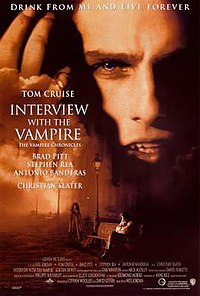
So I think more vampire movie reviews are necessary. I haven't decided exactly what films will be included. I will say that the vampire film I most want to see is Werner Herzog's Nosferatu: Phantom Der Nacht, which is unavailable on DVD, though I plan to try and hunt down a VHS copy. For now I'll chart my early history with the vampiric form, which, as far as I can remember, began with Neil Jordan's Interview With the Vampire.

It concerns a couple of vampires prancing about in frilly collars through Victorian Europe and civil war-era America, gently sucking blood from the exquisite necks of voluptuous 19th century bitches with not a second glance towards their brilliant tits as they dump them in the...well, that's never really explained, but we can assume they were doing something with the bodies, like maybe decorating, after all Neil Jordan never seems to have enough fucking set dressing. Not even Jack the Ripper had enough hooker skin laying around to tailor himself a hooker skin waistcoat and top hat, but these vampires would have enough to make a hooker skin circus tent with hooker skin elephants and clowns and probably a hooker skin audience once the police stopped them selling hooker skin tickets to hookers. Interview With the Vampire seems to be an indictment of old timey law enforcement before it's a vampire movie or a horror movie or a period piece or gay porn.

Not only are these vampires gay, they're fucking sad. They spend the entire movie shuffling around their little Gothic fairytale land complaining about being immortal and their ability to fly. They're like the rich kid in elementary school complaining that their butler forgot to marinate their steak in caviar while you spread the cafeteria's free butter over your leftover breakfast rocks. There's very little action beyond our vampires talking about being vampires and how much it sucks to be vampires; most of the film is just discussing this film's vampire mythology in the context of how much it sucks to be a part of it or establishing the characters.

I'm oversimplifying, so here's a real plot synopsis: Brad Pitt is Louis, the suicidal plantation owner who inexplicably accepts a vampire's offer to become his (totally platonic) companion for all eternity. Really he's the only whiny one, but it's hard to divide him from the rest of the characters when his constant complaining seems to enter the pores of the other characters, turning even the coolest, most relaxed vampire into a tidal wave of frustrated tears. While Louis mopes around about how much it sucks to be suicidal, immortal and at the mercy of human blood to continue his sad little life, Tom Cruise gets to dance around and make fun of him as Lestat, the pretty-fucking-evil nobleman who seems to have been vamping a few decades longer than Louis. He's the elated, fun-loving (and to whom fun means "wanton murder") mentor to Louis' sullen teenager of a student. Louis makes everything worse for the two because of his constant moping, and when his maternal instinct kicks in, Lestat produces a little vampire lady out of a child dying of plague, to whom Louis endlessly mopes. What begins as a playful father-daughter relationship becomes something more sinister as Claudia (Kirsten Dunst) becomes Lestat's equal in bloodthirst and evil. The best scenes (of course because of my predisposition towards thrillers) is the tension between Claudia and Lestat, and the film benefits from shoving the despondent Louis into the background, at least until the end. That's not to say Louis isn't a good character or that Brad Pitt's performance isn't good, but I simply derived more pleasure from watching Tom Cruise and Kirsten Dunst interact.

It took Brad Pitt a long time to become a worthwhile actor. Studios and filmmakers were always putting him in bland popcorn or Oscarbait films without anything to really do. It wasn't until Fight Club that he got a truly extraordinary character to play and began to give great performances consistently (he was fantastic in 12 Monkeys, but he regressed for a few years after that). His casting in things like Seven Years in Tibet, A River Runs Through It or Legends of the Fall were decisions made for the benefit of the film, they were chosen to give the film a bland commodity to trade in that would bring in all sorts of young folks. None of those roles he played were exceptionally written, and were almost unanimously boring ciphers or audience surrogates. Tom Cruise had a similar, if not nearly as pronounced, issue in his early career leading up to, say Born on the Fourth of July. Today it's quite apparent that Cruise is at his best playing villains. My favorite of his performances are Magnolia and Collateral, but our first evidence of this trend came in Interview With the Vampire where he was cast completely against type to loud outcries of miscasting. Casting against type and miscasting are completely different things, though, and Cruise seems nothing short of elated to shed his heroic leading man image and sink his teeth (VAMPIRE HUMOR) into the role of an irredeemable villain, a hellhound of such staggering badness (where the fuck is my thesaurus?) that he declares himself, in a moment of clarity, too evil for Hell.

If Tom Cruise wasn't so fucking pretty and wasn't such an egomaniac, he would probably be a great character actor specializing in villains and dickheads. There's no action franchise more boring than the Mission: Impossible films and we can thank Tom Cruise's villainous megalomania and subsequently disinterested performance for that, but when his real-life evil is funneled into a role not too far removed from his public persona, something notable begins to happen. This was the first time Tom Cruise really got to let loose, and it's always a little shocking to see how honest the evil in his performance is. Specifically I think of a scene in the film that I have a lot of affection for: a scene where Lestat, trying to strangle whatever humanity remains in Louis, invites two prostitutes into their home, kills one and drains the other to near-death. He then implores Louis to end her suffering and accept that to survive he must murder. He begins to torture the prostitute to further goad Louis into murder by forcing her into a coffin. As her forces her in and then lifts her out, he employs a joking, facetious tone that seems to effect the situation in no way aside from to satisfy his natural desire to play with his food. These lines are delivered with a devious evil faked in no way, like making eye contact with the Antichrist. There are a few scenes like this, and they all give me the fucking shivers, but none are so effective as this. It pierces the veneer of acting and puts us in the presence of a real-life maniac. Or maybe not. Maybe Tom Cruise is just the greatest actor ever.

In other news, Kirsten Dunst (something like eleven during filming) plays my favorite "innocent little girl that is actually a bloodthirsty monster". It's a role that requires a great deal of maturity on her part because it is essentially: little girl who has become an adult while keeping the body of a child and the spoiled obnoxiousness of a child but the maturity and evil of a seasoned murderer pretending to be a child. She possesses a charisma that not only is possessed by so few child actors, but that she never seemed to possess again. The role is made that much more difficult by her character being the most intelligent and cunning of the three and it requires a gravitas so rarely contained within a child to make that convincing.

While I'm talking about performances, I'd like to give a special mention to Stephen Rea playing (as Brad Pitt hammers into the audience's head, essentially destroying the effect of the scene) "a vampire pretending to be a human pretending to be a vampire". It's a small role, but an effective one especially considering that Rea is a truly great actor who doesn't get nearly enough good work. He plays a vampire who has waded in decadence so long that he's become a cackling hyena; his overindulgent lifestyle has left him no reason to ever act like he isn't a) on stage b) loudly laughing and joking with other vampire actors or c) murdering. It's such a stark contrast to Louis' stoic pouting that it deserves individual praise.

Now that I've exhausted your attention span with far too detailed accounts of the performances , I'd like to direct your attention to the purely functional story and Louis' slow arc. It's obvious that Jordan is an independent director because he effortlessly draws great work from his cast and spends the rest of his time building elaborate, unnecessary sets. I've heard people complain about the film being overproduced, but I'd argue the point. Surely the long shots of New Orleans ports or the cobblestoned streets of Paris aren't necessary, but they're pretty in a way that isn't especially distracting, especially since almost every scene takes place at night and it gives all the proceedings a gloomy, Gothic aura. All the sets are rendered rather beautifully and effectively, but they are only ever the centerpiece of individual shots, or rather parts of individual shots. Unless we're challenging the long-standing tradition of establishing shots, or the right of establishing shots to be pretty instead of stock footage of the Tanner family's home, I don't think there's anything to complain about here, although I've never seen a movie I would call "over produced", I'm sure it's a legitamite complaint for some films, just not this one.

The only thing about Interview With the Vampire that I think flat-out doesn't work is the whole Interview thing. It's an awkward framing device, like the team of divers in Titanic, that doesn't add much to the film. If it's an excuse for Louis to narrate the film, it's a weak one and there's no reason why you can't just have narration because you think that's how the story should be told. No one's going to bitch about that, not unless you impliment it poorly. It's not something that effects the film beyond repair, but it's worth mentioning because it's a perfectly effective film and none of the truly glaring flaws are that detrimental.

If there's any flaw that really effects the film as a whole, it's Brad Pitt. His performance is so listless and disengaged that we lose our emotional center and the whole piece lacks impact or emotional heft, and that trick he learned for Benjamin Button - acting only with his eyes - doesn't seem to have developed yet.

Despite its scrubbed emotional palette, there's a lot to be said for Interview With the Vampire. I was a little bit in love with it when I was younger and I think it might have had something to do with its sterility. The vampire thing is pretty incidental, it's basically a period piece about some folks who happen to be vampires and sort of eskews the notion that if it's a vampire film it has to be a horror film, and I find the straightforwardness of the approach rather refreshing. It's Gothic and atmospheric, but it doesn't go for scares. It has an endlessly fascinating lead role next to an exquisite supporting role against the backdrop of some really lovely design, and I think that's a lot to go on. Even if it lacks impact, it's memorable for a lot of other reasons, and it's certainly not a mess.

7/10

Tuesday, February 16, 2010

Wolf Father

I'm not against remaking classic monster movies. If there's any remake I get really excited for, it's the remake of classic monster movies. It seems like it should be really easy, mostly because the rules are pretty vague, whereas most remakes force the creative team into a tight framework, lest ye get too original. A monster movie requires only a skeletal formula, leaving a creative team free to explore all corners of the myth. It's staggering what an immense failure The Wolfman is in every respect, specifically in its attempts to work against the script and performances, thinly attempting to connect the two disparate styles with gum and paperclips and the hopes and prayers of orphans made manifest. If the film had committed to a tone, either one of these tones could have feasibly worked, but with half the film pulling in one direction and the other half pulling in the other, it manages to tear itself to shit, fucking up even the most fundamental aspects of story.

First, our protagonist should be someone we like and relate to. I don't take exception to this film's Lawrence Talbot, an actor long estranged from his family who spent some time in a mental hospital during his youth after witnessing the suicide of his mother, but as written and as played by Benicio Del Toro, he's totally static, unengaging and unrelatable.

It's sort of a miracle that Mumbles Del Toro is an actor today, one of the great justices of Hollywood that he can get cast in something like The Wolfman and has an Academy Award. I'm a huge fan of his, specifically his ability to communicate vast emotion through his junkie eyes and drunken slurs, always creating tragic characters with a unique charisma. I love the idea of him in mainstream releases, contrasting so strongly against the typical Hollywood star by never even coming within noseshot (haha dogs) of being boring. To be fair, he's in a badly written, badly directed film that was retooled and fucked with far too much in post-production, a practice that will never be kind to actors. Still, it's a testament to a film's ineptitude that they can make Benicio Del Toro, one of the most inherently watchable actors of his generation, completely bland. Similarly, Emily Blunt, one of the best actors of her generation, is totally wasted in a role that calls for her to overact in that subdued, costume drama way that we're used to from every actress that isn't Emily Blunt. It's a relic from when the film was what it should have been: a moody Gothic horror film. Oh, you still thought it was a moody Gothic horror film? So did I, until about twenty minutes into the film and so did the actors until, presumably, the premiere.

If you hear someone praise this film by tossing around phrases like "this is a Wolfman for our generation", toss that person's face like a fucking salad. Our generation sucks sometimes, and we can all agree (WE CAN ALL AGREE) that our generation's horror films suck more than anything else, including our war. The sad fact is that as you stood over that man's bloodied remains, you'd realize he was right: The Wolfman is a Wolfman for our generation and while an excellent cast and lavish production design are eviscerated, shredded, minced and fucked before your eyes, I defy you not to cry tears of blood thinking about how our kids are going to think we were gigantic fuck-ups. It doesn't even have any pretense towards real horror. Apparently after so many rewrites, reshoots and re-edits, a director loses his mind and decides to make the muppet kung-fu film we've always wanted, but with werewolves.

"Muppet kung-fu" is a pretty appropriate way to describe the tone of this film, but it neglects the gore-porn angle. For some reason, I thought this film was PG-13 going in, a thought I began to question after the tenth anal evisceration. I realize now that I was under this impression because there's no reason for The Wolfman to be anything large or bombastic or, in my mind, any way at all for it to be large or bombastic. It's high-concept horror with no intentions toward being horror. Still, I haven't even begun to describe how fucking mad this film is. Ironically over-violent horror films are a trick learned by direct-to-DVD Blockbuster exclusives years ago and one would think that a major Hollywood filmmaker like Joe Johnston would know how weak it is, but that's the only trick the film has. He doesn't even stage his action with any flair, it's all just campy decapitations between sandwiched between Very Serious dialogue.

At least Anthony Hopkins and Hugo Weaving aren't wasted, Hopkins because he gets the one scenery-chewing role in the film that comes close(ish) to the film's tone, and Weaving because he has never given a bad performance and could only be miscast as a preschooler. But those are just two parts of the film that don't explode in fiery failure

I love truly mad or unusual films, especially ones that were produced for a large audience in the Hollywood system, but that's not what The Wolfman is. It's pseudo-weird, playing tricks hacks have been playing for years to get a reaction stoned high schoolers have been giving to cheaper films for years. It's a movie for stupid people. The sort of thing people go to to talk loudly over and forget about a few minutes after they leave the theater. It's something that preteens go to until they discover alcohol and sex, but since it's rated R they won't be able to get in and will have to discover alcohol and sex. In fact, all the babies born of preteens in the next two years will be called "Wolfman babies", which will confuse religious crowds in the coolest way possible. As in shooting babies with silver bullets. Yeah. That'd make a good film.

2/10