Showing posts with label ridiculously gorgeous films. Show all posts

Sunday, April 4, 2010

Love on the Battlefield

I'll thank every God ever worshiped for giving me a weekend where I can first visit all the pitfalls of blockbuster filmmaking and become filled with the bitterness and distrust that most critics feel towards these films on one day, and on the next I can see a film that reminds me of everything I love about big films and why my eternally losing battle to champion these films is worth the gunshot wounds and flashbacks.

As I made staggeringly, irritatingly clear in my piece on The Princess and the Frog, I've got a thing for animation. It offers its filmmakers complete and total control over every visual element of the production and a talented filmmaker will use that level of control to create a landscape to compliment and deepen the audience's understanding and emotional involvement with the story and characters. A live-action film can do this, but the best few are rarely even close to as successful as the most mediocre animated films. And while it's more upsetting to see a creative team fail and squander that opportunity, it's not a commentary on the quality of How to Train Your Dragon, but rather a general handjob I give out to animated films just for being animated.

In the past I've avoided Dreamworks productions because they fucking suck (any of the Aardman Animation productions being the obvious exception). I liked Shrek when I was ten because I was ten, but beyond that I have no affection for their films, which have always been the commerce-obsessed cousin of Pixar, the one who always hangs out with Pixar at family reunions, but who Pixar really can't stand. They use cheap, gaudy gimmicks like casting celebrities just to put names on the marquees. Who casts Ewan McGregor for his voice? Or for any other reason?

That is one of the very few things I can hold against How to Train Your Dragon, a splendid motherfucking film for the whole family. It weaves the story of Hiccup, a skinny, anachronistic teenage outcast in a viking village plagued by dragon attacks. In this world, a viking's life is dedicated to dragon fighting, something Hiccup's frail little girl-arms were not slopped into existence for. He's instead become an apprentice blacksmith, something he is casually outclassed at by the one-armed, one-legged Gobber. Hiccup's routinely disappointed father Stoick leads the vikings and, thanks in no small part to Gerard Butler's naturally hostile voice, always sounds like he's ready to drop Hiccup and his chicken-legs into a vat of lava for viking soup. Hiccup employs his lamentable engineering prowess to wound the most dangerous of all dragons and to prove his success to his skeptical fellow vikings, goes out to put his prey in a sack and skin it into a fashionable belt. Being the girly boy-lover he is, Hiccup's first instinct is to befriends and exchange a few knitting patterns with his prey, a dragon named Toothless whose ability to fly Hiccup has destroyed. As the shroud of mystery lifts around Toothless, Hiccup begins to understand the woefully misunderstood dragons, never once exploiting their trust for a surprise strangling.

I won't defend the film on the basis of a plot outline because it's a genre film, where the true value is found in the details and in this case it's the relationship between Hiccup and Toothless, which builds from the ground up and takes the entire length of the film to develop in its entirety. It's a rare thing to see a film aimed at children with so much patience for its characters. Not even Ratatouille, which had a similar relationship between its two protagonists, built its story on the spine of a bond growing and strengthening. The animated "performances" for the characters are first-rate and the film would lose half its impact without them. While Hiccup is strongly written, interesting and well animated, his arc is mostly the rack upon which we hang the plot and is a lot more straightforward than Toothless's. Toothless is a totally mute character whose every ounce of character depends on animation, not droning exposition, and the animators sustain a level of mute emotiveness found in only the best animated films animated by the very best animators. He'll almost certainly be the finest animated character to be found in a 2010 film.

As for those genre sensibilities that drive the narrative, the story makes several advanced leaps that I didn't expect from the moment the conflict or thread was introduced. In fact, a brief aside: right off the bat I was enthralled with this movie for--what else?--its action. The opening action scene is likely to be on my list of favorite action scenes of the year, featuring some voice-over narration explaining the world and conflict while keeping the visuals swift, kinetic and exciting. I grew a bit worried, however, when they started to introduce threads and conflicts that will obviously fit in to the narrative in the most played-out, cinematic way possible. For instance, the obligatory love interest, Astrid, whose charmingly anachronistic ensemble could introduced to the fashion world as "viking-chic" and is marketable because it includes Ugg Boots, is introduced in front of an explosion in a slow motion moneyshot establishing her as the chick in the movie. Again, I expected a typical "Oh she hates me, oh we have some stuff in common, oh let's resolve the conflict together and close the movie with our first kiss hooray the nerd got the hot chick" arc, but it was far less typical than that. Much like Hiccup's relationship with Toothless, it builds from the ground up and the narrative never betrays its characters. While it ends the way you expect, their relationship remains combative and truly hostile. When I say "hostile", I don't mean "playfully hostile" like we've come to expect of movies, I mean genuinely hostile. She insults him and belittles him publicly and really despises him, and their relationship is the devolution of that relationship and the ascension of a relationship built on a foundation of respect, and from there a small pubescent spark forms. It's shockingly genuine, it's just that it's played out in a stylized world.

I love the way conflict is introduced and resolved in this film, and I love that the narrative and works for the characters, is driven exclusively by the characters and evolves out of the characters desires and actions. My only major complaint with the film is a little late-second act conflict dump. It leads to a pretty standard "clear-cut good guys vs. clear-cut bad guys" climax, and while it's visually stupifying and rousing and exciting and climactic and all the things I hoped it would be, it's also disappointing in its standardness. The whole film has been characterized by understanding for all its different characters and a disregard for typical conflict setup that the climax rings a bit hollow and hypocritical. We're supposed to root for the destruction of the antagonist when this whole film has been building our respect and attachment to the dragons. It's a little revision to the thematic palette that I did not appreciate, but god DAMN it was pretty.

Oh yeah, the whole film is ridiculously pretty. As pretty as, or even prettier than any of Pixar's efforts, thanks to The Roger Deakins, who consulted on this film as he did for Wall-E. The film's colors and cinematography is the other 50% that gives it the emotional heft that Dreamworks' films have been missing for so long. Let's hope this gets remembered Oscar time. If Avatar can get a Best Cinematography Oscar, I don't see why How to Train Your Dragon can't.

One last thing: I love the title. It's charmingly simplistic in the face of the film's thematic complexity. Hiccup surpasses the notion that he's "training" toothless after maybe their second time together and their relationship being a genuine friendship has become sort of forgone. When the title card appears just before the closing credits, it's almost more of a question: How to Train Your Dragon? With compassion and respect, that's fucking how.

9/10

Thursday, March 11, 2010

Madness: It's A Rule Now

The Crazies is probably the best movie that can be made out of the modern horror formula, you know, the one I keep talking about that's as stale as a brick that went through the wash but sat in the drier for days. Oh, you don't know the formula, liar? It's about a capable, resourceful man who has to take charge of a band of survivors when his hometown is overrun by a grotesque threat (it's almost always zombies). A second threat, almost always human, is introduced to up the stakes and answer the cynical modern horror audience's calls to see humanity played as a bunch of bloodthirsty opportunists. The hero and his love interest are the only ones to survive at the end, but the cynical end credits usually blow them up or sick a Rancor on them or something. The audience masturbates through the rest of the end credits.

Any regular readers (are you there?) know that I like genre films (stop reading at any time), and The Crazies is exactly that: a genre film polished to a mirror shine, then rubbed with diamond cream and vampire sparkles. I know I've spent the last month bitching about how boring modern horror is, and The Crazies represents everything that's boring and antiquated about the genre, but it does it with excitement, good characters and a reasonably involved story. Oh yeah, and some very pretty visuals. Really, way too pretty for this film. So pretty, in fact, that it makes me think this is just a genre effort from an extremely talented filmmaker who hopes to use a simple genre film to break out onto the mainstream. He goes through all the motions, but everything about this film is absolutely better than it has to be. The standard-issue jump scares are still there, but they're mostly there to make the film palatable to 14-year-olds giving each other awkward, raw handjobs in the back of the theater while the projectionist records it to splice into the second reel of Alice in Wonderland and make that film more nightmarish.

So yeah, the story fits straight into that mold like some sort of script girder. A sheriff, his wife, her secretary and the deputy are one of only a handful unaffected by a disease that makes the infected illogical, violent and veiny. The military shows up and starts killing everyone and our heroes try to escape.

I think the reason this film works so well is that, while it advertises itself as a horror film, has some jump scares and zombie-like things that vaguely define it as a horror film and otherwise fits into the mold of a horror film, it's really a thriller. It's a pretty straightforward thriller with people sewing each others' eyes shut instead of people frantically deleting files from a computer, and it's sort of cheating, although it's effective cheating. Like most thrillers, there's more emphasis on character and plot, but with the streamlined story of a horror film. Good for it, but now you're a dime-a-dozen thriller instead of a dime-a-dozen horror film...which actually leads to some interesting overlap in the horror-thriller venn diagram.

Let's start with the sheriff. He's a pretty standard protagonist for these sorts of films. First of all, he's a sheriff, which means he has a gun and can kill the bad guys by making their brains fall out. Second, he's a hard-driven man of principles and action, and presumably the only person in town with a Bowflex. Again, that's a pretty standard character description for the hero of a zombie movie, so let's discuss something that's pretty miraculous about the character, despite being something that we should expect of every movie. He's pretty realistic. Obviously he gets into some wacky situations, but the way he deals with them is at once realistic and totally understandable. Rarely does he get into a situation where he's engaging more than one crazy, and he's pretty excited to just run away screaming whenever he can. The one time he gets action hero 'roid rage is when he's watching his wife be tortured, and I'm pretty cool with him pulling a knife through his hand in that situation. He only seems relatively experienced with a gun, like a small-town sheriff who spends all his time getting cats out of trees would (unless he's an insane Western sheriff) and his gung-ho deputy is really just a lunatic. And the women aren't really that interesting, as usual. One of them is pregnant, which is as close as you can get to a personality trait with women, I think.

I really like the structure of the film, too. Most of the film is written around specific setpieces, and they're all pretty spectacular (although the one in the morgue isn't nearly as great as the others), with a special shout-out to the showstopping bedroom setpiece. And they're not necessarily action sequences! It's better to define them loosely as setpieces or conflicts and they're spread very well throughout the film. Like a conflict or [action] setpiece should, they're built from the bedrock of interesting characters and designed to get into their heads while keeping the film exciting and visually dynamic.

It's a great example of genre filmmaking, but I don't really want to see more films like it. I'm happy with The Crazies and now I want horror to move on. I know that won't happen, though, and thrillers in horror masks is about as good as we're going to get. It's a formula, and it's simple, and it's almost forgettable and it really isn't something that I thought about or reminisced about too much after I saw it. Also, it's sort of a lie. A good lie, but come on, it's lying through its teeth.

7/10

Monday, February 22, 2010

One Man as an Island

It's only February and I'm already done with movies for 2010. I'm declaring Shutter Island the best movie of the year and buggering off to an opium pipe until next year.

As some of you may know, Taxi Driver is one of my very favorite films. I'll always hold it aloft as the best example of a film using a heavy amount of style to convey a character. I love style, I love characters, so that's kind of up my alley. Shutter Island is Scorsese's update of that method, this time putting his protagonist through a meat grinder of events and depositing his ground up brain in a metal bowl for everyone to poke.

I can already tell you that Shutter Island is not likely the film you imagine it is, and if that last paragraph didn't give it away, I'm giving it away now. I'm not inclined to blame this on the marketing campaign, because the film engages in the same sorts of trickery that the advertisements do, but declare the marketing a natural extension of the film and a unique tool in preparing the audience for the emotional gauntlet they will be dragged face-first through. I say this not as criticism or warning, but as an observation that, for once, the marketing campaign enhances the impact of a film instead of drowns it out and I wonder if the film will maintain certain elements of its impact when removed from its advertisements, for Shutter Island is all about raw emotion. In the same way that a mad man is driven by nothing but raw, teeming emotion, Shutter Island beats the audience into a bloody, crippled coma with emotion like nothing I've ever seen before. It's not the Gothic horror you think it is, and it's not the exciting detective story that you might think it is if you're five. It does, however, still contain the twist that you think it does and that Scorsese can't possibly be less interested in.

There's a dance I could do to keep from revealing the twist, but it's pointless since you've already guessed it. If you don't want to know, don't read any further, but if you have seen the film, you know that our hero, Teddy Daniels, is a patient in the Ashecliffe mental hospital located on Shutter Island. I have now seen this film twice. The first time I saw a hallucinatory, experimental dramatic thriller thing with all the contrivances and self-importance that goes with that genre that I just made up. The second time I saw it, I saw a very sad portrait of a clearly insane person who, despite all the ridicule and disinterest the people around him can bathe in, he remains unaware of his own delusions. I would be just as happy to have Teddy declared insane in the first scene and leave the rest of the film exactly the same, but this way we're offered two completely different readings of one film. Personally I think people who shout about having guessed the twist before setting foot in the theater are giant douchebags; anyone who doesn't give the film a chance to tell the story on its own terms is probably a fifteen-year-old girl and is texting the entire fucking film anyway. If I were to tell you the plot synopsis of The Sixth Sense ("there's this little boy who can see ghosts and talk to them and he hangs out with his psychiatrist all the time!") you'd guess the fucking twist. If I were to tell you about The Usual Suspects ("this dude is telling this cop who caught him at a destroyed ship full of dead bodies about how the crime was perpetrated by an enigmatic crime lord that no one has ever seen!") you'd guess the fucking twist. The Usual Suspects in particular works because of the way Bryan Singer and Christopher McQuarrie misdirect the audience, especially towards the end. Similarly, there's a lot of excellent misdirection in Shutter Island (although it's hard to hide a twist as momentous as "the main character is insane and a lot of this may be occurring in his head" sometimes) that threw me off the scent, although I did sigh a sigh of disappointment when my initial suspicions were confirmed. I think, though, that Scorsese doesn't really give a fuck about the twist and is only using it to give the film some mass appeal (we've been going through a lot of plot synopseez here and "dude goes crazy for two and a half hours" won't look very good on promotional Burger King cups) and that the twist was really only a detail of the film he hoped to make. I think my suspicions are confirmed by how untrusting he is of the "big reveal" scene to be interesting on its own, so he couples it with what is absolutely the best scene in the film: a flashback to the day his character well and truly snapped. If there is a twist in this film that isn't totally routine, and I say that there is, it's that scene, so I will say no more of it.

All I've done so far is make excuses for the film, so let me tell you what it's really about, and that's the emotional gauntlet I referred to a while back. Every scene seems to be saturated in a different emotion, sometimes going so far as to have an abrupt, distracting change in color palettes (that's not the only jaw-droppingly bad cut from an editor who should know better, but has never really been concerned with continuity; The Departed is full of continuity errors, too) and the supporting cast, almost all of whom are given just one scene, seem to be in on this and play their parts with but a single emotion: Jackie Earl Haley's part is played with nothing but fear in the portion of the film that's the most straight-up horror of any, Ted Levine plays with hostility in a conversation that starts with casual discussion of the beauty of flowers, Max von Sydow with the lust of authority, Emily Mortimer with fragility and despair, and so on and so forth. It's easy for these performances to blend because the gimmick isn't overbearing. They all have one scene, remember? One more thing, because I must make absolutely sure that no one misunderstands my point here: I'm not saying that each character represents a different emotion in Teddy's head, I'm saying that each character is given a certain emotion as a motivation to deepen that gauntlet I keep talking about and their job is to illicit that response, or personify that response if you're a snowman, for the audience.

The three characters that get real screen time are Leonardo DiCaprio, Mark Ruffalo and Ben Kingsley who hasn't been noteworthy since House of Sand and Fog, or Sexy Beast if you're a cynical fuck (he was the least-interesting part of Transsiberian) and continues this proud tradition here. Mark Ruffalo actually keeps you guessing about his character's loyalties, always coming off stupider than he is, until the end, and the first audience I saw the film with seemed to really like him. I'm apparently going to have to become a champion of DiCaprio's performance in this film, though. DiCaprio is always at his best playing strung-out characters in over their heads and rarely the charismatic hero that he seems to see himself as, and that fits the mold of Teddy Daniels perfectly. At the beginning he fancies himself the charismatic hero, but as events unfold and his delusions take hold of him he becomes that mad wreck that DiCaprio is best with (see: The Departed, the last third of The Aviator). By the end of the film he can barely contain the emotions sprinting through his head and he drags us with him.

So I feel like I've done nothing but make excuses for the film, but it's not at all the case that this film needs excuses made for it. It seems to be the consensus that it's one of Scorsese's weaker films. Don't get me wrong, Gangs of New York is a shitty script with a shit performance from DiCaprio glued to Daniel Day-Lewis' camera-destroyingly awesome performance and some of the best period sets and costumes ever and it was basically his return to form. The Aviator is just pretty Oscarbait, but especially watchable Oscarbait, and while The Departed is probably the crime drama of our generation (if we don't count The Dark Knight), it's certainly not becoming of someone who gave the last generation its crime drama with Goodfellas to do it again. It's just some thrilling editing, witty dialogue and excellent lead performance that makes that film what it is, not really something that requires one of the greatest filmmakers of all time to produce. I don't hesitate for a moment to say Shutter Island is his best film since Goodfellas. It's visually striking and narratively charged with storytelling more experimental than anything Scorsese's tried to do since Taxi Driver. It gets into the head of a dynamic, interesting protagonist with the deft use of techniques unique to the language of film, and it punched me through the head with its raw, teeming emotion. It's a lofty, abstract goal that can only be achieved if Scorsese approaches this film with that sort of madness and recklessness he had i the 70s and 80s. Thelma Schoonmaker's editing (when it's keeping its shit together) is maddeningly dense, and in Emily Mortimer's scene is used to the most perfect effect that editing can be used for: first to disorient, then to isolate. Scorsese himself uses rear projection and those pounding , overbearing orchestral scores that were used in the police dramas and haunted house films that he initially seems to be emulating before it all breaks apart and his real intentions are revealed with hallucination scenes of eye-shattering beauty. I could watch those scenes again and again and get spooked every time.

I suppose in the end it comes down to the effect the film has on me. I've seen it twice and the second viewing, although filtered through a completely different reading, had a similarly visceral effect on me. If Scorsese goes back to safe, Academy-friendly and box office-friendly pictures after this that can be described with the phrase "consummate professionalism" again, I'll be okay. We'll always have Shutter Island.

10/10

Monday, January 25, 2010

Puppy Love

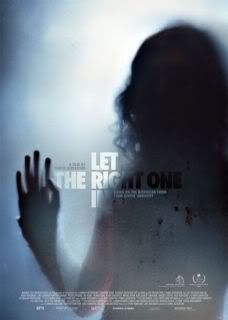
Let the Right One In is a film that I've been interested in for a long time. During its initial theatrical run, it didn't come to my state. When it was released on DVD there was a great deal of controversy about the dumbing down of the subtitles and I opted to wait for the original translation to be released on DVD before I viewed it.

It was thus brought to my attention that my best friend, Netflix Instant Watch, had a copy of the film with the original translation intact and. Unlike many foreign language films Netflix Instant Watch pimps, they don't force a dubbed version on me like the public school system completely failed me. Watching a dubbed film is like having my dad cynically half-describe a movie to me from the other room. In other words, it's for children. I know people my age who refuse to watch films with subtitles. The first film I saw with subtitles was Crouching Tiger, Hidden Dragon when I was ten. Maybe I was born for this, but I think it's more likely that you should read a book sometime.

I digress. Vampire films have a spotty history, and the best comparison I can make is to pirate films. The best pirate film ever made is obviously The Crimson Pirate, but ever since then there have only been a handful of pirate films produced that are even worth watching. While I'm an Interview With the Vampire apologist (I love production design, okay?), I could probably count the great vampire films on one hand. The genre isn't exactly known for being fresh. So few vampire films did anything different since Bram Stoker introduced vampires to sexuality. And pop culture. And we've been watching vampires make out sensually for the eighty years since.

Let the Right One In trades in sexuality, but it goes at it from several fresh angles and it trades in more than just that. To its advantage, it really isn't a vampire film so much as a romantic (I use the word loosely) thriller with a vampire in it. It's loosely plotted and mostly concerns a 12-year-old boy named Oskar who is viciously bullied at his school and his relationship with Eli, a girl who looks to be about his age but is quickly revealed to be a vampire. Mostly we follow their lonely worlds as they expand to include each other.

The film's violence plays into that as well. Easily the best blood-sucking or vampire-related imagery I've ever seen in a film, it's especially effective because Eli doesn't just appear innocent, but is innocent. There are several big, floating question marks around her character that not only have to do with her past (where there are several big, scarred question marks floating) but with her character. Despite her age, she is clearly very sheltered and is in most ways a 12-year-old, but killing for survival brings with it a certain maturity that only appears in flashes. Her character is handled with a logic. Lina Leandersson plays Eli with the characteristically vampiric flourishes, but at a different angle. Mostly we think of vampires as calm, collected and cold monsters because they've lived for so long and rejected emotion in a way that we think is obvious to assume a person that old would. Eli is calm, collected and cold, but it comes from a place of innocence and curiosity rather than one of cynicism. It's an extraordinary performance.

Elsewhere, the cinematography seems to be influenced by Asian, and specifically Korean, and even more specifically Chan-wook Park films. It's not aggressive in its beauty, but holy fuck it's beautiful. Cinematographer Hoyte Van Hoytema has a marvelous aesthetic, framing his shots symmetrically with slow tracking and a bleak color palette, mostly devoted to blacks and various shades of white. The production design is obsessed with squares and harsh angles, and maybe that's characteristic of Communist Sweden, and if it is I'd like to high five the shit out of whoever designed that gulag of a country at the same time as sort of be scared of ever going near it. It's such a perfect match for the cinematography, and if you ever want to discourage someone from being a Communist, all you have to do is show them this film.

The visuals do so much to push Let the Right One In as a horror film, and they do a damn good job of it. As I noted above, it's not really a horror film at its heart, but director Tomas Alfredson seems intent on showing us that if he had wanted it to be a horror film, he could have made it a horror film. There are a handful of scenes that, aside from the visuals, are extremely effective minimalist horror, and none of them directly involve any vampiring, as if to further prove the director's talent.

It's been years since we've had a worthwhile vampire film, much less an essentially perfect vampire film.

10/10

Wednesday, January 13, 2010

Looking Up

Two things:

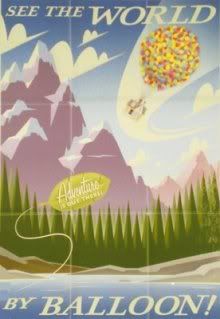
First, that's not the theatrical poster over to the right, it's an alternative poster done by Eric Tan, whose blog can be found here.

Second, I most admit that I have made a mistake. A week or so ago I wrote up my top seven films of the year with Up at #6. Upon rewatching it for this review I have realized how wrong I was. I regret not watching it again before writing that because I hadn't seen it since May and its effect had dimmed in my memory. I would like to make amends and declare Up my second favorite film of 2009, making my official list:

1. Inglourious Basterds
2. Up
3. A Serious Man
4. The Princess and the Frog
5. Observe and Report
6. Coraline
7. Star Trek

It seems like madness that I would put Up so low on my list when I so vehemently declared it the best film Pixar has yet produced. Oh, yes, I know that's a big statement, and after all, there's no genre-bending or gap-bridging or technology-striding in Up. It used to be a pretty solid punch-out between Wall-E and The Incredibles for the title of Best Pixar Film, but I think Up manages to come out on top . Maybe I need to watch Wall-E again; after all, I keep a Wall-E figurine on my desk.

Picking a favorite Pixar film is stupid, though. To watch a Pixar film is to be shot in the head with quality and have your brains paint a wall that is exuberance. Up is simultaneously Pixar's most emotionally potent, most fun, most exciting and funniest film. It's the tale of a lonely old widower named Carl Fredricksen. The world is moving fast around him and he has no reason to change. When his wife died he lost not only his wife, but the person who had been his life partner since they were children and the more willfull half of his existence. In his depressed stupor he commits assault and ties 20,000 balloons to his house in honor of his wife's memory. He kidnaps a child named Russell and escapes to Peru. Little does he know that the United States has had an extradition agreement with Peru since 2001, but that never really comes up.

Mainly the narrative is thus: Man lives entire life promising himself and his wife adventure. They lead a happy, if ordinary life and then she dies. He goes off to find adventure and has adventure. He feels rejuvenated by the relationship he has with a young boy, bereft of fatherly influence.

The opening of the film is very realistic and then we introduce the unrealistic Adventure! aspects to bring Carl's arc together. This would be an easy pitfall for any creative team that wasn't Pixar, but they manage to ground the Adventure! and merge it with the more tragic elements of the story. Sure, it's jarring, it's meant to be jarring, but the film never loses sight of its story or characters and is all the richer for managing a huge tonal shift right in the middle and knowing that the best way to do that is to anchor the film with strong characters.

Carl himself is a wonderfully squatty little creature, seemingly composed entirely of squares. He's introduced in that most emotionally wrenching of opening montages that you've obviously heard praised endlessly, so I'll avoid analyzing that particular scene. I hypothesize that his entire character, and therefore the entire film (remember that we established the entire film rests on the shoulders of the characters to keep the mad tone shift from tearing it in half like a smilie face earthquake) rests on this montage. If we didn't feel and understand every bit of Carl's pain, it would be easy to dismiss him as a crochety old fucker and an unpleasant protagonist (a common critical loophole if you haven't gotten your quota of negative reviews filled for the month).

The supporting characters are all magnificent, including Russell, the innocent, excitable wilderness explorer who stows away on Carl's house, Kevin, the giant multicolored bird that Russell adopts and who speaks in squawks and whose movements provide some of the funniest physical comedy I've ever seen, and Dug, the dog who has been given the gift of speech and says exactly what a dog would say if a dog could speak, which is so fucking awesome that I want to kick every filmmaker that made a movie with a talking dog and it wasn't like this right in the fucking shins.

Rounding out the supporting cast is my favorite Pixar villain, Charles Muntz. I have a special place in my heart of Gaston from Beauty and the Beast because his stake in that film's plot is purely emotional. Similarly, Muntz has spent decades hunting the mythical Beast of Paradise Falls (Kevin) and is the owner of Dug and the inventor of the collar that allows him to speak. The Adventure! plot is just so damn well-constructed and so full of exciting action sequences and so well connected to the rest of the story. Dug and Kevin are easily my favorite Pixar comic relief characters.

And those action sequences, oh my those action sequences. With so many films trying to be throwbacks to 1930s adventure serials, it seems a stroke of simple genius to set the film in present day but employ elderly characters using antique machines, allowing the filmmakers to posit the showstopping climax on top of a zeppelin. I don't remember thinking that the climax was so marvelous when I saw the film in theaters, but it's received three individual viewings since I rewatched the film this morning. The most shocking and effective moment in this scene is the reveal of the gun, which works for a few reasons. First, how common is a gun in an animated film? Second, not a single weapon is shown throughout the film. It is, after all, an adventure film, not an action film (learn the difference, Hollywood). But I don't want to demean the actual reveal, the use of music and cinematography, the reactions of the characters, the soundscape. All of these things work in harmony throughout the film and appropriately peak at the climax.

Of course, that's the case with all Pixar films. Up is stupidly, ridiculously gorgeous as as piece of cinematography and is the primary argument for those retarded awards ceremonies to share some of that Cinematography gold with animated films (the cinematographer's guild just gave a nomination to Avatar; we may be getting somewhere). That is, if Wall-E didn't already convince you. And as always, Pixar gives us the best original score of the year, this time courtesy of Michael Giacchino, one of the best composers working today.

But I'm wasting my time. You know all this, you don't need me to tell you. Pixar doesn't make bad movies. They just don't. If Cars were a Dreamworks film (and that's a fair criticism), it would be Dreamworks' masterpiece. Every time they release a film it's a masterpiece to topple their previous masterpiece. If you don't like Pixar, you're fucking stupid.

10/10

Friday, January 8, 2010

Waking Nightmares

I'm not ashamed to say that if I'm asked what I thought the scariest movie was of 2009, I say Coraline without any hesitation. For this review, I watched it with my four-year-old brother and ten-year-old sister and both of them nearly wet their skulls in terror. While my ample body hair will weave together and crush my skeleton as a defense mechanism against fear, I understand the sensation from a scientist's position and think Coraline would be the best candidate to inspire the sensation should I be a weaker man one day.

Horror for children sounds a bit derogatory, so let's clear something up: films should not be made with a demographic in mind. The marketing campaign is the one that decides the demo, but because a film is animated, or features a child as a protagonist, or isn't rated R for extreme skull fucking, doesn't delegate it to being played on repeat in an orphanage until rug pirates do something made of chocolate.

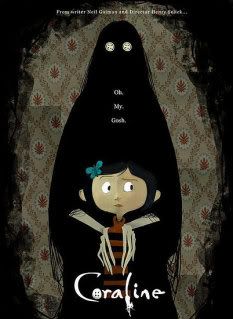
Coraline is the very Gaiman-esque story of a little girl who encounters a magical creature in her house, one that assumes the form of her mother and populates a world almost precisely like her own. But where Coraline's home world is as dull and boring as anyone's (except she lives in a STOP MOTION WORLD, which would be cool, the little brat), this Other world is a fantastical world where everything is tailor-made to Coraline's wishes. Before long, this Other world starts to show its seems and Coraline's Other Mother begins to show some nasty intentions that would get her reported to CPS by any responsible neighbor.

The film is based on a Neil Gaiman book from 2002, and while I'm not familiar with that particular book, I'm familiar with Neil Gaiman and I'm familiar with Dave McKean's cover art, and I'm familiar with the crushing disappointment I felt when I discovered that the film wouldn't be in the style of McKean's art. As much as I love seeing stop-motion animation, and I love stop-motion, I can still lament what a visual handjob this movie would be if it had been done with traditional 2D animation in this style.

Yeah, yeah, we all know (Maybe. Who are you?) how much I love hand-drawn animation, but its underappreciated little brother, stop motion, is pretty fucking incredible as well. It's also the most labor-intensive form of animation. When I was nine or ten or something, I saw a featurette on the animation process behind Chicken Run where they explained that a really good day saw a little less than one second of animation being shot. I know to this day that I would probably hang myself after the first week, which would give the desperate animators a chance to cut some corners and use my dangling feet as a piece of set dressing.

It's unfortunate that, unless James Cameron's home-theater 3D is the real deal, I'll probably never be able to see this film as it was intended ever again. In 3D, Coraline is truly impressive. As I mentioned in my brief writeup for my 2009 in Review, stop motion offers the perfect venue for 3D: while it fails to add a realistic depth to a cartoony CGI film, and it looks too cartoonish for a live-action film, stop motion is the perfect compromise between animation and live action, and therefore provides the most seamless 3D experience.

And look at that, the 3D does something in this movie. Instead of eye candy, it becomes a visual cue that we have entered the Other world (that's not to say Cameron didn't do something similar in Avatar, but I think that the jungles of Pandora were marked more by a specific color palette than use of 3D, although there was some of that). Our first glimpse of this world is a wide, deep-focus shot of a kitchen, lit with the glowing amber and bright reds that will also come to characterize the Other world, just as the dull blues and grays will come to characterize the real world. Coraline's wonder, in this case, is our wonder.

Coraline herself is exceptionally expressive for a stop motion character, something that I haven't ever really expected from this medium. Her emotions never seem out of place for an eleven-year-old girl and the filmmakers are tasteful enough to not juxtapose moments of inhuman maturity and clarity for the sake of plot-building against more realistic eleven-year-old

Like all of Gaiman's work, it's rooted deep in mythology, and if he has aspirations to be a modern myth-maker, he'll never come closer to success than with Coraline. His inclusion of so many mythological elements, such as talking animals with personalities based on that animal's traits (the laconic cat, the scheming rat), the abundance of the number three, and lots of other stuff that you don't need me to list. As a hero, Coraline is a very typical eleven-year-old (I'm guessing) girl, and the film doesn't jump around that to try and stuff her into the mold of the hero. She's bratty, argumentative and impulsive and has the interests and dress sense of a little girl raised by professional gardeners.

But the real triumph, the real terror of the film is the Other Mother. With buttons sewn over her eyes, she at first appears (aside from, you know, the buttons) exactly like Coraline's real mother. Slowly over the film, she becomes more insect-like and the buttons more like the beady black eyes of an insect. In her final scene, the set dissolves into a nightmarish spider web and she into an enormous spidermonster (?) that will send your children to the therapist for years. Maybe it's because I never expect a movie marketed towards children (I know, I know) to even attempt horror, but that scene has never not given me the fucking spine-tingles.

In the end, my love for this movie comes down to a simple matter of taste. This sort of subdued horror, especially in animation, is something that appeals endlessly to me. There are things in this movie that are truly inappropriate for children, not because of the content, but because of the execution. Some of the creatures designed for this film and the world they inhabit is exactly the sort of thing that inhabits a grown man's nightmares. Where most horror films try to startle you and give you a murder boner, Coraline gives you nightmare imagery and claustrophobic editing, and I'll consider those scares far more genuine any day.

10/10

Saturday, December 19, 2009

The Last Rainforest

First of all, I fucking called it.

Just wanted to get that out of the way before I got into anything else. All you faggots saying it looked retarded and that it was going to be the biggest flop of all time, commercially and artistically, can go to hell.

Okay, so my excuse for posting this so late: I bought my IMAX 3D tickets way the hell ahead of time, like two weeks in advance. Dragged some kids who didn't think it looked good with me to see it. As we were watching it, we leaned forward and had a little powwow session. We all three agreed that the 3D was really distracting, didn't look that good and was detrimental to the success of an otherwise very, very pretty movie.

Then we had an intermission, which the theater manager said we weren't supposed to have. Apparently they had assembled the print wrong because when it came back on the 3D looked just fine. I then made it my mission to see the film again because that unpleasant first half had messed with my perception of the film, and that was the fault of the theater owners, not the filmmakers. Also because the dicks at the IMAX 3D theaters don't let you keep the space goggles.

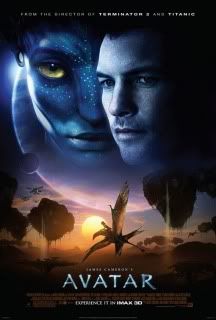
So the best place to start, for more than a few reasons, is the story. On the distant planet Pandora, a corporation has taken to mining for a valuable resource and has hired out mercenaries to deal with the hostile environment, namely a 10-foot tall humanoid species known as the Na'vi, the very dangerous, very tough and very intelligent dominant species of Pandora. In order to better relations, Dr. Grace Augustine (Sigourney Weaver) has been involved in developing the Avatar Program, a program wherein a human remotely pilots a Na'vi body, grown in a vat. When one driver is killed, his twin brother Jake Sully (Sam Worthington) is brought in to pilot his avatar, avatars being linked to drivers by DNA for full nervous system immersion (or some other sci-fi technobabble).

The human forces are led by the most evil man they could possibly have found for the job (Stephen Lang), who reminds me too much of my dad. He wants to use Jake's in with the Na'vi to acquire tactical data for the impending conflict. Unfortunately, Jake is being seduced by the Na'vi's natural lifestyle, in tune with the elements of Pandora, meant in no small way to remind you of Native Americans. He quickly falls in love with the strong-willed Neytiri, a hunter of the forest folk and heir to a seat of power in the Na'vi tree house gang. I don't think I'm giving anything away if I say that Jake eventually sides with the Na'vi against the humans.

This plot has come under a lot of fire for being too simple, but it works so goddamn well I don't see how the simplicity is even an issue. It's bare bones and elemental, and if there's one thing that Cameron has a real and true grasp on, it's the elemental. Col. My Dad doesn't have any redeeming human qualities, he's not even a character. He's just pure evil, not unlike Cal from Titanic. And as I said, Cameron has a problem with his leading men being ciphers, but for this film Jake Sully works perfectly and Sam Worthington's listless performance is a perfect match. It's like the performances in 2001 or Blade Runner, where the humans are intentionally played as bland archtypes to bring to the fore the personality of the environment or the other non-human elements. That the human element of the film is totally sterile is exactly the point, Jake even comments on it one scene, saying how much more surreal the human world is after spending so much time in his dreamscape. And the audience feels exactly the same. I wonder if the 3D element of the human scenes look strange and awkward on purpose, so that when we step into Pandora and it gels perfectly it feels natural and far more real, despite being a complete fantasy world.

And WHAT A FUCKING WORLD IT IS. Every plant, fern, rock or square inch of dirt pulsates with life in the most gaudy, colorful way possible. And when the lights went out and the world lit up with neon plants and fluorescent water, I had to take out my eyeballs and dunk them in a glass of water. The world may not work totally logically, but holy shit is it a wonder to look at. This may be the most stunning fantasy world ever constructed for film and my reaction to it is how I imagine people reacted to The Wizard of Oz back in the olden days. If this whole film is an excuse to give us vistas of Pandora, I am more than fine with that.

But that's not all it offers. First is, obviously, James Cameron's old pro hand at action. He stages masterful action in his sleep, which is why it's so surprising that an early chase scene through the forest (!) is pretty unspectacular, even a little bit bad. But I'll forgive that in a second for the epic climax, a battle tallying around twenty minutes that will overwhelm all five senses with the sensation of pepperjack cheese. I don't want to give anything away, but it's spectacular and if you have even a little bit of appreciation for action cinema, you're sure to love it.

And the other big thing is - hold on a second...


ZOE SALDANA FOR BEST ACTRESS

Okay. So Zoe Saldana is absolutely incredible in this film. The first truly great motion capture performance since Andy Serkis in Lord of the Rings. Her character is a combination of all the great things about actors mixed with all the great things about computer animation. It might well be one of the greatest combinations of actor and filmmaking craft towards the goal of creating a great performance. It's more than obvious that an inordinate amount of time went into animating her facial movements. Her performance is incredibly subtle, and while it's hard to say where Saldana's performance stops and the animation begins, I'd like to give equal credit to both sides. It's her strong, animalistic, sexual performance that anchors the entire film. It's a great example of a perfect performance and yet another marvelous female performance in a James Cameron film.

But the main character, if you'll excuse the faggotry, is Pandora itself. If there is an avatar in this film outside of the quite literal avatars, it's the Na'vi for Pandora. They represent the interests of the planet, commune with it and protect the balance of life, always acting with it and understanding it perfectly. It's the elemental tale of a world, not a people, fighting invaders. There are times when Pandora seems to even betray emotions.

The entire film would fall apart as anything but a visual exercise without Saldana. I'm no good at describing performances, but no female performance I have seen this year (despite being super behind, An Education isn't playing anywhere in my fucking STATE) even compares. I hope to god it isn't overlooked because it's motion captured. I hope the gorgeous production design isn't overlooked because it's in a big budget action movie. And I hope that James Cameron doesn't get overlooked for this sort of thing, the sort of thing that he's best at, that he excels at and that every other filmmaker in the world should sit down, shut up and take note of.

9/10

Friday, December 11, 2009

Of Love and Music and Beauty and Magic

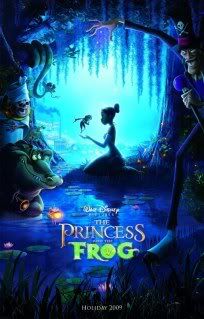
I was born in 1990, meaning my exposure to Disney's animated films was largely of the Renaissance variety. I grew up with Beauty and the Beast, Aladdin and The Lion King, and so embedded are they in my life that I can't even watch them critically. So when Disney chose to make The Princess and the Frog, their glorious return to hand-drawn animation, it was almost a cheap shot that they made it in the tradition of those films from the early 90's. There was no way I wasn't going to love the Christ out of this movie.

I love the Christ out of this movie.

The decade or so since they last produced a worthwhile hand-animated film has given Disney the magical gift of hindsight and the ability to assess what worked and what didn't work about the films produced in the 90's and to narrow in on a perfect variation of their classic formula, with added grace and maturity. Disney's brilliant collection of animators, having been want of things to animate for several years, have exploded back onto the scene with the most infectious enthusiasm, and while, dare I say, the Princess and the Frog is an absolutely glorious little animated masterpiece, it's a particularly uneven glorious little animated masterpiece.

We open on New Orleans around 1910 or so, establishing the life of our protagonist, Tiana. Unlike her privileged friend Charlotte, she has simple dreams of one day owning a restaurant with her father. This dream, modest as it may be, is a quite lofty goal for a poor black family in 1910s New Orleans. Still, she persists, working hard and saving every penny she makes in menial jobs to make her dream come true, even after her father dies. And here we arrive at the main of the film. Handsome, vain and completely broke Prince Naveen has arrived with a rather dick-headed plan to marry into wealth, but quickly falls in with a Voodoo sorcerer named Dr. Facilier who transforms him into a frog and sets into motion a plan to acquire Charlotte's family's wealth with the help of Naveen's gullible manservant. Tiana is roped into the story when, due to some confusing fine print in the Frog Prince story, she also becomes a frog.

I mention that it's uneven, in spite of being positively brilliant, and I should explain myself. The first and third acts are as fantastic as anything I've ever seen in an animated film. We'd have to go back to Beauty and the Beast to find anything this good in a Disney movie, but the second act is just not up to par. It's fun and entertaining and has a few great songs, but you can see that all the writers' and animators' joy went into the beginning and the end, leaving a sort of confused middle section. It wouldn't be so noticeable if the beginning and the end weren't so extraordinarily great.

For one, Tiana just became Belle's equal for the title of "favorite Disney princess". Yeah, Snow White and Princess Aurora and Ariel are supposed classics (and one could make a good case for Ariel), but that's by virtue of being in classic films rather than being particularly well-defined characters. In fact, it's a common complaint that the message that these movies sends to little girls is "be pretty and shut up", which has always made Belle a favorite of mine. As a character, she's intelligent and sophisticated and, despite somehow not finding Gaston the coolest person on the fucking planet, very open-hearted. She's a good character first and a pretty doll second. Same with Tiana. As great a doll as I'm sure she'll make, she's a strong character first. She constantly harps on the importance of hard work, something I can't really recall seeing in the Pygmalion, wish fulfillment Disney canon. It's refreshing to see a Disney character with her life in her own hands, moving in the direction she wants even before all her dreams start to come true and her prince comes and finds her.

The musical portion of The Princess and the Frog is the most successful since Beauty and the Beast, anchored by a jazz-tastic score sung by people who can really sing, rather than big stars that will bring in the crowds but add nothing to their characters.

But the real success of this film can be summed up in two words: Dr. Facilier. Every time he's even near the screen the film's jazzy beat speeds up and grows darker, culminating in what may be the most jaw-dropping piece of animation I have ever seen with Facilier's showstopping number "Friends on the Other Side". Pitched with explosive, orchestral jazz against a frighteningly dark masterwork of color and movement, I can't exactly remember everything that happened in the subsequent scene because I was still reeling. Facilier himself is a bit of lanky charisma, a street magician and Voodoo practitioner of overflowing evil, captured so well by the animators and Keith David's distinctive voice.

At one point Facilier commits an act of such cold cruelty that I was beside myself with shock, as was the rest of the audience. Even Scar gave Mufasa the dignity of an epic, kingly death.

All the characters are exquisitely animated, with the other standout being Charlotte, the dolled-up spoof of classic Disney princesses. Born into money and ignorant of the difficult life Tiara leads, all she hopes for is to one day be wed to a prince. At one point, when things don't seem to be going her way, she decides "maybe I should wish harder" and starts begging the wishing star to bring her a prince. Her animation is as shapelessly cartoonish as I can imagine a realistic character being. She seems to explode with energy and exuberance in every moment of her existence, and she doesn't seem to have any fixed weight or even figure at all.

If the film has any concrete failings, it's in the comic angle, specifically the comic relief characters of Louis and Ray who are never as defined as the rest of the cast and seem to be there just to keep the little kids laughing. Although it's not all bad. Some of Louis' early scenes are quite funny, but his character especially never has a dramatic angle; he's comic relief through-and-through, making him feel like a flat stock character. And there's one scene involving a trio of frog hunters that struck me as totally out of place, despite being a fun throwback to Looney Tunes and all that--I don't think it really had a place in the movie. But since these two characters and that one scene are featured so prominently in the middling second act and do nothing to disrupt the absolute perfection of the first and third act, I'll forgive it all without a second thought.

I could talk for days about the animation. When was the last time animation of this quality was married to a story of equal quality? The Little Mermaid and Beauty and the Beast had pretty limited budgets (I'm not arguing that those aren't superbly animated, I'm just saying that the limited budget didn't allow a lot of complex animation) and the more exquisitely animated films of the earlier days of Disney, like Sleeping Beauty and Alice in Wonderland, tend to be pretty rigid affairs. I'm tempted to go all the way back to Bambi for a film with animation that is in service of such an effective story, rather than for its own sake. But it could just be that I got out of the theater two hours ago and am still overjoyed by the experience.

There are so many things about this film that make me never want to watch another computer animated film again (and let me quickly apologize to Pixar for saying that--I'll always love you). I'm suddenly reminded of all the things that make hand-animated features a more joyous affair: the colors, the backgrounds, just the way the characters look. It's all so warm and welcome, and since this is the first time I've seen an animated film in theaters since Tarzan, the simple experience of seeing it on the big screen was exhilarating.

Only time will tell if it will become a classic, and only time will tell if this is the start of another golden age for Disney, but my God I hope so.

10/10

And considering all the mean things I had to say about the middle portion, that should illustrate how goddamn great the first and third acts are.

Monday, November 2, 2009

Every Man for Himself and God Against All

It's a sign of what incredibly bold filmmakers the Coens are that they often state the theme of their movies in such plain terms. At certain times, the first line of the film has been the theme (that's Miller's Crossing, if you're wondering). In A Serious Man, it comes about halfway through, in response to what is seemingly an insignificant subplot (although who's to say what's significant and what isn't, argues the film). A man puts it simply: "Please, accept the mystery."

The film offers a vague answer because no one actually knows the answer (and by "vague answer", I mean "really vague answer"). The Coens aren't interested in arguing in favor of God or a certain view on our Purpose or even pushing their own personal religious beliefs on us, and they're especially not interested in giving us the false answers Hollywood is prone to. They're interested in telling the story of Larry Gopnik.

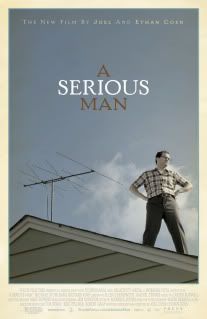
A Serious Man is the tale of Larry Gopnik, a college professor living in a midwestern Jewish community, with all kinds of problems. His wife is leaving him for the well-to-do Sy Ableman, his kids are a wreck (his son is in trouble with the resident high school drug dealer), a student is trying to bribe him for a passing grade and may be writing defamatory letters to the tenure board, and his gambling-addicted brother, who is little more than a man-child, is sleeping on the couch.

All these problems push Larry towards metaphysical crisis and he seeks the help of three different rabbis as his life spirals further and further out of control.

And what a tale! It's so hard to say "The Coens' best/funniest/etc film since..." because only a few of their films can be considered anything less than spectacular. I make no secret of the Coens being my very favorite living American filmmakers by a significant margin. Almost every single one of their films is a masterpiece of some degree, and their assembled crew is a filmmaking super-group.

One of the most peculiar things about this film is its similarity to The Man Who Wasn't There, one of their most underrated films. Both are period pieces about ineffectual men whose wives are unfaithful, and both are stories of those mens' lives as they begin to spiral out of control. Both mine similar thematic territory and if I had to choose a Coen film to compare the tone to, it would be The Man Who Wasn't There.

This is not a slight, but more praise on the Coens' part for taking two similar stories and two similar protagonists (although The Man Who Wasn't There is clearly the more cartoonish and film-ick of the two) and using them for different ends. But these are merely the ramblings of an under-fed Coen enthusiast.

Most of the criticisms I've seen aimed at this film have been "The Coens clearly have no love for their characters and enjoy seeing them tormented", which is inexplicable. That they put Larry through trials and tribulations and have him come out merely confused on the other end is not a sign of hatred. In fact, the honesty with which they approach Larry suggests unrequited love for this character. The Coens are sometimes guilty of being cynical, but I don't know when "cynical" became synonymous with "hating their characters". Similarly, they're considered condescending, which is a word I altogether do not understand; it's just a way for people to be anti-intellectual (something critics should feel victimized by).

The film, like all Coen films, is perfectly cast, down to the smallest role. Michael Stuhlbarg is brilliant in the lead role, and absolutely deserves a Best Actor nomination come Academy Awards time. Similarly, Fred Melamed is loads of fun as Sy Ableman, the man who has swooped in to steal Larry's wife. Despite his gentle, scholarly appearance, he seems to have an air of triumph about him, so as he tactfully and gracefully suggests Larry stay at a local motel, he's gloating just enough to let Larry see.

And of course, the cinematography is second to none. Roger Deakins makes a welcome return, making the film unnecessarily lovely (especially a rather showy shot involving a ladder).

I don't feel like I even have to recommend this film. It's the Coen brothers. It took me a month to see it, despite my best efforts (illness took hold and it requires a 60 mile drive to get to the nearest independent theater), so why haven't you seen it already? It's surely one of the best films of the year, because, well it's the fucking Coens. Do I really need to tell you again?

10/10

Friday, August 21, 2009

Men on a Mission

Several years ago there was a boy. He had a great deal of interest in a great many things, but none of them offered him that intangible something that he wanted. Perhaps a medium that best suited his tastes or something of significant depth that he could really sink his teeth into. One day, the boy fell ill and stayed home from school. There, bored, he rifled through some cabinets looking for something to do. He fell upon his older brother's DVD of Reservoir Dogs. He had little else to do, so he decided to take a gamble on something that his brother clearly liked, which, of course, doesn't always pay off.

But when that movie ended, that boy couldn't bring himself to move a muscle. Completely transfixed by the power of a medium he had never seen harnessed, he knew at that moment that he must start a blog. In four years.

So as you can imagine, Quentin Tarantino has a very, very special place in my heart. I've never regarded him as a truly Great filmmaker.

Until now.

I always though of him as a great writer who also happened to direct his writing, for he transformed the face of cinema and kickstarted the independent movement essentially based on his scripts.

Kill Bill is a great film(s), but it's not as groundbreaking or genre-bending as Pulp Fiction and it's not as gut-wrenching and visceral as Reservoir Dogs. But Death Proof really dampened my faith in the man. Not only was it overlong and terribly boring, but it somehow seemed to isolate all his worst impulses and leave out any of the things that make those bad impulses work in his other films.

If someone were to have told me a week ago, or five hours ago, that Inglorious Basterds would somehow combine the genre-bending and inspired dialogue of Pulp Fiction with the open gut wound that is Reservoir Dogs and wrap it in a flour tortilla of the loving kitsch that makes Kill Bill so unique, I would likely have declared you mad and had you spend the rest of your days having your hair harvested for wig-makers to practice on.

I would have been wrong. I would have falsely imprisoned you, and I would wear your wigs if I ever went bald so that at least one part of you would be able to glimpse the outside world again.

Inglorious Basterds may well be the perfect alignment of the planets otherwise known as Tarantino's body of work (which is very different from it being his best film). It combines everything that is great about him and rolls up his bad impulses in a rug and heaves it into a deep river where it will be retrieved as treasure by 24th century rug pirates.

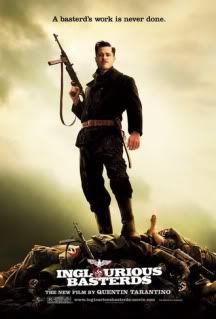
But as is tradition here at Herr Machine, I'm way ahead of myself. Here's the plot for those of you who don't know (for those of you who do know, I'm purposefully insulting your intelligence): Brad Pitt is Lt. Aldo "The Apache" Raine. He is the leader of a squad known as The Basterds, assembled of the finest Jewish-American soldiers and sent deep behind enemy lines to, well, murder the fuck out of the Germans. Why? To strike fear into the hearts of the enemy. When they see the mutilated corpses that they leave in their wake, whether they be scalped, disemboweled or or bludgeoned to death the Germans will talk and fear will spread until the Basterds are the boogieman of the American army. And isn't that just a marvel of anti-history and affectionate kitsch?

Several sub-plots weave in and out of that story, including a famous German actress, a very evil Nazi officer named Hans Landa, a young Jewish woman operating a cinema in Paris and a young Nazi war hero.

The principle actors include Brad Pitt as Aldo the Apache, a role that recalls a seeming phantom of my movie-going history. His cartoonish character is required to smirk at the camera, never deviate from the speech patterns branded to his tongue and blow my mind. If American soldiers were told about a man who kills and scalps hundreds of Nazis and commands a group of soldiers that beat Nazis to death with baseball bats, Brad Pitt's Aldo is exactly the image they would conjure. That doesn't mean he's the least bit realistic, he's every bit as batshit as the mythology and it is a ballsy performance for Pitt, as anyone could easily mistake his performance for a lazy caricature. But the way that Pitt maintains this cartoonish persona at the same time as wrapping his tongue around Tarantino's tricky dialogue every bit as well as the finest actors who have found themselves in front of his lens makes Pitt's performance one of his finest, if not his very finest, performances ever.

But the real stand out is Christoph Waltz as the very evil Col. Hans "The Jew Hunter" Landa. His talent is only something that Tarantino could pull off: he is a wordsmith. Someone who can extract information and get anyone to do anything he wants with his devilish charm. Every second he circles his target, waiting for the exact. Right. Moment. To strike. That doesn't mean that he waits a few minutes, that means he draws his prey in closer and closer for an agonizingly suspenseful period of time, but the deathblow is so quick you could blink and miss it.

Waltz gives a performance so glorious and spectacularly realized, that I may have to call it the best performance ever in a Tarantino film by a significant margin, and let me stress that that includes ALL the great performances in Tarantino's films. Harvey Keitel in Reservoir Dogs. Samuel L. Jackson and John Travolta in Pulp Fiction. Pam Grier and Robert Forster in Jackie Brown. Uma Thurman and David Carradine in Kill Bill. Writing that list of performances, I couldn't help but chortle at how far into the stratosphere Christoph Waltz blows them.

One of the chief pleasures of a Tarantino film is that the man just can't contain himself. His passion is infectious. Passion for film, passion for dialogue, passion for stories. People who complain that his scenes go on too long aren't on the same wavelength and they aren't experiencing the same movie I am. The film I saw was a 150-minute love letter to 100 years of filmmaking tradition. And not just the tradition that the critics fawn over, or even the masses, but the little things. The forgotten films that indulge our basest desires are given more cuddle time than any Citizen Kane, and why not? Tarantino loves the medium unconditionally, and that's why he's a cinephile's director. His films are a greatest-hits compilation of world filmmaking, the kind of greatest hits compilation that makes you proud to watch hundreds of movies a year.

Watch! as Tarantino slowly ratchets up the tension in his dialogue. Watch! as the dialogue sizzles and boils for ten, fifteen, twenty minutes. Watch! as guards go up and tensions rise. Watch! as those tensions catch fire. Watch! as those tensions erupt like a fucking volcano. And let's watch it again. It's a trick I didn't know Tarantino had, and it is glorious. It is glorious for its ballsiness, it is beautiful for its experimental nature. Something this experimental hardly finds its way into 3000 theaters and my pulse quickens at the thought of people seeing something this bold, this sharp, this original, this flippant, this violent, this funny, this complex, this exciting, this visceral, this great.

When I say I love a film, I mean just that. I love the bloody fucking bejeezus out of this movie. I write this only a few hours after having seen the film, and every second that I'm not seeing it again is time wasted. At one point I looked at my phone to check the time and I realized there was only another half hour in the movie. I sighed a sigh of sadness. I could have gone for another two hours of this movie. I loved every frame of this film, every word of dialogue. I fucking loved this movie.

10/10