Showing posts with label vampire movies that don't suck as much as Twilight. Show all posts

Saturday, February 20, 2010

Night Time Through the Ages

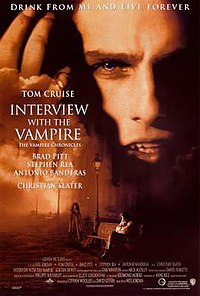
So I think more vampire movie reviews are necessary. I haven't decided exactly what films will be included. I will say that the vampire film I most want to see is Werner Herzog's Nosferatu: Phantom Der Nacht, which is unavailable on DVD, though I plan to try and hunt down a VHS copy. For now I'll chart my early history with the vampiric form, which, as far as I can remember, began with Neil Jordan's Interview With the Vampire.

It concerns a couple of vampires prancing about in frilly collars through Victorian Europe and civil war-era America, gently sucking blood from the exquisite necks of voluptuous 19th century bitches with not a second glance towards their brilliant tits as they dump them in the...well, that's never really explained, but we can assume they were doing something with the bodies, like maybe decorating, after all Neil Jordan never seems to have enough fucking set dressing. Not even Jack the Ripper had enough hooker skin laying around to tailor himself a hooker skin waistcoat and top hat, but these vampires would have enough to make a hooker skin circus tent with hooker skin elephants and clowns and probably a hooker skin audience once the police stopped them selling hooker skin tickets to hookers. Interview With the Vampire seems to be an indictment of old timey law enforcement before it's a vampire movie or a horror movie or a period piece or gay porn.

Not only are these vampires gay, they're fucking sad. They spend the entire movie shuffling around their little Gothic fairytale land complaining about being immortal and their ability to fly. They're like the rich kid in elementary school complaining that their butler forgot to marinate their steak in caviar while you spread the cafeteria's free butter over your leftover breakfast rocks. There's very little action beyond our vampires talking about being vampires and how much it sucks to be vampires; most of the film is just discussing this film's vampire mythology in the context of how much it sucks to be a part of it or establishing the characters.

I'm oversimplifying, so here's a real plot synopsis: Brad Pitt is Louis, the suicidal plantation owner who inexplicably accepts a vampire's offer to become his (totally platonic) companion for all eternity. Really he's the only whiny one, but it's hard to divide him from the rest of the characters when his constant complaining seems to enter the pores of the other characters, turning even the coolest, most relaxed vampire into a tidal wave of frustrated tears. While Louis mopes around about how much it sucks to be suicidal, immortal and at the mercy of human blood to continue his sad little life, Tom Cruise gets to dance around and make fun of him as Lestat, the pretty-fucking-evil nobleman who seems to have been vamping a few decades longer than Louis. He's the elated, fun-loving (and to whom fun means "wanton murder") mentor to Louis' sullen teenager of a student. Louis makes everything worse for the two because of his constant moping, and when his maternal instinct kicks in, Lestat produces a little vampire lady out of a child dying of plague, to whom Louis endlessly mopes. What begins as a playful father-daughter relationship becomes something more sinister as Claudia (Kirsten Dunst) becomes Lestat's equal in bloodthirst and evil. The best scenes (of course because of my predisposition towards thrillers) is the tension between Claudia and Lestat, and the film benefits from shoving the despondent Louis into the background, at least until the end. That's not to say Louis isn't a good character or that Brad Pitt's performance isn't good, but I simply derived more pleasure from watching Tom Cruise and Kirsten Dunst interact.

It took Brad Pitt a long time to become a worthwhile actor. Studios and filmmakers were always putting him in bland popcorn or Oscarbait films without anything to really do. It wasn't until Fight Club that he got a truly extraordinary character to play and began to give great performances consistently (he was fantastic in 12 Monkeys, but he regressed for a few years after that). His casting in things like Seven Years in Tibet, A River Runs Through It or Legends of the Fall were decisions made for the benefit of the film, they were chosen to give the film a bland commodity to trade in that would bring in all sorts of young folks. None of those roles he played were exceptionally written, and were almost unanimously boring ciphers or audience surrogates. Tom Cruise had a similar, if not nearly as pronounced, issue in his early career leading up to, say Born on the Fourth of July. Today it's quite apparent that Cruise is at his best playing villains. My favorite of his performances are Magnolia and Collateral, but our first evidence of this trend came in Interview With the Vampire where he was cast completely against type to loud outcries of miscasting. Casting against type and miscasting are completely different things, though, and Cruise seems nothing short of elated to shed his heroic leading man image and sink his teeth (VAMPIRE HUMOR) into the role of an irredeemable villain, a hellhound of such staggering badness (where the fuck is my thesaurus?) that he declares himself, in a moment of clarity, too evil for Hell.

If Tom Cruise wasn't so fucking pretty and wasn't such an egomaniac, he would probably be a great character actor specializing in villains and dickheads. There's no action franchise more boring than the Mission: Impossible films and we can thank Tom Cruise's villainous megalomania and subsequently disinterested performance for that, but when his real-life evil is funneled into a role not too far removed from his public persona, something notable begins to happen. This was the first time Tom Cruise really got to let loose, and it's always a little shocking to see how honest the evil in his performance is. Specifically I think of a scene in the film that I have a lot of affection for: a scene where Lestat, trying to strangle whatever humanity remains in Louis, invites two prostitutes into their home, kills one and drains the other to near-death. He then implores Louis to end her suffering and accept that to survive he must murder. He begins to torture the prostitute to further goad Louis into murder by forcing her into a coffin. As her forces her in and then lifts her out, he employs a joking, facetious tone that seems to effect the situation in no way aside from to satisfy his natural desire to play with his food. These lines are delivered with a devious evil faked in no way, like making eye contact with the Antichrist. There are a few scenes like this, and they all give me the fucking shivers, but none are so effective as this. It pierces the veneer of acting and puts us in the presence of a real-life maniac. Or maybe not. Maybe Tom Cruise is just the greatest actor ever.

In other news, Kirsten Dunst (something like eleven during filming) plays my favorite "innocent little girl that is actually a bloodthirsty monster". It's a role that requires a great deal of maturity on her part because it is essentially: little girl who has become an adult while keeping the body of a child and the spoiled obnoxiousness of a child but the maturity and evil of a seasoned murderer pretending to be a child. She possesses a charisma that not only is possessed by so few child actors, but that she never seemed to possess again. The role is made that much more difficult by her character being the most intelligent and cunning of the three and it requires a gravitas so rarely contained within a child to make that convincing.

While I'm talking about performances, I'd like to give a special mention to Stephen Rea playing (as Brad Pitt hammers into the audience's head, essentially destroying the effect of the scene) "a vampire pretending to be a human pretending to be a vampire". It's a small role, but an effective one especially considering that Rea is a truly great actor who doesn't get nearly enough good work. He plays a vampire who has waded in decadence so long that he's become a cackling hyena; his overindulgent lifestyle has left him no reason to ever act like he isn't a) on stage b) loudly laughing and joking with other vampire actors or c) murdering. It's such a stark contrast to Louis' stoic pouting that it deserves individual praise.

Now that I've exhausted your attention span with far too detailed accounts of the performances , I'd like to direct your attention to the purely functional story and Louis' slow arc. It's obvious that Jordan is an independent director because he effortlessly draws great work from his cast and spends the rest of his time building elaborate, unnecessary sets. I've heard people complain about the film being overproduced, but I'd argue the point. Surely the long shots of New Orleans ports or the cobblestoned streets of Paris aren't necessary, but they're pretty in a way that isn't especially distracting, especially since almost every scene takes place at night and it gives all the proceedings a gloomy, Gothic aura. All the sets are rendered rather beautifully and effectively, but they are only ever the centerpiece of individual shots, or rather parts of individual shots. Unless we're challenging the long-standing tradition of establishing shots, or the right of establishing shots to be pretty instead of stock footage of the Tanner family's home, I don't think there's anything to complain about here, although I've never seen a movie I would call "over produced", I'm sure it's a legitamite complaint for some films, just not this one.

The only thing about Interview With the Vampire that I think flat-out doesn't work is the whole Interview thing. It's an awkward framing device, like the team of divers in Titanic, that doesn't add much to the film. If it's an excuse for Louis to narrate the film, it's a weak one and there's no reason why you can't just have narration because you think that's how the story should be told. No one's going to bitch about that, not unless you impliment it poorly. It's not something that effects the film beyond repair, but it's worth mentioning because it's a perfectly effective film and none of the truly glaring flaws are that detrimental.

If there's any flaw that really effects the film as a whole, it's Brad Pitt. His performance is so listless and disengaged that we lose our emotional center and the whole piece lacks impact or emotional heft, and that trick he learned for Benjamin Button - acting only with his eyes - doesn't seem to have developed yet.

Despite its scrubbed emotional palette, there's a lot to be said for Interview With the Vampire. I was a little bit in love with it when I was younger and I think it might have had something to do with its sterility. The vampire thing is pretty incidental, it's basically a period piece about some folks who happen to be vampires and sort of eskews the notion that if it's a vampire film it has to be a horror film, and I find the straightforwardness of the approach rather refreshing. It's Gothic and atmospheric, but it doesn't go for scares. It has an endlessly fascinating lead role next to an exquisite supporting role against the backdrop of some really lovely design, and I think that's a lot to go on. Even if it lacks impact, it's memorable for a lot of other reasons, and it's certainly not a mess.

7/10

Friday, February 5, 2010

Portrait of a (Vampire) Killer

Watching From Dusk Till Dawn has helped me realize why horror films so rarely work. Things need to change and evolve, become new and connect with a new audience. Horror hasn't changed since the 80s, even today when we go see a horror film, nine times out of ten we're watching teenagers get hunted by a murderer of some sort, or maybe we're just watching a person meet a slow demise. People don't actually shake in terror from these things, it's just gore-porn with no real ideas or intentions behind it. Because Hollywood has been lazy and audiences have been even worse, we've been trapped in a revolving door full of mutilated corpses for about thirty years.

That's not a new criticism, but it's a fucking relevant one until someone does something about it. It means a lot to me that From Dusk Till Dawn exists for that reason, even if no one understands its intentions. You see, a major change in any artform has to come in a package that's easy to consume for the public, and after that the truly great genre films will appear. By nature, true horror films are not easy to consume for the public. When something that's truly horrifying but lacking the defining genre stereotypes that make it identifiable as movie horror arrives, people do not know what to do with it and tend to discard it. We're left with truly exceptional experiments that succeeded in more ways than they had any right to that were left totally ignored by the public, and whose reputation has less to do with the actual intentions of the film and more to do with the self-conscious kitsch it wrapped itself in and the reputations of the creative team involved.

Robert Rodriguez and Quentin Tarantino succeeded more readily than any other filmmaker in trying to do something new and different with horror. I can understand how heartbreaking and disappointing the film's failure was and how that could have driven Tarantino to never touch the genre again and to return to what made him popular in the first place with the nice but forgettable Jackie Brown. If you ask me, and you may as well because you're reading this, From Dusk Till Dawn is Tarantino's strongest screenplay of the 90s, if only because it pulls off such bizarreness so flawlessly.

I can't even begin to summarize the film's plot, so I will say this: it is about two bank robbers slash brothers in Texas. There's a preacher and his family in there somewhere, a bar, a few shootouts and the film may or may not have something to do with vampires. All those plot points and secondary characters are peripheral, though. If you're determined to think of it in these terms, you could call the bank robbers the "monsters" of the film, specifically Richie (Quentin Tarantino) a character that the film lives and dies for. Everything truly important and edgy happens in the first thirty minutes of the film when the secondary characters are just barely introduced and just barely defined.

Which inelegantly brings me to another point. The lengths the film goes to to define characters most people would see as stock (murdering bank robbers) are interestingly contrasted with the film's half-hearted attempts to define the preacher, Jacob (Harvey Keitel, clearly the most professional and actorly of any of these actors), who receives a glazed over characterization in one scene where Seth (George Clooney) prods him for information on his life. The preacher gives him all the typical character bites: his wife died a painful death, he lost his faith, quit his job, he's taking his children with him as he runs away out of grief and the two criminals that have kidnapped him are pushing him to the edge, and he's willing to kill for revenge should either of his two children be hurt. In that one scene we're given a character who is often seen as an interesting, compelling character, but Tarantino shows him to be more a stock character than the murdering bank robbers that he loves with all his heart.

There's a story that Tarantino started writing this film the night that he won his Academy Award. If Tarantino said that in an interview or something he intentionally gave his film another layer of meaning. Tarantino regards Jacob's character with respect, but is far less interested in holding his hand through his routine arc than he is with showing a deranged killer with no capacity to change run into obstacles that he can't wrap his child-like mind around. I hesitate to say Tarantino spits in the face of Oscar bait, because I don't think that he would have included Jacob in the film and given him such rich dialogue and hired an actor he respects as much as Harvey Keitel if he didn't love the character, but I certainly think his presence in the film is a commentary on what was happening in the world of film at the time and how critics and audiences were lumping his films with stuffy domestic dramas just because Pulp Fiction won an Academy Award. Tarantino's love of film has always been B-Movies and exploitation and trash, whereas the sensibilities that the critics fawn over, like his dialogue and his careful characterization, are derived from art and life in general.

In more ways than the blatantly obvious, this film is Tarantino's statement on winning an Academy Award. The clearest evidence that this film is all about Richie is that Tarantino himself plays the character, seemingly untrusting of another actor to take on a character he holds so close to his heart. If we were to list all the movie psychos, my hard drive would probably fry and I'd crash Google's servers, but Richie Gecko is a totally different beast. The movie doesn't relate to him on our terms, it relates to him on his own terms. In many scenes, we're literally inside the head of a murderous psychopath, and that world's similarities to ours make it all the more seductive. The differences are painfully subtle, but perfectly captured in my favorite shot in the film. At one point, Kate, the daughter of Jacob (played by the uniquely sexless Juliette Lewis) turns to Richie and says "Richie, could you do me a favor and eat my pussy? Please?". The suddenness of this statement keeps us wondering if it's really happening for about a second too long, and Richie is totally transfixed by her in all her sexless glory. How the great Guillermo Navarro shot her is a mystery to me, but the effects may be the purest little nightmare I've ever seen. Her eyes are different colors, one a harshly lit green, the other much darker. Her hair is a texture that you would be afraid to touch or that you might have nightmares about being suffocated by. The way her face dominates the frame suggests the powerful sexual urges Richie feels when near a woman he finds sexually desirable. It's interesting to see this scene in context, too, because the two best scenes in the film, featuring the Geckos and a hostage named Gloria, shows Richie's sexuality in a different mode, perhaps fueled by a lack of physical attraction to Gloria.

These two scenes, as I've said, are the best in the film. At the beginning of this post I suggested that From Dusk Till Dawn had a very new brand of horror up its sleeve and it's mostly expressed in those two scenes. In fact, they're so dark and so suspenseful and so perfectly realized that as I watched them this most recent time, I found myself sweating in terror. My point about modern horror is that the novelty of slashers and such has worn off after thirty years, and while I'm well aware of many horror films without men in hockey masks, so few of them work without eventually selling out and becoming just another cheap horror film. An untrained eye could accuse From Dusk Till Dawn of the same crimes, and it wouldn't be a totally unsubstantial argument, but I would argue that Rodriguez and Tarantino aim to make a large statement not only about horror, the history of horror and the optimistic future they have in mind for horror, but the direction that horror is going in thanks to lazy filmmakers and audiences. Their new brand of horror is self-contained and featured in just a few scenes. After that, as is typical of Tarantino's writing, he bounces around from style to style, quickly getting bored with one, but always moving seamlessly.

In fact, Tarantino's genre infatuation (and I'm a man who loves his genre films, so Tarantino is really right up my alley) has never more blatantly been the foundation on which is film is built. Observe: most every character in this film is a genre stereotype who behaves with the logic of that genre "world". I already discussed Harvey Keitel's character, but Seth Gecko, George Clooney's character, is clearly super-slick action hero type, perhaps even a James Bond type. You'll notice he's the only one in the film who can kick a shelf full of bottles and have the exact one he wants fall right into his outstretched hand. He's the only one who can punch someone standing right behind him and cartoonishly knock them unconscious, and you'll notice that he's the one who gets all of Tarantino's trickiest dialogue. Richie is a bit harder to peg, but as I watched the film I got the feeling that his character was mostly derived from screwball comic relief characters. Of course, the twist is how unhinged that person would be, always tagging along with his slick, handsome older brother and watching everything he does fail in comparison to his brother's casual successes.

Now I think it's time we address the elephant in the room: vampires. The fact that it's vampires is incidental, and there's a lot less going on in the second half where Tarantino and Rodriguez indulge their love of B-movies, but there are a few things of note. I'm always taken aback at Tarantino's death scene no matter how many times I see this film. He's become more sympathetic since he murdered Gloria and it's become more and more clear that he's just a child. His death scene has an air of tragedy, and I think that has a lot to do with the filmakers' love and sympathy for the character. Also, Seth makes a statement about the vampires that has a lot behind it:

"I know why you lost your faith. How could true holiness exist if your wife can be taken away from you and your children? Now, I always said God can kiss my fuckin' ass. Well, I changed my lifetime tune about thirty minutes ago 'cause I know, without a doubt, what's out there trying to get in here is pure evil straight from hell. And if there is a hell, and those monsters are from it, there's got to be a heaven. There's just got to be."
There's a lot happening in this speech, but I'd like to direct your attention to the bolded statement. Richie was the monster in the film's first half, and when the vampires are introduced, he is killed. I'm inclined to say the reason the second half exists at all is to mitigate Richie's actions by comparing him to creatures of pure cocksucking evil (there's also a line at the very end about psychos that has a similar effect). Richie may have been a bad person, but he certainly wasn't pure evil straight from hell.

I admire Tarantino's tenacity more than anything about him, but I can't bring myself to commend his performance here. I think it might be a symptom of two major personalities working together so shortly after becoming big fucking deals and not being able to be completely honest with each other. If Tarantino had directed this film and had viewed the dailies, he would have understood why his performance wasn't working. I understand that he's protective of the role, but he's just not right for it because he's not an actor. It's absurdly clear when he's interacting with Clooney, who's doing some of the best work of his career in this film. Tarantino understood that he has an awkward screen presence, but he did not understand that an awkward screen presence is not the same thing as an awkward presence in this film. I think Tarantino learned his lesson here, too, because to illustrate my point, it's very easy to point to Frederik Zoller in Inglourious Basterds. His very presence disrupts the flow of the film with its awkwardness without ever once taking you out of the film with stiff expressions and movement and stilted speech.

Aside from Clooney, my favorite performance in the film is Brenda Hillhouse (who I just discovered was Tarantino's acting teacher) playing the hostage Gloria. She only has a few lines, but the camera is unwilling to stop looking at her, and she gets the most interesting character moment in the film that isn't given to Richie. When Richie innocently and disarmingly invites her to watch TV in the other room with him, she spends a few moments hesitating before she and the audience begin to understand that he's genuine and that he is truly a child. We understand his capacity and penchant for violence, but we are as yet unaware of his capacity for sexual violence. We know something bad is happening, and there's an ominous fog over the whole scene, but we root for Gloria and hope that she survives and that we've just misread Richie. How much Hillhouse communicates just with expression is one of those acting marvels.

I can't express how badly this film has been misjudged. Hopefully history will be kind to it, but its only reputation is as the midnight movie that it sort of is for about thirty minutes. It's given no thought or credit outside of that and I blame audiences too lazy to engage with it on a level outside of exploding vampires. It's not unusual for a brilliant genre film to be ignored for everything but its cheap pleasures, but the disservice done to our fucking culture by ignoring From Dusk Till Dawn is head-spinning. The beating it took critically and at the box office may not have been your fault, peers of mine who were six years old when this film came out, but it's your fault for not rediscovering this film for more than its trashiness.

10/10

Monday, January 25, 2010

Puppy Love

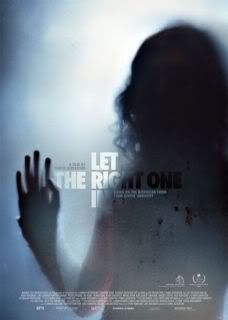
Let the Right One In is a film that I've been interested in for a long time. During its initial theatrical run, it didn't come to my state. When it was released on DVD there was a great deal of controversy about the dumbing down of the subtitles and I opted to wait for the original translation to be released on DVD before I viewed it.

It was thus brought to my attention that my best friend, Netflix Instant Watch, had a copy of the film with the original translation intact and. Unlike many foreign language films Netflix Instant Watch pimps, they don't force a dubbed version on me like the public school system completely failed me. Watching a dubbed film is like having my dad cynically half-describe a movie to me from the other room. In other words, it's for children. I know people my age who refuse to watch films with subtitles. The first film I saw with subtitles was Crouching Tiger, Hidden Dragon when I was ten. Maybe I was born for this, but I think it's more likely that you should read a book sometime.

I digress. Vampire films have a spotty history, and the best comparison I can make is to pirate films. The best pirate film ever made is obviously The Crimson Pirate, but ever since then there have only been a handful of pirate films produced that are even worth watching. While I'm an Interview With the Vampire apologist (I love production design, okay?), I could probably count the great vampire films on one hand. The genre isn't exactly known for being fresh. So few vampire films did anything different since Bram Stoker introduced vampires to sexuality. And pop culture. And we've been watching vampires make out sensually for the eighty years since.

Let the Right One In trades in sexuality, but it goes at it from several fresh angles and it trades in more than just that. To its advantage, it really isn't a vampire film so much as a romantic (I use the word loosely) thriller with a vampire in it. It's loosely plotted and mostly concerns a 12-year-old boy named Oskar who is viciously bullied at his school and his relationship with Eli, a girl who looks to be about his age but is quickly revealed to be a vampire. Mostly we follow their lonely worlds as they expand to include each other.

The film's violence plays into that as well. Easily the best blood-sucking or vampire-related imagery I've ever seen in a film, it's especially effective because Eli doesn't just appear innocent, but is innocent. There are several big, floating question marks around her character that not only have to do with her past (where there are several big, scarred question marks floating) but with her character. Despite her age, she is clearly very sheltered and is in most ways a 12-year-old, but killing for survival brings with it a certain maturity that only appears in flashes. Her character is handled with a logic. Lina Leandersson plays Eli with the characteristically vampiric flourishes, but at a different angle. Mostly we think of vampires as calm, collected and cold monsters because they've lived for so long and rejected emotion in a way that we think is obvious to assume a person that old would. Eli is calm, collected and cold, but it comes from a place of innocence and curiosity rather than one of cynicism. It's an extraordinary performance.

Elsewhere, the cinematography seems to be influenced by Asian, and specifically Korean, and even more specifically Chan-wook Park films. It's not aggressive in its beauty, but holy fuck it's beautiful. Cinematographer Hoyte Van Hoytema has a marvelous aesthetic, framing his shots symmetrically with slow tracking and a bleak color palette, mostly devoted to blacks and various shades of white. The production design is obsessed with squares and harsh angles, and maybe that's characteristic of Communist Sweden, and if it is I'd like to high five the shit out of whoever designed that gulag of a country at the same time as sort of be scared of ever going near it. It's such a perfect match for the cinematography, and if you ever want to discourage someone from being a Communist, all you have to do is show them this film.

The visuals do so much to push Let the Right One In as a horror film, and they do a damn good job of it. As I noted above, it's not really a horror film at its heart, but director Tomas Alfredson seems intent on showing us that if he had wanted it to be a horror film, he could have made it a horror film. There are a handful of scenes that, aside from the visuals, are extremely effective minimalist horror, and none of them directly involve any vampiring, as if to further prove the director's talent.

It's been years since we've had a worthwhile vampire film, much less an essentially perfect vampire film.

10/10