Showing posts with label the TV box. Show all posts

Friday, February 26, 2010

Rats in a Maze

I know that mostly on this blog I bring you my opinions on films, and not pieces on recent pop culture, but since I can't imagine anyone being particularly invested in this blog, I'm going to veer off course. Today I bring you a brilliant piece of anti-art that deconstructs various social phenomena and beg that you take it seriously.


Yeah, I'm talking about Jersey Shore, a show that has stirred retarded amounts of controversy for being about stereotypical modern Italians. There are stereotypical morons everywhere and just because they exist and a television network aims to show that they do exist doesn't mean that they're racist, pretending they don't exist is what's racist. Jersey Shore is a wholly justifiable account of stupid people being stupid in an environment where reckless stupidity is encouraged from birth.

I'm tempted to not even call Jersey Shore a show, but rather a social study. If an editor with some authority had realized this, Jersey Shore could have become a truly great documentary, but those of us savvy enough to see through the flashy editing and thick, gelatinous layer of drama see something far more interesting and perhaps a next step in social evolution.

Let's take their physical confrontations first. I've seen people get their heads bashed against walls and have their chests stomped in. When you see people in situations like that, there's a real possibility that a fatality will occur. Now, on the Jersey Shore, people will get in fights over nothing ("Go back to Staten Island!") and despite the mens' raging testosterone they do nothing but slap-fight. It's more of a territorial display than a confrontation driven by rage. Maybe it's the fantasy world constructed by MTV, but these people are never in danger of not having money or gym memberships or being harmed physically. The only real looming threat is alcohol poisoning, which shows up like the Ghost of Christmas Past to flash their lives before their eyes every god damn day.

For those of you who know the characters on the show (yes, they're fucking characters, and they may as well be animated), it's easy to say that the men are the most fascinating. Mike "The Situation"'s egomania could get him institutionalized, Pauly D actually comes off as a sort of shy nerd who thinks his DJing and neck muscles are going to keep everyone from noticing he has no idea how to interact socially, and Ronnie is a giant woman who spends a week every month shuffling around in sweat pants with his hair tied up complaining that women don't pay enough attention to him. And while historically, women murder themselves dieting and working out to be presentable to the men whose growling beer guts will bark at each other over which woman they want, the men now spend around two hours a day at the gym making sure their six packs are finely detailed enough that the tabs can be cracked while the women are constantly mistaken for a used tire dump. I'm not against women slugging beer like a keg and eating enough bacon grease to fry what's left of Haiti per se, but when the guys are injecting steroids into their eyelids to just be presentable, a problem is escalating.

The only one who seems to realize the absolute madness in the house is Vinnie, who is living his first summer as a 21-year-old at the Jersey Shore. My twentieth birthday is on Friday, so I completely relate to Vinnie's drunken antics, but most of the housemates are close to thirty and look like raisins baked in alcohol and glued to Sylvester Stallone's body. Vinnie bags more hot chicks and is more likely to comment on the insanity that flows through the house like vomit through Snooki than anyone else.

As for the women, the only outright insane one is really Snooki, a living balloon animal who is the brunt of some comic editing at least a few times, like the time that she dresses up like a pumpkin with tits and talks about how making out with and/or getting fingerfucked by a stranger in a club isn't really that big of a deal before we cut to her making out with a dude who's at the club with his girlfriend, standing about three feet away. She then storms out of the club and cries about how she can't find love when she takes off her underwear on the dance floor before picking herself up with a one-sided conversation about going to community college to become a veterinary assistant because "I fucking love animals". She also describes herself as "the fucking princess of fucking Poughkeepsie", a phrase that needs to be given a bath.

Otherwise, we have JWOW who seems to be under the impression that fake tits look like anything but soccer balls glued to your chest and that the Wicked Witch of the West had a sexy voice; Sammi, who is relatively sane for a seventh grade girl; and Angelina, whose position as most attractive girl in the house lasted about eight seconds before she started screaming at everything that was made of wood until she got kicked out of the house in the third episode. Snooki has become the celebrity of the women, and when that became apparent the producers clearly tried to push her into a relationship with The Situation, which was awesome because they spent the entire summer coming to terms with the fact that no one would fuck them. Unfortunately, I smelled foul play as soon as The Situation left Snooki naked in a hot tub, came up with a lame excuse for the cameras and went back downstairs to scrub his dick.

It's easy to make fun of these people for being stupid, and one of the reasons I waited so long to post this was to avoid being piled in with the many bloggers who were ragging on the cast of Jersey Shore for being stupid, but my real point is that in a modern society where all stresses are removed and the hunter-gatherer instinct is placated, the modern mating ritual comes front and center and Jersey Shore offers every kind of mating relationship possible, and it would seem that it comes by this conclusion completely naturally and innocently. That's a rare and truly incredible thing in art and I think it's worth pointing out. I think Jersey Shore gets to the center of human sexuality in a far more honest, compelling way than many great works of art that made its mission the exploration of sexuality. It's trash, yeah, but it's trash that stumbled upon something great.


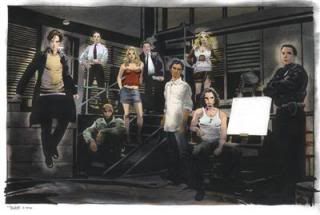
PS - I made this infographic to illustrate the show for those of you who haven't seen it yet. It was going to be prettier but I decided it wasn't that important to the impact of my piece, so I left it the way it is. I didn't even bother making the background blend with my blog's background. Hohoho!

Saturday, January 30, 2010

Best Friends Forever

I'm not a psychic, but I am more perceptive than you. When I say that I fucking knew that Dexter would shit itself inside out when the first two seasons' cocaine barrel ran dry, I'm not bragging, I'm just using my powers for the good of the land.

The first season tracked Dexter's interactions with another serial killer, getting into his head in a very talky, meticulous way while the second season made Dexter the protagonist of a thriller, engaging his character with more action and suspense (more my syringe of poison). Now we're apparently out of angles to go at Dexter's character with, and like so many dramas the writers need to find new things to keep the audience's attention. Cheap gimmicks and violence porn will take the place of the well-written, meticulous character study we've all gotten used to streaming off the finest television pirating websites that 1997 can buy.

The writers' and producers' gimmick is the best friend one. A best friend that Dexter can go golfing with and talk about power tools with and make friendship bracelets with and slit throats with and one that he can eventually drive to the brink of sanity with violence and secrets. Which actually sounds like a good way to approach a story, but there were fundamental flaws in that idea that the show was never going to get around. It's my inclination that Miguel Prado (the best bud in question) being more sympathetic and wanting to help Dexter control his urges but eventually being driven mad by the evil that is only just below Dexter's skin would make for a far more interesting arc. It's unfortunate that the writers opt to make Prado a scheming villain instead, presumably as a quick way to ultimately dispatch the character once the season is over. That gives us nine or so episodes of Prado being a good guy and getting through to Dexter's inner demons, and then throwing him away by making him evil, even contradictory towards his established character once his character has run its course, which strikes me as terribly cheap. For one, it's hard to buy Prado's deception when he's been more like a little kid than a brilliant assistant district attorney. Also, he doesn't seem to understand how being a district attorney works, or at least he has a thirteen-year-old's view of it. After fourteen years of being an ADA, he still hasn't figured out why defense attorneys are there and thinks that district attorneys are the untouchable kingpins of Miami that cannot be stopped even by death.

There's a completely separate case that all our favorite Miami Metro Homicide team is on while Dexter dicks around at sleepovers, and it could not be more lame. It's like an episode of CSI Miami stretched out over twelve episodes. There's just nothing of value or substance in this plot line and it's the worst, most obvious sign that the writers were out of material. They're hunting a serial killer who is looking for a drug dealer that disappeared (Dexter killed him, setting off a string of murders that effects him in no way! They never even mention it!) and that's it. There's nothing else to it. They talk to witnesses who give them clues that, with their police resources, they use to tighten the gap between them and the killer, which like listening to someone describe an episode of Law & Order for two hours. And when they run out of boring police procedural shit, they go to Deborah, who's having a retarded interracial romance with some punk, which is cool because last time we saw her she was balling a Peter Fonda lookalike.

The show is aiming to make Dexter more normal, which is at least an arc for him to go through, but I'm not convinced it's for the best. It's easy to relate to him getting married and having a baby, but him pretending to be normal or doing routine stuff has never been what makes this character interesting. Thankfully, Michael C. Hall is still up to the task of making his character compelling. I've realized that the way Dexter interacts with people when he's preparing to kill someone requires an actor with a complete and comprehensive knowledge of every social grace of every group, ethnicity, age and whatever. Hall understands his character very well. It's a performance with a lot of ticks and sudden changes in demeanor. There are shades of classic movie spies in it, strangely. Also, and I don't know whether to accredit this to Hall's performance or his anonymous looks - I suppose both - but the scenes where he kills are by far the best things about this season. It's a shame there are fewer of them this time, but Hall's performance is very intense. So many of his emotions are faked, and faked so well that we often forget he's faking, but one of the few times we get any real, genuine emotion from Dexter is when he has someone on his table and his words come out in a controlled hiss of pure fucking evil that plays so well against his happy family man/mild-mannered blood spatter analyst image and for just a few moments the show lets Dexter become the villain. There's something deliriously macabre about his apron and his clothing in those scenes, with their muted greens and grays and crisp, freshly laundered look.

I don't know if this season really is host to better acting from Hall or if I just never really grasped that aspect of the performance before now. I'll lean towards the former so that I can credit this ass train of a season with less and I can end with a statement to the writers.

If you run out of story ideas for your show and you don't want the swimming pool to stop getting filled with cocaine-basted roast chickens every morning, you're going to have to make the executives in charge understand that your show needs to stay on the air. And since you've been freebasing Oxycontin off script pages all morning, you're going to have to come up with something fast, but that thing you come up with fast should no longer be "we'll waste such great performers in such great roles", because a savvy studio executive will see through that and have you fed to alligators and your former body parts will spend the rest of their existence being set dressing in Australian comedies. Although I wonder if I could get another Jurassic Park film made with that logic.

3/10

Wednesday, January 20, 2010

Isn't It Good

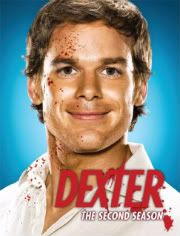
It's a curious thing to watch something slowly but swiftly move into greatness, and there's nothing more satisfying than seeing a great creative individual or team turn their failures or missed opportunities into greatness. Every shortcoming of Dexter's first season has been used as a trampoline to grab onto the treebranches of excellence, and the excellent second season would not be possible without those very specific shortcomings. I know in my boners that the writers and producers of Dexter knew that their first season would be their weaker season, but if they could succeed at making it a hit, the second season would be their great achievement.

That said, it has a great deal of surface flaws that could have been fixed quite easily. That it's rife with flaws is just something one has to learn to respect about serialized drama, and that these flaws are so wildly specific to the need for twelve hours of drama lest ye die is disappointing. It's the eternal reminder that, as a product, film and television is always going to be hamstrung by its need to meet certain requirements for the sake of marketability and longevity of investment. I'm more willing to forgive these flaws, though, because television offers a venue for serialization at the same time as long-form drama and while certain concessions are necessary, they're not concessions made by the creative team but rather by the medium they're working in. Television is a flawed medium and that's not going to change until televisions themselves are entirely replaced by the more malleable streaming content or until a mad genius figures out how to work commercials into a narrative.

For those of you who haven't seen the first season, I'll be discussing plot points for the second season that tie into the end of the first season. Also, you may want to know that the show is about a blood spatter ANALyst and sociopath who murders bad guys. In faggot's terms, spoile4s hehe.

After dispatching the Ice Cream Sandwicher, Dexter has become distraught. For almost a year the personal mindgames he played with another serial killer gave his life verve and meaning. His sister is a shaken mess and living with him after her intensely intimate encounter with the Ice Man Cometh and Sgt. Doakes is suspicious of Dexter and following him at night. Oh yeah, and a scuba diving team uncovered the dozens of dismembered bodies Dexter has been dumping in the ocean for years.

On the lame side of things, Dexter's girlfriend Rita thinks that Dexter is a heroin addict and sends him to Narcotics Anonymous where he meets a fox named Lila who, like all attractive women, is totally out of her mind. This is where the series shows its allegiances. When given the choice between being an intense thriller slash dark comedy and being a soap opera, it jumps into the neon jean shorts of soap opera with no shame.

And god damn the writers for taking the easy way out, because they strike dogs about halfway through the season only to give it all up like they couldn't wait. As the first season flirted with dark comedy and horror, the second season becomes a full-fledged black-as-the-heart-of-Africa comedy and we get a scene or two of such knee-shattering horror that it became heartbreaking to watch the writers and producers cop out for the sake of tits. Everything aside from its meandering narrative is an improvement over the first season. Every character is fleshed out and given dark, rough angles, especially Angel, the loveable brown spot on Dexter's rainbow of political correctness who gets a comic and tragic angle and goes through a very sympathetic arc. Deborah, Dexter's sister, is given the most complete arc that also falls victim to some soap opera writing towards the end, but her story is incredibly true to her established character, which goes against the time-honored tradition of destroying a well-established character and rebuilding it for the sake of the plot.

But really the best character on the show was Sgt. Doakes, the endlessly intense, borderline psychopathic police officer who is obsessed with proving that Dexter has some kind of secret. This is the dynamic that allows the second season of Dexter to become the best thriller I have ever watched on television. All those stupid asides that focused on Doakes last season that I complained about are given purpose. Without his character fleshed out, and without his background probed, we would never understand the transformation he goes through and we'd never sympathize with the horrors he goes through.

What makes Doakes such a spectacular antagonist is not only the way Dexter's heroism (in that he's the character we follow, and therefore the hero of the story even if someone else has the moral highground) is established against the Ice Tray Cracker (who is pure, swamp monster evil) in the first season and then challenged by Doakes in this season. Doakes is an asshole, for sure, but he's also a good cop who plays by the rules and gets the bad guys the right way. Dexter is an evil little bastard who hopes Doakes fails so that he can kill the criminals that slip through his fingers. Like all great hero-villain relationships, the conflict is tied to our own sense of morality and we choose sides based on that. If a film or television show understands that, they have the viewer by the balls.

I misjudged Dexter based on its first season and want its forgiveness. I take back everything mean I said about the first season and only stick by my criticisms of the second season. It's a strong argument for not passing judgment until you've seen every episode of a television show, but mostly I'm pleased that Dexter called me out on my lack of patience. It's a show with patience and I'm glad I stuck with it. I encourage anyone considering starting with this show to approach it with the same patience.

9/10

Friday, January 15, 2010

The Tightening Noose

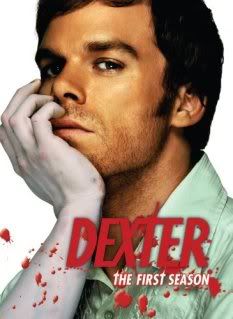
I've just finished the first season of Showtime's Dexter, which I started watching shortly after I discovered how much was available to watch on Netflix Instant Watch, and holy shit there's so much to watch on Netflix Instant Watch. I was completely unprepared for it. When the option was first presented to me, I quickly looked through the available films, saw a handful of good titles and even watched the first few seasons of The Office on a bender with a friend's Xbox.

So Dexter became the ultimate test of this Instant Watch service. And what can I say? It's streaming content, so it's certainly not HD quality or anything, but that's a worthy sacrifice if, like me, you tend to want to ingest TV shows all at once instead of waiting for individual discs to arrive in the mail, and especially if you're sharing an account with a family of seven and you have the two-at-a-time service and every time you get something you're renting a Michael Bay film.

I'm sure you all know that Dexter is about a blood spatter analyst cum serial killer played by Michael C. Hall, but he's a serial killer with a catch: he only kills bad guys. How does he determine who's good and who's bad? Cold logic. He's a sociopath, after all. And why is this film so different from all those shows and movies about subverting the law and murdering to satisfy your personal code of morality that I hate so very much? Not enough, honestly, but Dexter is a sociopath who kills first and foremost to satisfy his desire to murder; I just wish the show would keep that in mind when they deviate from the main story line to have Dexter pornishly execute a drunk driver. Dexter is a sociopath who has the same relationship with a code of morality that I do with the process of making a tequila sunrise. If I mix all these things together I can have a tequila sunrise, which has tequila in it, so hooray. I could drink the tequila straight, but that's not how it's done, I'm supposed to have something larger and I'm supposed to take it slower. The writers take a more commercial approach to the murders, trying to appeal to the audience's love of violence and disgust with criminals. The more interesting approach would be Dexter's hatred of the code, but continued obedience to it out of respect for the man who taught it to him.

Aside from the show's antiquated hatred and misunderstanding of marijuana, there's one scene that's very tellingly constructed from a morally conservative standpoint. Spoilers for the rest of this paragraph. One episode follows Dexter's disposal of a couple who bring Cubans into America and kill the ones whose families can't pay the activation fees. A child hiding in a car trunk gets a front-row viewing of Dexter sedating and dragging the wife off. Dexter has to investigate his own crime scene (rote and you knew this would happen from the moment you heard the premise, but come on, it's still pretty cool) when the police discover the child. They get him to talk to a sketch artist and together they produce an immaculate drawing of JESUS CHRIST. It's like having sugar poured directly into your tear ducts by Glenn Beck. I almost stopped watching the show right then and there. If Dexter was going to become the symbol of the heroic that catch the wicked on behalf of those damned liberal courts that never seem to catch them themselves, I wasn't going to be a part of it. I pressed on, mostly out of curiosity for Dexter's character. Despite what happened in that episode, I was getting invested in the character, despite how hard large portions of the show were working against it.

And in spite of all that they did, the character, remains intact and interesting. The most interesting portions of the show are his interactions with the police officers he works with as a blood-spatter analyst and his personal interactions. Now, those personal interactions are best when he's with his girlfriend Rita, but I'm not convinced they couldn't be better with his sister, a detective who he also works with. In fact, Rita and Dexter's relationship is a sub-plot I'm not entirely sure I like. Rita's a well-written character, but her relationship with Dexter is played out, especially since we get the same pieces of character from his relationship with his sister, and his relationship with his sister tends to be pertinent to the plot.

But what would they do with forty hours of freed-up time getting rid of Rita would give them? More introspection and more fantasy sequences. Being a sociopath, it's difficult to get to know Dexter through his interactions with others, and the writers, for whatever reason, only use his narration and fantasy sequences in conjunction with his interactions with others, rarely to reflect on the world around him. He even says he lives his life in his head, and being in there with him would be a billion times more revealing than trying to figure out what he's thinking while he interacts with people and pretends to be normal.

The biggest offense I think the show commits is to take us out of Dexter's head and give us entire subplots about the world around him, especially the fucking cops he works with. Every time we have a subplot about them, it drags us away from the best part of the show and into the land of boring, Law & Order police procedural bullshit. I don't see why the show needs to create all these salt-of-the-earth characters and put us in their presence for so long. I assume it's because they think we won't be able to relate to Dexter and need to fall back on boring stock characters. And they're right. Most of their audience aren't sociopaths and can't relate to what Dexter is going through, but that's only one way to connect to a character. Just because he's not relateable doesn't mean he's not sympathetic or interesting. And if we can relate our everyday struggles to a character, chances are he's not terribly interesting. Dexter's head is an interesting place and nothing else the writers come up with really compares.

Excel though it may when we're inside his head, the show's approach to the mind of a serial killer isn't exactly original or unique. It's seriously indebted to the writings of Bret Easton Ellis, and even manages the most excruciating homage to his work in one scene that's like being hit over the head with a pole made partially hydrogenated stupid. After all, Ellis' stuff has been brought to life on film really well only once and I think it has a lot of life left in it.

In any case, I just watched the first season. Perhaps all the problems I have with the show are solved further down the line, but based on what I've heard, they aren't.

6/10

Thursday, November 5, 2009

Those fucking kids

Patrick Stewart is a man's man. I get such a jolly from watching him perform, and he's the coolest captain the Enterprise ever had. As much as I like watching the bridge crew drag Kirk away from the self-destruct console after he spots a spider near his chair, Picard is beyond badass. Patrick Stewart (and by virtue, Picard) is everything a 21st century man should aspire to be.

By formulaic, I mean it might cure jaundice and confuse me on my math midterm. But Star Trek: Generations is damn formulaic. So formulaic it doesn't seem to understand the difference between a television show and a theatrical motion picture (wider aspect ratio, FEWER STUPID SUB-PLOTS).

Here we go. We open on Kirk, Scotty and Chekov being shown around the bridge of the newest incarnation of the Enterprise. Kirk is bugging out because Sulu had time to grow some children-trees despite being gay and despite his commitment to Starfleet. They take the Enterprise out for a stroll around the block when they receive a distress signal from a group of transport ships caught in some strange magnetic anomaly. The inexperienced, indecisive new captain struggles with his ill-equipped ship until Kirk takes over, ultimately dying in a freak accident when trying to rig the hull to buy a few extra minutes for the crew.

This is a fitting death for Kirk. It's the sort of end many people have met on the Enterprise but none of the bridge crew have met because so rarely do they venture into the hull.

Flash forward 80 years to the GAYEST possible film introduction to the Next Generation crew we could have POSSIBLY conjured. They're on an 18th century warship, all dressed in French military uniforms and giving Worf a best friend bracelet in a phenomenally gay ceremony. Apparently it's a hologram (whatever), but this hologram machine can't hologram-in-ite them uniforms, so they spend at least a few minutes in front of their crew in French sailor uniforms.

Unfortunately, Data begins to grasp the meaning of cruel irony but without the restraints of remorse. Worried that Data will soon become an efficient killing machine with a tenuous grasp on humor, LaForge stuffs an inhibitor chip inside of him that makes him feel all the shitty emotions like sadness and fear but without the awesome emotions like murderous rage and bottomless greed.

That's when they find Malcolm McDowell who is, surprise, evil. He's going to blow up a star so he can get back into something not unlike the simulator Picard and the Gang were just hanging out in. I'm still not clear on how blowing a star up is necessary, perhaps he just wanted to be on the (very) long list of people who challenge the Federation and the (very) short list of people who don't get vaporized or thrown into a pit of lava for their trouble.

He's struck up a deal with some Klingon lesbians and they stand around and suck just like everything else in this fucking movie.

Let's break down the Next Generation crew, shall we?

Picard is a badass, yeah, I know. But LaForge is a little girl, and blind, and totally incompetent. Data is the emotionless science officer, not unlike Spock, but without Spock's predilection towards kicking tons of ass and generally being an emotionless killing machine/pun dispenser. Also he's the only android I can think of that gains weight.

Worf is...well, what the fuck does he even do on this ship? Scare children? Public relations? I understand that if you're shooting every day in elaborate makeup, it can get tiresome, but it looks like he walks into the makeup trailer every day and just shoves his head into a bucket of brown makeup with some eyebrows carelessly thrown in. Also, he sounds like he's on the run from gambling debts and has half-heartedly tried to change his voice.

Riker looks like a seasoned sexual predator, but not of the rapey variety. Of the "I've got you in the makeup trailer all by yourself and I can already smell the sexual harassment suit coming my way" variety. His uniform is also too damn broad with shoulder pads making his shoulders boxy but his midsection round. I get that most of these actors are pretty old already, but Jesus, don't let people self-conscious about their aging pick out their wardrobe.

The whole film looks cheap, like their budget is lower than it was on the TV show. They couldn't redesign the uniforms? How much could that cost? Forty dollars? But it doesn't even matter, the whole film feels like a season finale. William Shatner is thrown in so that people will have some reason to go see this fucking thing and he's given a death with all the dignity of being punched to death behind a Denver Denny's and left in a dumpster. I'm pretty sure Kirk has crossed bridges before and many times. Was he nervous in front of Picard?

The whole film reeks of a script that could have been very strong in the hands of a better director, or maybe with a few rewrites. There are some interesting things going on, such as the opening that could have been breathless, not unlike the opening for Abrams' Star Trek and there's a scene where Picard is separated from the villain and is trying to talk him out of his plan that could have worked better with some stronger dialogue and some better imagery.

But the thing that endlessly undercuts whatever might be working about the film is Data's subplot. It adds nothing of thematic value to the story and doesn't tie into the main plot at all. It's just a rejected plotline meant to give Bret Spiner and his diamond cream more screen time.

It sucked.

But then again, Patrick Stewart.

3/10

Saturday, August 15, 2009

For the World is Hollow and I Have Touched the Sky

The second season of Heroes catches a lot of shit for, well, being the second season. As far as I can tell, people seem to hold the Writer's Strike against it, and far be it from the guy who holds a grudge against Paul Newman for being dead to tell you that's unfair.

But I didn't think it was bad. In fact, I thought it was roughly as good as the first season, with some cool plot twists stuffed in along the way. Most people seem to think that the first season was some rip-roaring adventure tale, full of excitement and peril, but I never really felt that way. The writers of the show never seemed to figure out how to pace the show well. Episode-to-episode, the show was paced very well, but scene-to-scene the show displayed an amateurish knowledge of what makes things suspenseful, often undercutting its own hard work with stupid sentimentality.


The exception to the rule, though, is the abso-fucking-lutely fantastic episode "Homecoming". I'm only through the second season, but I have my doubts that the show will ever be able to top its excellent work there, where all the problems I have with the show were temporarily caged in favor of kicking ass. As much as I love Zachary Quinto in this show (and I fucking love Zachary Quinto in this show), his character was a lot more fun when he just stood in the shadows, making things fly around and taking peoples' brains in the most spectacularly violent method possible. And I miss the whole Isaac Mendes premonition business.

People also seem to hold the last episode in high regard. The final showdown between Sylar and Peter seemed very small-scale and anti-climactic, although they only made it worse with Nathan's fucking monologue that did nothing but sap any suspense out of the scene.

The second season resolved a lot of problems and introduced a host of new ones.

First problem they introduced. Where the fuck did Sylar go? I couldn't help but feel like his line was artificially lengthened by sending him on a road trip with some Nikki and Paulo.

And something that has been an issue from the beginning is that we are never given a clear indication of the lengths and limits of the characters' abilities. For example, at the beginning of the second season, Sylar kills the chick who makes illusions, and then freaks out when he doesn't absorb her ability. The whole fucking first season he's been snatching up brains, and now he doesn't and all of a sudden he's shitting himself over how he lost his powers. In any case, the whole brain-snatching thing doesn't make tons of sense. Is he eating them? Rubbing them on his skin? Making a necklace? Putting googly eyes on them? How does he absorb abilities that aren't necessarily mental through the brain? Does the brain tell your body to have super strength? If so, shouldn't he be able to develop powers by sheer force of will?

One of the nice things about this season was that Nikki-Line was pretty much shoved to the back, so I didn't have to watch more characters fawn over how beautiful Ali Larter is just because she's banging the producers. Unfortunately, Micah-Line is just as bad as it was the first season, and we pretty much have to watch Claire go through the exact same arc, except this time with some flying loser nerding all over the place and babbling high school cliches about how being different really is good. Maybe all the middle-aged housewives that are watching this show will give up football tryouts and join the math league now.

The plus side of Claire-Line is that Jack Coleman really gets a chance to stretch, and he has been one of the best parts about the show (even if they won't shut up about his glasses).

And Peter's line continues to be really boring, ever since they retconned his power to "taking off his shirt". This time he doesn't even have the more-interesting Nathan character there to boost that lamewad story.

But the real crime in this season is Hiro-Line. I get that making Kensei the villain in present day is pretty inspired, but there's no reason in the cosmos to make the ancient Japan story go on for so long. It had all the aesthetic pleasures of an episode of Reading Rainbow, the thematic value of one of their featured books and the breeziness of Ayn Rand.

But it wasn't a monstrosity like everyone made it out to be. It about evened out with the vastly overrated first season. It's still a pretty good show, but it has been, and always will be, the over-eager but well-meaning little brother of Lost.