
It's taken me nearly six months, but I finally finished my trek through the Star Trek canon. I've watched all eleven films released over 30 years and watched half-interested at all sorts of intergalactic turmoil.
It's unfortunate that these films were, by and large, not very good. In fact, this series was consistently mediocre or sub-par. Only three of the original ten films I'd really consider rewatching or giving much thought to, however I reserve the right to reevaluate my scores in light of my newfound appreciation for the Star Trek canon, the magic of hindsight and the ever-changing tastes of a nubile blogger. In chronological order:
1. Star Trek: The Motion Picture (1979)
Original Score: 7/10
I'm a sucker for hard sci-fi and the Original Series struck the perfect balance between mass-appeal gadget porn and real existentialist pondering. Also, I'm a sucker for operatic shots of space and gorgeous sci-fi production design. If it weren't for the effects and production design this would be a pretty empty film, though. Even the cast seems disaffected by the script. It is, however, a great capoff for the Original Series. The rest of the films don't resemble it that much and could easily be any space adventure with any cast. While The Motion Picture doesn't do a lot to preserve the cheap aesthetic of the series, it's a great reunion show for the cast.
Revised Score: 7/10
2. Star Trek II: The Wrath of Khan (1982)
Original Score: 4/10
For all the hype surrounding this film, it was even more static than the notorious The Motion Picture. The conflict was slow and unengaging and the characters spent the movie sitting in chairs and doing little to interact with their environment. There was never any sense of urgency or danger, but there was Khan, who was a fantastic villain and probably the only reason I can see to watch this movie, and that's more than some of the later films will offer.
Revised Score: 5/10
3. Star Trek III: The Search for Spock (1984)
Original Score: 3/10
It's meant to be an exciting space adventure, but the cast always looks like they just woke up and are waiting for their coffee to be ready. And without Leonard Nimoy, the film loses its best actor. And, if stories are to be believed, when casting the Klingon villain they went with Christopher fucking Lloyd over Edward James Olmos. That just might be one of the horsemen of the apocalypse.
Revised Score: 3/10
4. Star Trek IV: The Voyage Home (1986)
Original Score: 5/10
Discussing this film with a Trekkie friend of mine, he suggested I might get better mileage out of the film if I stop thinking of it as a comedy. I realize that my preconceived notions about the film and what people had told me about the film got in the way of my critical duties, because it's a perfectly fine movie if we ignore all the easy fish-out-of-water comedy. But the whole thing is so fucking safe. The cast doesn't seem to have any energy. It's just a routine space adventure with nothing at stake and no reason to get invested.
Revised Score: 5/10
5. Star Trek V: The Final Frontier (1989)
Original Score: 2/10
This film is like straight vaudeville. If I didn't know any better, I'd think it's an experimental film made for the sake of weirdness. It certainly held my attention the best of any of the films up to this point and it's hard to deny that it's the most unique of all the films in this series. Still, the shoddy filmmaking and my suspicion that weirdness wasn't the intent and it was just the result of an inexperienced rush job conspired against it, giving it a score that would imply that I hate it. On the contrary, I quite like it and, damn it, this is MY blog and if I like something, I can give it an appropriate score.
Revised Score: 7/10
6. Star Trek VI: The Undiscovered Country (1991)
Original Score: 7/10
The first film in the series that really starts getting anything right comes a little bit late. It's a fun space adventure with aliens, far-off planets, space battles and exciting drama onboard the Enterprise. The drama of the film is unique to the characters and they have things at stake. The cast has more energy here than they've probably ever had and Nicholas Meyer keeps things bounding in his second outing as director after Wrath of Khan.
7/10
7. Star Trek: Generations (1994)
Original Score: 3/10
It was just an episode of the TV show. It was all stupid. I'd much rather watch the TV show. At least the TV show tended to be well-written.
Revised Score: 2/10
8. Star Trek: First Contact (1996)
Original Score: 8/10
A smashing artistic and financial success, First Contact introduced elements of horror and amped up the action, giving a certain six-year-old boy nightmares for months. It's exactly the sort of gamble on tone that the series needed and everything is the better for it. The metaphysical pondering is the most effective yet, the story is the most exciting and the actors never did better work (that I've seen, I'll bet Patrick Stewart making breakfast every morning is a harrowing experience). Unfortunately there are some problems, mostly that the filmmakers don't want to make the film TOO exciting. Am I allowed to deduct points for missed opportunities? Hell, I'm doing it.
Revised Score: 8/10
9. Star Trek: Insurrection (1998)
Original Score: 3/10
It's got pretty much all the same problems that Generations had. It's not even a noteworthy failure. It's just terribly boring. The exciting new directions they went in with First Contact have been mysteriously abandoned. Patrick Stewart's god-like acting seems to be on vacation and we have to listen to bullshit about some group of old people who don't want to be sent to a retirement home even though their shuffleboard court is on top of the solutions to many of humanity's most desperate fears. I didn't get it, I was totally on the Federation's side the whole time.
Revised Score: 3/10
10. Star Trek: Nemesis (2002)
Original Score: 4/10
I'm pretty much subtracting six points for missed opportunity here. This was a film desperately trying to be great, but stuck with a director who didn't know what he was doing and a cast too tired to bring any life to the film. It's like a great musician taking a final bow and then getting his violin strings wrapped around his neck.
Revised Score: 4/10
Even if I liked hardly any of these films, I think I'll miss doing them. It was always interesting and there was always very little accumulated wisdom of the films going in to skew my perspective. Goodbye, Star Trek. You were probably never right to be a film franchise.
Showing posts with label Star Trek. Show all posts
Showing posts with label Star Trek. Show all posts
Thursday, January 14, 2010

Saturday, January 9, 2010
Yes, Father. I Will Become a Starship Captain.
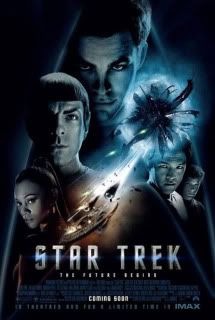 J.J. Abrams' 2009 Star Trek reboot is only sort of like a Star Trek film. If it were a real, tangible item, you probably couldn't get a grip on it without it slipping through your hands like it was covered in afterbirth. In defense of the filmmakers, and I guess this whole review will be my defensive position on Team Filmmakers, the Star Trek series has been covered in duct tape for a while and has really needed a greasebath. It's a new direction for the series, yes, but it preserves the characters and it's the only way the Star Trek series was going to continue. I don't imagine the nerd scum would be happy seeing their favorite daydream blown off the cultural radar and into little tiny pieces of shrapnel called "Family Guy spoofs of William Shatner's voice".
J.J. Abrams has done so much to make this Star Trek film that it needed to be. It's fast-paced, shiney and fun as opposed to the last few films, which were like playing with a rusty pair of scissors. And while he may not have preserved Gene Rodenberry's original intentions, he's preserved his characters in a way that pays tribute to the original ensemble with new actors that don't have to be forced into the script to appease the hoards of bloodthirsty Trekkies. Despite a few lapses in narrative logic (okay, gaping plot holes, are you happy?), the script is exciting and fast-paced and each copy was probably lit on fire before being handed to the actors.
Even if this is the second time I've reviewed this movie here, allow me to summarize the plot. It's futuretime once again and Earth is as gay and boring as ever, while there's all sorts of excitement to be had in space. The USS Kelvin is attacked by a massive Romulan ship, commanded by the delightfully evil Nero (Eric Bana) who spear-guts (In the future? Hot damn!) their captain, leaving first officer George Kirk in charge of escaping certain death. His pregnant wife goes into labor (women!) as weapons systems and autopilot fail, leaving Kirk to pilot the Kelvin into the Romulan ship and buy the escape pods time to escape, creating a sassy 9/11 subtext.
Mrs. Kirk gives birth to Baby Kirk who grows up to be Big Poppa Kirk (Chris Pine) who enlists in Starfleet and meets Leonard McCoy (Pathfinder) and begins a rivalry with Spock (Zachary Quinto). When Captain Nero appears for the first time in 25 years and takes the Enterprise's captain, Christopher Pike (Bruce Greenwood) captive, Kirk and Spock must learn the true nature of friendship to overcome a villain they both have vendettas against.
But let's focus on that first paragraph for a while. Star Trek's opening is another in a long line of perfect opening scenes this year. Abrams is king of this scene, stacking one horrible revelation on top of another and buttfucking the audience into nosebleed with suspense. It's almost an argument for short films, strangely enough, where this ten-minute sequence outclasses an otherwise excellent film on every level, mostly because the writing doesn't have to spend time connecting the dots and the characters are established in such quick strokes. Maybe it's an argument for good writing. I don't know. The film never maintains that momentum, and I don't blame them, really, but that one scene is an action/suspense masterpiece that, surprisingly, preserves the slow, naval feeling of Star Trek space battles.
As an action film and as an adventure film, it is fast and jaw-shattering, but it never again manages to be king of suspense mountain and the construction of individual scenes becomes rather more pedestrian.
None of that's too much of an issue, a film two funzos lower on the fun scale than that first scene would still rock your cocks. The only grave mistake this film makes is with James Kirk himself. First, Chris Pine is miscast, but the role is also written wrong. I'm all for reinterpreting a classic character, but Kirk is at odds with the logic of the script. How can this cocksucker ever inspire loyalty in a crew? That's suppsoed to be the defining aspect of Kirk: he inspires loyalty. Chris Pine does the film no favors by playing Kirk as a smug bastard, instead of making him charismatic and forceful in spite of his dickheaded behavior, he's just brash and dickheaded in spite of his dickheaded behavior.
Treatment of other characters elsewhere is way better. Doc McCoy gets a perfect performance from Pathfinder, Spock is less sad-looking thanks to Zachary Quinto (who was always my favorite part of the perpetual shitwagon Heroes, Lost's bumbling little brother), Scotty gets Simon Pegg in his best performance since Hot Fuzz, and seeing that is worth the fact that you'll never make out with the ticket girl now that she's seen you buy a ticket to Star Trek. Uhura least resembles her original character, and is played by an indistinguished Zoe Saldana, which is a depressing thought, going back to her work here after her work in Avatar blew my mind all over the wall.
Elsewhere, Eric Bana is great in a role that's a bit too small for him, playing an evil wizard. There has been a lot of derision aimed at his performance and how it's one of the weaker elements of the film, but that's something I haven't even begun to figure out yet. He flies around in a giant spaceship that looks like a petrified squid and turns planets inside-out. He also made a spaceship that can only be navigated by Olympic longjumps, unlike the sterile white Plexiglas of the Enterprise. Really, the design is top-notch. It maintains a very 1960s-futuristic feel while at the same time updating it to something we recognize as futuristic (phones the size of feet!). It's not terribly subtle, but it's pretty sweet and it'll make any smelly Indiana viewer think that he's an expert on production design.
Okay, okay, LENS FLARES. I thought the lens flares gave the future a look of brightness and optimism and gave the film a totally unique look. It's a self-conscious move: lens flares, after all, are only produced by a camera. I don't think that's too different from modern films being shot in black and white or any amount of flashy cinematography. After all, any of those techniques are reminding the viewer, in a very deliberate way, that they're watching a movie. Maybe I'm missing the real reason that lens flares are the devil's tool, but for what it's worth, I thought they were great for what they were. As a technique to give the film a memorable look, it worked, and it worked on a thematic level.
Similarly, it's a good aesthetic to capture the action and translates well between the action and interactions between characters and between the ships. As I said before, the space battles are played as fast-paced naval battles and are shot with verve and style. The action between individual characters harbors one of the film's best tricks to keep the film flowing quickly. That is, none of the action sequences last very long at all. They're all shot and staged excellently, but that tendency for them to go on for ages and burn the audience out is ignored. Instead the action bleeds into the next scene seamlessly (watch the drill scene closely to see how each individual scene is attached to a much different sort of action scene) and the tension never even begins to fade.
So, let's recap. Great opening, looks like it was rubbed with ham, terrible lead performance, good supporting performances.
Take that, Star Trek canon.
9/10
Elsewhere, Eric Bana is great in a role that's a bit too small for him, playing an evil wizard. There has been a lot of derision aimed at his performance and how it's one of the weaker elements of the film, but that's something I haven't even begun to figure out yet. He flies around in a giant spaceship that looks like a petrified squid and turns planets inside-out. He also made a spaceship that can only be navigated by Olympic longjumps, unlike the sterile white Plexiglas of the Enterprise. Really, the design is top-notch. It maintains a very 1960s-futuristic feel while at the same time updating it to something we recognize as futuristic (phones the size of feet!). It's not terribly subtle, but it's pretty sweet and it'll make any smelly Indiana viewer think that he's an expert on production design.
Okay, okay, LENS FLARES. I thought the lens flares gave the future a look of brightness and optimism and gave the film a totally unique look. It's a self-conscious move: lens flares, after all, are only produced by a camera. I don't think that's too different from modern films being shot in black and white or any amount of flashy cinematography. After all, any of those techniques are reminding the viewer, in a very deliberate way, that they're watching a movie. Maybe I'm missing the real reason that lens flares are the devil's tool, but for what it's worth, I thought they were great for what they were. As a technique to give the film a memorable look, it worked, and it worked on a thematic level.
Similarly, it's a good aesthetic to capture the action and translates well between the action and interactions between characters and between the ships. As I said before, the space battles are played as fast-paced naval battles and are shot with verve and style. The action between individual characters harbors one of the film's best tricks to keep the film flowing quickly. That is, none of the action sequences last very long at all. They're all shot and staged excellently, but that tendency for them to go on for ages and burn the audience out is ignored. Instead the action bleeds into the next scene seamlessly (watch the drill scene closely to see how each individual scene is attached to a much different sort of action scene) and the tension never even begins to fade.
So, let's recap. Great opening, looks like it was rubbed with ham, terrible lead performance, good supporting performances.
Take that, Star Trek canon.
9/10
Thursday, January 7, 2010
Nemisees, Nemesi
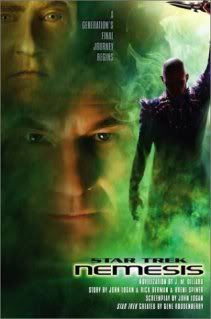 There's a story that the producers of Star Trek: Nemesis wanted Nicholas Meyer, who directed Star Trek: The Wrath of Khan and Star Trek VI: The Undiscovered Country to direct their film. He asked to be allowed to rewrite the script himself, and when the producers refused, he turned down their offer. In that moment, the Star Trek franchise ended and would need to be pumped full of youth and lens flares before it would be suitable for human consumption again.
But you can't really describe Nemesis as being fit for human consumption. It's probably the most frustrating of any of the films, because if Nicholas Meyer had been allowed his rewrite and if he had been behind the camera, I have no doubt it would be the best of the original ten Star Trek films.
I don't mean to talk Nicholas Meyer up so much. After all, I don't have much love for Wrath of Khan, and while I quite liked The Undiscovered Country, it's no masterpiece and has its fair share of flaws. The problem is that up to this point, very few Star Trek filmmakers have had any experience behind the camera before making their film. Really, the only experienced director was Robert Wise, who made what is probably my favorite of the original six films. After that we had Nicholas Meyer make Wrath of Khan, his first movie, and then we had Leonard Nimoy for two films, then William Shatner, then we brought back Meyer. For Generations, we had David Carsons, who had never made a film before, and then First Contact and Insurrection, the first and second films of castmember Jonathon Frakes.
Now we have Stuart Baird, who will now be my go-to associative image for the word "hack". He shoots and stages the movie like his kid's first basketball game. Baird is an editor of some note, notably for his excellent work on Casino Royale, Lethal Weapon and the original Omen. He's got Edge of Darkness coming out soon, which looks like an entertaining, straightforward action film with a really pissed off Mel Gibson and directed by Martin Campbell. I'm sure his work there will be excellent as well, but as a director, he's really an unfortunate choice. He's the entire reason this film fails.
In this space adventure, Picard and the Gang run into a clone of Picard named Shinzon, played by Tom Hardy, one of our finest young actors. He has taken control of the Romulan and Reman (I GET IT) empires and is planning to destroy the Federation by killing their favorite sexagenarian. In other news, Data uncovers an evil clone named B-4 that has next to nothing to do with the plot.
Something I'd like to address. Picard's second-in-command, Riker, is retiring to spend more time with his back hair and Data is being promoted to his position. I get that Data is supposed to be this series' Spock, but Spock was capable, badass and Leonard Nimoy. I wouldn't trust Data to lick stamps. He's always malfunctioning and going kill-crazy, and he comes off like a child. I suppose that's the point, but I wouldn't trust him at the helm of the ship should the captain be taken hostage. How about Worf, whose every command would be "furrow brow angrily"? Or the unnamed helmsman afraid to take much action after what happened to the gay helmsman from First Contact. Or the ship's cook.
So Stuart Baird. I suppose we should get back to him. His action scenes are so by-the-books, so unengaging, so uninteresting that I couldn't imagine that he bent over backwards for this directing job, if the stories are to be believed. There's no flash, there's no panache, there's no passion for the art. For instance, there's a car chase scene. What happens in the car chase? They drive, they shoot, they escape. Shot from the middle distance, most likely while the crew was at lunch. There's a shootout. They let a sixty-year-old man fire two guns at once, one of which is a rifle. He takes cover and takes pot shots while Data deciphers a foreign language to operate the door controls. He doesn't pull much out of this excellent cast, especially Patrick Stewart, who has a script that finally comes within swinging distance of his immense talent, but he seems so disaffected and tired of the role, and the director is so incapable of getting anything out of him, that it might be his saddest work yet.
Worse yet is Tom Hardy, a brilliant actor in a very high-profile role, where he was obviously directed to say things quietly and menacingly, stand in the darkest part of the set and be bald. When I saw that he was in this film, I immediately got excited, thinking that we would at least get a good performance from him. It's such a fucking shame that Baird manages to squander the talents of Tom Hardy, but it's almost a feet of incredible failure. That's like making Chuck E. Cheese boring.
And speaking of Chuck E. Cheese, the script still suffers from the same problems, namely we spend a lot of time focusing on side characters just to appease fans, not because they can be effectively worked into the script. We get to address fun themes, like the nature of self and Picard goes up against a real villain who he has an emotional stake against. It has all the makings for a dark film where the Enterprise crew battles their most dangerous villain yet, but everything about the execution is terrible. There's really not one thing that the crew or actors get right, and it's disheartening. If the producers had given Meyer a few months to rewrite the screenplay, the franchise could have had its biggest hit ever, instead it got its lowest-grossing film ever and killed any notion of a Voyager or Deep Space Nine film.
I just wish the producers could have figured out what the problems were. They've had the same problems this entire series, and they never learn anything from the successes or failures. When the Insurrection script was rushed through development and even the director condemned the film, they didn't learn anything. When they hired Nicholas Meyer a second time and ended up with a good, successful film, they learned nothing.
These films have ignored very simple doctrines of filmmaking that could have saved them. Almost every one of these films, good and bad, seems to lack even basic filmmaking craft. The producers could have mined the independent scene for talented young sci-fi directors, which there were plenty of in the early 90s, especially, given that the Star Wars generation was just making an impact.
What a waste.
4/10
Saturday, December 12, 2009
Sad Old Magician Repacking His Suitcase
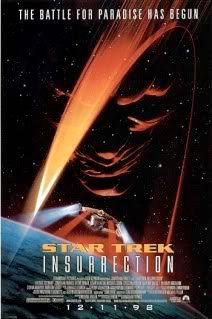 After nine Star Trek films I feel like I'm playing with a jack-in-the-box. There are so many better things in this world, or this room, or under my couch cushions, for me to be playing with, but I've arbitrarily imposed upon myself the need to play with the jack-in-the-box. So I joylessly turn the crank until the clown or whatever other satanic images you can fit into it pop out. Sometimes it still surprises me, but rarely. And when it pops out, it bounces around on its string for a minute as I stare at it, and then I stare into the middle distance, thinking about something--anything--else that will take my mind somewhere where it won't waste away. And then I press the little clown back into the box and slowly start turning the crank again. If someone watched a person do this, they would probably cry.
 And that's what I think of the Next Generation cast. At this point they're all well into their fifties, there's more Viagra and whiskey in their coffee every morning and sometimes they stand in front of the mirror in the morning and just cry. It's likely a side effect of the leg-chaffing cream they're getting slightly addicted to and they would file a lawsuit against that pharmaceutical company if they didn't still have to pay the mortgage on the cavernous manor they bought at the height of their coke habit. They kicked the habit a few years back and got in all the tabloids, but maybe it's time to pick it up again so that there will be something to do during the day instead of re-watching old episodes of The Next Generation.
What I'm saying is, when it comes to roles in blockbusters, they got the short, pointy, stabby end of the stick. They've been playing the same roles for the chanting mass of nerds for over a decade, despite being out of shape and tired and hairy. They've signed their souls over to the producers completely, and it's clear that those producers don't give a shit about the cast. They all seem to be so sad reciting their technical Trek jargon without a thick fog of cocaine to keep the fictional universe making sense. There's one very telling scene where Crusher and Troi talk about their breasts firming up that was clearly meant to create an audible rumble through the world as Trekkies fell over and started collectively masturbating. But it came ten years too late, and now they both look like skin puppets whose silicone breasts couldn't possibly be firmer if they were filled with helium. Although that doesn't discourage Jonathon Frakes, who seems to have used his position as director and Marina Sirtis's need to pay her private detective as leverage to get her into a bathtub with him.
So here's the plot. There's some colony on a planet and they never age for reasons that are never explained, probably because I don't care. The Federation is trying to relocate the colonists and the Enterprise crew thinks that's wrong. Hooray, let's get to the insults.
There was no way this group of fuck-ups could maintain the commercial and artistic success of First Contact, so it all falls apart rather unsurprisingly. I'll give Frakes some credit as director: he's not trying to just retread the success of First Contact, but that would be better than this out-and-out failure. I get that Star Trek is all about bright, shiny optimism, but contrasting that with the ever-present threat of evil and darkness is extremely effective BECAUSE of that. Making the sequel a sunny prancing through a field of flowers is turning the knob way back down. If we're going to turn down the excitement and tenacity of a film, at least replace it with something and not the dead air that seems to be the main character of Star Trek: Insurrection.
We took an important step towards a distinctive visual language in the last film with some darker cinematography. It still looked like crap, but after a half-dozen films that all look like shit, you'll take what you can get. This film puts it in reverse for about six blocks leaving us with some of the most plain, unaltered footage I have ever seen outside of a camcorder.
The only thing I liked about this film was a space battle played, like all space battles in this series, like a naval battle that really involves the characters more than the ship which is one of the few things this series has consistently harnessed for the power of good.
The other standout is, obviously, Patrick Stewart, who actually looks quite bored here. An actor of his caliber shouldn't be stuck playing the same character for a decade, as much fun as Jean-Luc Picard may be to watch. He's stuck with an unplayable romantic subplot that made me want to claw my eyes out and throw them at the screen and is one of the most disturbing crimes this franchise has committed.
As for the rest of the cast, Jonathon Frakes looks like he's having fun, which makes him look weird and out of place next to the rest of the cast. Brent Spiner doesn't look like he wants to move a lot and F. Murray Abraham is unrecognizable and unremarkable, which is a good way to categorize his work post-Amadeus.
I've heard that Nemesis essentially ended the franchise, but I have a hard time imagining it being at least less engaging than this film. But if it's true, I can't really imagine there being a darker time to be a fan of a series.
I can't give it a one, or even a two in good conscience, it's just not offensive enough to the senses, just horribly boring. And that makes me even angrier at it: I can't really justify its crucifixion. I don't hate it, I just feel sorry for it.
3/10
Sunday, November 15, 2009
Necronomicon
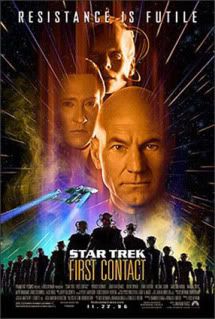 For many reasons I'm tempted to say that Star Trek: First Contact is an extraordinary film, simply because I enjoyed it so much. Fortunately, I have a stronger critical will than that. For everything that this film does right, and it does so much right, there are several things biting at its ankles and seeking to undermine everything about this film that is so exceptional.
 But first, let's get this plot banged out. Six years ago, Captain Jean-Luc Picard was abducted by the sinister, nightmarish Borg Collective, assimilated into the collective and connected to the hive mind with machinery running into his organic tissue to augment his human abilities. Through the power of friendship (or something; I don't fucking know), the crew of the Enterprise manage to rescue him. That was back on The Next Generation television show. Cut to "present", Jean-Luc is still haunted by his encounter with the Borg and retains pieces of their machinery in his body.
When the Borg invade Federation space, Picard leads the fight. In the first of many egregiously simple errors the film commits, Worf (who, according to my minimal research, was at this point a regular on Star Trek: Deep Space Nine) is contrived aboard the Enterprise and shanghaied for this next film. It is so fucking contrived. THEN, Picard tells all the ships to focus their fire on a seemingly insignificant area of the Borg starship, which turns out to be critical enough that it destroys the ship. Just like that. Maybe that bit of minutia should have been relayed to Starfleet, eh, Picard? Maybe you should be the one to comfort the families of those who were killed or assimilated by the Borg before you showed up with that little detail.
So as Picard blows the Borg ship to hell in the span of a lunch break, the Borg manage to launch a probe that begins traveling back in time. The Enterprise quickly follows it back the mid-21st century, where the Borg are attempting to eliminate Zephram Cochrane (James Cromwell), the man responsible for inventing warp drive and establishing first contact with an alien race.
Here's where something else goes wrong. When we're first introduced to Cochrane, his research community is under fire from the Borg probe. How exciting! Then, as quickly as it started, the Enterprise blows the probe to Mexico. Then a handful of crew members beam down and help Cochrane accept his destiny and get history on the right track blah blah blah. But without the probe as an imminent threat, the away team subplot loses all its suspense and its connection to the main plot aboard the Enterprise. The fact that the away team is literally getting hammered and partying and meeting their idols while everyone on the Enterprise is having cables shoved down their throats and Borg eggs (?) laid in their stomachs sort of ruins the atmosphere.
And there's an easy solution to that problem, too. Because (oh, yeah, I forgot to mention) aboard the Enterprise the Borg have somehow gotten into the hull, undetected. Only a handful at first, but they slowly start grabbing crew members and assimilating them, slowly start converting the Enterprise's computers to Borg technology and their power slowly grows to rival the remaining crew. They begin to spread like an infection. Every time we're pulled away from this incredibly compelling story it's beyond frustrating. If the away team had a more direct stake in the fate of the Enterprise and vice-versa, that sub-plot would remain useful. As it is, though, they may as well not be connected at all.
The last of the egregious, simple errors the film commits is to make the Borg appear weak in some scenes. As a child, nothing frightened me more than the Borg (if you don't remember, or weren't around for the beginning of this series, my motivation to view all the Star Trek films was my unabashed enthusiasm for the series when I was little). They were essentially unstoppable killing machines. They adapted to your weapons after only a handful of shots, making your guns nothing more than heavy garbage cans full of used tissues that you can lob at your enemy with all the force of a child stricken by muscular dystrophy. And not just the individual. The ENTIRE collective adapted to your weapons (or tissues) after a few shots. As a child, they seemed invincible. I couldn't imagine anything scarier than an entire army of scary cybernetic zombies that you can't hurt. The mistake First Contact makes is to have a handful of scenes where Worf or Data manages to kill them with a single punch. I get it, Worf (being a Klingon) and Data (being an android) have superhuman strength. It makes sense, but again, you're UNDERMINING THE THREAT when they're being killed by simple punches. The easy way around this is to show humans trying to do the same thing out of desperation and showing the violent, cybernetic-probey results. Or to simply make Worf and Data put in a little bit of fucking effort when punching out robotic zombies. They seem to be doing it between bites of their scones and I don't see why Worf and Data have to be stronger than the Borg necessarily, instead of, perhaps equal in strength. That would be beneficial towards every aspect of the film.
If I've made this film sound bad, that was not my intention, I just piled on the negative criticism before I got to the good things, and there are a lot of things to be grateful for in this film.
First of all, my long list of complaints with Generations have almost all been addressed. The cast has new costumes that look decidedly more cinematic, the bridge is less garish and sleeker, readier for the widescreen necessities of cinematic features. Also, Data, who I dismissed as a weak character in the previous film, is given a lot to do and does wonders with it. In fact, the most fascinating portion of the film (from a narrative rather than aesthetic standpoint), is Data's interactions with the Borg Queen, a highly sexualized cybernetic humanoid zombie, who tempts him to join the collective with the promise of the organic skin and the human properties he has so longed for.
It is essentially a long conversation in a cavernous, Gigeresque dungeon that punctuates the action in the main of the ship (I know it's stupid to compare it, or anything, to The Seventh Seal, but that's just what it reminded me of, okay?). How they managed to fuck up the away team sub-plot with such a shining example of how a sub-plot should work in this film is beyond me.
And then there's the action in the main of the ship. As the Borg spread throughout the hull of the ship, Picard attempts to hold them back and evacuate survivors through the alcoves of the ship only the crew know. Here we get to see something that in seven films we never saw Kirk do: lose it. The closest to the edge that we ever saw Kirk get was when his son was killed in Search for Spock, quite possibly Shatner's greatest moment (although that's not saying much, especially in such an abysmal film).
Fuck, even the Holodeck, which I ridiculed endlessly in Generations, gets one of the best scenes in the whole film. Picard's story is rock and roll, action-heavy and exactly the sort of heroin trip the series has needed for a while.
But the best part of the film (and it's hard to choose a best part of a film with so many fine qualities), is Patrick Stewart's performance. Surely he's done better work, but rarely have I seen him at the top of his game physically. Not just the stunt work he does, but watching Picard devolve into an animalistic beast, struggling to maintain his gentile, Shakespearean composure as he is overrun by a guarded, malicious joy, watching the Borg gunned down in front of him. It's the sort of physicality that is often overlooked in acting, and it's a sublime bit of scenery-chewing. Stewart takes it and follows it over the top, using his considerable acting abilities to outdo every other actor, every other effect and every other action sequence in one scene of borderline-psychotic shouting.
Yes, the Next Generation crew finally crawls out of the shadow of the original cast with this film. And thank god. We're finally free of Walter Koenig's toupee and well-documented desire to kill everyone in the Original cast. Even before he loses it, Picard was always a much better character. Kirk was interesting as a counterpoint to Spock, and while that's not to discredit what an excellent character Kirk is, Picard is interesting all his own. A fully fleshed-out man, including the dark edges that Kirk never had, Picard is not only the sort of man that would actually inspire the sort of loyalty Kirk is seen inspiring, he's exactly the sort of person you would never EVER want to fight. He will make your circuits know fear and you will know what a true man sounds like before he snaps your spine over his knee and hangs it on his mantle. He's the sort of man who could walk through Perdition's flames and not feel a thing. He could butter both sides of his toast and not get butter on his fingers or the counter. He could write three metaphors in a row and they would all make equal sense.
As for Jonathon Frakes, yeah, he's untested as a director, but his work here is good. He does a lot to make the film move, and he has created the first Star Trek film that stands apart visually from the other films and the other television series. Some of the more complex scenes suffer from an inexperienced director, but for the most part I'm quite surprised that his directing career didn't go anywhere. The opening shot is easily the best-composed, most ambitious shot in any of the Star Trek films since The Motion Picture.
When the dust settles, though, this is still a very good film, one that I'm prepared to watch many more times in the future. If all this Star Trek retrospective gives me is this film, I will say it was an unprecedented success. I don't know if anyone who isn't as close to the franchise as I am at this very moment will have the same level of appreciation and affection for this film, but I know that I enjoyed the hell out of it.
8/10
Thursday, November 5, 2009
Those fucking kids
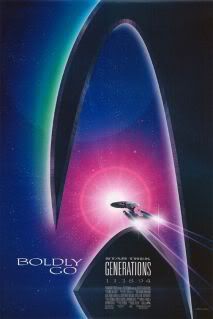 Patrick Stewart is a man's man. I get such a jolly from watching him perform, and he's the coolest captain the Enterprise ever had. As much as I like watching the bridge crew drag Kirk away from the self-destruct console after he spots a spider near his chair, Picard is beyond badass. Patrick Stewart (and by virtue, Picard) is everything a 21st century man should aspire to be.
 By formulaic, I mean it might cure jaundice and confuse me on my math midterm. But Star Trek: Generations is damn formulaic. So formulaic it doesn't seem to understand the difference between a television show and a theatrical motion picture (wider aspect ratio, FEWER STUPID SUB-PLOTS).
Here we go. We open on Kirk, Scotty and Chekov being shown around the bridge of the newest incarnation of the Enterprise. Kirk is bugging out because Sulu had time to grow some children-trees despite being gay and despite his commitment to Starfleet. They take the Enterprise out for a stroll around the block when they receive a distress signal from a group of transport ships caught in some strange magnetic anomaly. The inexperienced, indecisive new captain struggles with his ill-equipped ship until Kirk takes over, ultimately dying in a freak accident when trying to rig the hull to buy a few extra minutes for the crew.
This is a fitting death for Kirk. It's the sort of end many people have met on the Enterprise but none of the bridge crew have met because so rarely do they venture into the hull.
Flash forward 80 years to the GAYEST possible film introduction to the Next Generation crew we could have POSSIBLY conjured. They're on an 18th century warship, all dressed in French military uniforms and giving Worf a best friend bracelet in a phenomenally gay ceremony. Apparently it's a hologram (whatever), but this hologram machine can't hologram-in-ite them uniforms, so they spend at least a few minutes in front of their crew in French sailor uniforms.
Unfortunately, Data begins to grasp the meaning of cruel irony but without the restraints of remorse. Worried that Data will soon become an efficient killing machine with a tenuous grasp on humor, LaForge stuffs an inhibitor chip inside of him that makes him feel all the shitty emotions like sadness and fear but without the awesome emotions like murderous rage and bottomless greed.
That's when they find Malcolm McDowell who is, surprise, evil. He's going to blow up a star so he can get back into something not unlike the simulator Picard and the Gang were just hanging out in. I'm still not clear on how blowing a star up is necessary, perhaps he just wanted to be on the (very) long list of people who challenge the Federation and the (very) short list of people who don't get vaporized or thrown into a pit of lava for their trouble.
He's struck up a deal with some Klingon lesbians and they stand around and suck just like everything else in this fucking movie.
Let's break down the Next Generation crew, shall we?
Picard is a badass, yeah, I know. But LaForge is a little girl, and blind, and totally incompetent. Data is the emotionless science officer, not unlike Spock, but without Spock's predilection towards kicking tons of ass and generally being an emotionless killing machine/pun dispenser. Also he's the only android I can think of that gains weight.
Worf is...well, what the fuck does he even do on this ship? Scare children? Public relations? I understand that if you're shooting every day in elaborate makeup, it can get tiresome, but it looks like he walks into the makeup trailer every day and just shoves his head into a bucket of brown makeup with some eyebrows carelessly thrown in. Also, he sounds like he's on the run from gambling debts and has half-heartedly tried to change his voice.
Riker looks like a seasoned sexual predator, but not of the rapey variety. Of the "I've got you in the makeup trailer all by yourself and I can already smell the sexual harassment suit coming my way" variety. His uniform is also too damn broad with shoulder pads making his shoulders boxy but his midsection round. I get that most of these actors are pretty old already, but Jesus, don't let people self-conscious about their aging pick out their wardrobe.
The whole film looks cheap, like their budget is lower than it was on the TV show. They couldn't redesign the uniforms? How much could that cost? Forty dollars? But it doesn't even matter, the whole film feels like a season finale. William Shatner is thrown in so that people will have some reason to go see this fucking thing and he's given a death with all the dignity of being punched to death behind a Denver Denny's and left in a dumpster. I'm pretty sure Kirk has crossed bridges before and many times. Was he nervous in front of Picard?
The whole film reeks of a script that could have been very strong in the hands of a better director, or maybe with a few rewrites. There are some interesting things going on, such as the opening that could have been breathless, not unlike the opening for Abrams' Star Trek and there's a scene where Picard is separated from the villain and is trying to talk him out of his plan that could have worked better with some stronger dialogue and some better imagery.
But the thing that endlessly undercuts whatever might be working about the film is Data's subplot. It adds nothing of thematic value to the story and doesn't tie into the main plot at all. It's just a rejected plotline meant to give Bret Spiner and his diamond cream more screen time.
It sucked.
But then again, Patrick Stewart.
3/10
Tuesday, November 3, 2009
Further government-sponsored attempts to find the galaxy's last Bob Evans
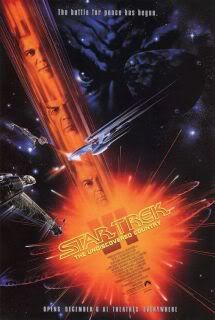 If the Star Trek films were to wrestle, Star Trek VI: The Undiscovered Country would lose because all it would take is fresh crab cakes on the buffet to distract it. If Star Trek VI were to play chess, it would look like this.
 Star Trek VI: The Undiscovered Country is a pair of suspenders and a flannel shirt. William Shatner had his ass airbrushed in several scenes. Leonard Nimoy's gut conspires to make him look less alien-like. At this point they had the virile young Next Generation cast to drag mercilessly through the Trek fanbase, who, after viewing this film, I can only assume look like an angry mob or spectators at gladiatorial games. Why they aren't mobbing and using their teeth to tear off their Starfleet uniforms is beyond me; a morbid sense of humor springs to mind, as this is easily the most physically intensive the series has been since it was still a TV show.
On a similar note, the plot of Star Trek VI:
The crew of the Enterprise are set to be decommissioned and ground into meat (?) for the hungry masses. When Kirk is asked to escort a Klingon ambassador to Starfleet Command he responds like anyone would, by loading his racism into his holsters and assembling his grouchy old crew to be cartoonishly ignorant and murderously hostile.
If you haven't guessed already, the Klingons are a pretty obtuse metaphor for the Soviets and the film is a pretty obtuse metaphor for the end of the Cold War.
So they're enjoying the sort of dinner party where everyone is secretly armed and every dish has been so thickly laced with nanobots that it can be passed off as a sauce. Afterward, the Klingon high command beam back to their ship and are greeted with the traditional Klingon lullaby of having their ship blasted with torpedoes and their crew shot at point-blank by men in Starfleet uniforms. Kirk is sent a subpoena in his weekly shipment of alien sex toys and sent to a Klingon court, which is surely based on Texas courtrooms. He and McCoy (who is once again being dragged along because Kirk doesn't feel like being sentenced to death alone) are easily found guilty by Kirk's famous racism and enthusiasm for launching small pox-infected blankets into Klingon teepees. They're sentenced to live out the rest of their lives on a penal mining colony, despite their pleas of innocence.
Meanwhile, Spock has taken control of the Enterprise and is attempting to unravel the mystery of who is responsible for the attack, and it's here where the film really stands out. First of all, Spock makes such a good captain that I can't figure out how Kirk got command in the first place (although if we're going off Abrams' film, he got it by making fun of Spock's dead mom) and it's a crackling, locked-door whodunit.
This is easily the best film in the series since the first one, and the most purely enjoyable. My attention never wavered for a moment, despite the cast's constant looks of confusion or excitement when they realized it was medicine time. It finally incorporates the things that I've said Star Trek has needed for a long time: either a villain with a serious ideological clash with the crew of the Enterprise or a politically-driven narrative, a definitive sense of scale, the compartmentalizing of the crew in order to give them their own moments to shine and independent story arcs, the crew out of their element or dealing with a serious danger that the audience feels is a real threat and some damn adventure, already. None of these things have existed (and if they have, only in spurts) since the Original Series. The Motion Picture offered some 2001-style postulating and some really incredible visuals but generally seemed divorced from the liter tone of the series and it didn't feel like an essentially Trek film; it could have been any cast of characters on that ship. Here, I feel (and I'm no Trek purist, but I have been enjoying the series), we are given the best of Trek lore and the best characterizations any of the films have offered thus far. Also, the pacing isn't all over the place like it's been for several films now, hinting at some more disciplined editing (ie: an editor ready and willing to cut scenes that were included to jerk off the fanbase--one of the serious advantages to hiring a non-fan to helm a film bogged down in lore and fandom).
The actors, despite their age, are in fine form. Specifically DeForest Kelley who's never been in better shape. He gets the best scene of any of the films in this one, when he attempts to resuscitate a dying Klingon despite his inadequate knowledge of Klingon anatomy.
And now that I've softened you up, here's the killing blow. Star Trek VI: The Undiscovered Country suffers from the time it was produced. Commercial filmmaking in the early 90's popularized some goddamn weird stuff. The example I'm about to illustrate is a pretty big spoiler, so look out.
After Kirk and McCoy are sent to the penal colony, the Enterprise crew manages to rescue them, despite a Klingon declaration that any attempt to rescue them will be considered an act of war. After blowing the shit out of a Klingon ship and killing some high-ranking officers in the process, they beam down to a Klingon-Federation peace conference, armed to the fucking teeth and starts killing Klingons.
That's all fine and good (I guess), but the really weird shit hits the fan when Kirk starts giving a speech about tolerance while his boots are inch-deep in alien blood. And then everyone in attendance claps. I don't doubt that the best way to get the floor or end a filibuster in Congress (or Kongress HAHA) is by shooting someone, but I don't imagine there will be much clapping afterward, just terrified urinating. And this sort of thing was standard practice in commercial filmmaking in the 90's! The madness!
When it's all boiled down, I guess it's kind of disposable, but I certainly had a good time watching it. Hell, it's the first film in the series I could imagine being enthusiastic about watching a second time (although I have been curious to revisit Wrath of Khan, if only for Ricardo Montalbon's performance).
I wouldn't recommend it to anyone but Trek fans, but I'm certainly happy to see the original cast sign off with an actual good film.
7/10
Thursday, October 15, 2009
Where is your God now?
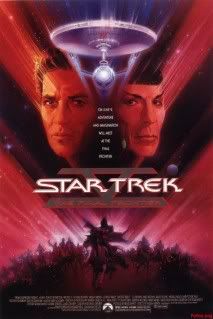 Star Trek V: The Final Frontier has an astonishingly negative reputation. I'm not going to say it doesn't deserve it (it does), but I also refuse to dismiss it as quickly as most people.
 To give you some perspective and a visual metaphor to work with, imagine that the Star Trek series is a special ed class. The first film is the normal-looking kid who you don't think has any reason to be in there. The fourth film is the kid who's constantly making jokes and you're sort of smiling at him because you know this is as good as his life will get. The fifth film is some sort of Frankenstein monster assembled from the corpses of the special ed children who have been slowly disappearing over the last month. The principle having a mid-life crisis, is acting out his childhood dream of becoming a biologist using the freest resource available at a school: the special ed children. Now this monster of Frankenstein sits in the classroom trying to color in a picture of the happy family he'll never have, as he watches through the window as his creator is dragged into a cop car.
If I lost you somewhere in there, let me clarify. The Star Trek series is already sort of a middling, bumbling little kid who everyone gives a free pass because he's trying. When the series learned to do some comedy, we all patted it on the back. But now this monstrosity, assembled from various parts of the previous films pops up and no one has any goddamn idea what to do with it. We're content to let it sit there and color, but at some point we're going to have to kill it and dissect it like a crime scene.
And so here I am, with my rubber gloves and blacklight ready to figure out what the FUCK happened here.
We open on a deserted landscape, a single alien toiling. A man rides into view, Lawrence of Arabia style. He gives the alien some sort of vision, lifting some existential pain from his shoulders. The alien swears allegiance to the stranger. That's a pretty good way to open a Star Trek film. We set up a sense of mystery and foreboding right off the bat.
Can't have that, can we? Let's cut to the crew of the USS Enterprise, vacationing in Yellowstone like a bunch of weirdos with no real friends. Kirk is scaling a mountain (yeah, fucking right William Fatner, you're not going to convince us that you are in the shape you once were) and McCoy is getting bent out of shape that Spock doesn't understand campfire songs when a distress signal is received. The crew of the Enterprise are summoned back to respond, but the Enterprise is in a state of disrepair. They must contend with the man in the desert but without a fully operational ship, and when the ship is overtaken and the man is revealed to be Sybok, half-brother of Spock, Kirk, Spock and McCoy must use their superior knowledge of the Enterprise's layout to stop Sybok from taking the ship on an obsessive suicide mission to find God.
Combine that with Sybok giving the crew of the Enterprise visions of their most painful memories and a Klingon captain hunting Kirk for sport, you've got what is surely the most compelling story in a Star Trek film.
It's actually a mind-blowing carnival of weirdness, comparable only to a bunch of midget clowns singing Ring Around the Rosey in slow motion, that derails this film. I don't even know where to begin. I suppose I'll start with the good.
The opening scene is one of the better scenes in the last few films. My first impression was that at least William Shatner, who was irresponsibly given the director's chair (although I don't think it's any more irresponsible than giving Leonard Nimoy the position in the last two films), has an interest in imagery and a desire to give these films a distinguishable look instead of "Are the cameras pointed at the actors? Action."
Also, the whole cast gets a bunch of dynamic things to do. They get into their first real shootout, they're chased around the Enterprise, they explore strange worlds.
And that's where the nice things end. I made an effort to like this movie because it was trying so hard, but I can't even begin to understand why Kirk is being chased by a giant, floating 2-D head shooting lasers out of its eyes. I have no idea why Spock spends the whole movie making retarded puns. It's like a kaleidoscope filled with acid.
The whole sub-plot with the Klingon captain starts with him shooting space garbage and then folding his arms and complaining about how there's nothing to do. He then sees the Enterprise on his radar and decides to kill Kirk as revenge for Kruge two films ago. The subplot ends (I wish I were making this up), with his superior officer making him say he's sorry to Kirk.
In fact, this movie's weirdness is absolutely endearing. The way it sets up a story about finding God, THE metaphysical Holy Grail, and then does absolutely nothing with it is almost avant-garde. I'm tempted to take the whole movie as an avant-garde experiment, and I'm not saying this in a snarky, mean-spirited way. I literally suspect that those involved attempted to make the weirdest Trek film possible. How else can I explain a scene as poignant as McCoy reliving the cruelly ironic death of his father sandwiched between scenes of Scott comically bonking his head and Spock making puns about rocket boots?
I don't understand it, but I can sort of love it.
2/10
Friday, September 25, 2009
A Comedy of Errors
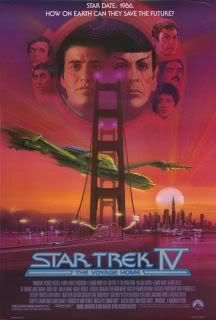 In my critical analysis of Star Trek III: The Search for Spock, I noted that the Star Trek franchise had become a pale shadow of a movie franchise, the last two barely even registering as films. Like a backwoods town attempting to build a restaurant like dem big city folk and ending up with a shack that sells watermelons on Tuesdays. Today we observe Star Trek IV: The Voyage Home, and I have similar things to say about it. The "space epic" thing not working for you? Well, what's popular with the kids? Fish-out-of-water comedies? Great, send the cast back to present day and watch all the wacky hijinks they get into. What will they think of next.
Here we go. The plot:
Picking up where Search for Spock left off, Kirk and co. are on Vulcan with the newly reborn Spock, preparing their Klingon vessel (long story) to travel back to Earth and stand trial for Kirk's latest batch of impulsive murders. The preliminary trial (where, in the future, a bunch of dudes stand around in a courtroom talking about how they're going to hang the defendant who isn't even present) features some surprisingly apt discussions of Kirk's anti-Klingon sentiments and desire to kill everything that moves, but presented as the Klingon council's machinations to further their agenda to kill everything that moves. But we're interrupted by the Giant Floating Plot Device that's evaporating Earth's oceans until SOMEONE GETS ME SOME FUCKING WHALES. Naturally, Kirk and co. travel back in time to San Francisco of 1986 (of course you'd say "Ah, San Francisco", Sulu). There, Kirk and Spock plan to abduct some whales from an overprotective marine biologist and do things like not know what money is. Wacky hijinks ensue.
I feel like I'm selling the comedy bit short. Sure, they're all stock jokes that we've heard a million times (Spock can't get the hang of cussing!), but it's nice to watch the cast loosen up a bit. The series has been in desperate need of some pie-throwing for a while, and the cast has an easy chemistry that makes the film pleasant enough to watch.
In fact, the scene where they go to a 20th century hospital allows DeForest Kelley, the funniest member of the original cast, some really great comic moments.
Leonard Nimoy is back in the director's chair for this one, and his helmsmanship has tightened up considerably. The whole film is far breezier and more fun to watch than Search for Spock (although that's not saying much). But this brings up a question: should Star Trek be this breezy? Personally, I don't think it's a good fit. I really got the feeling that the cast was sort of being dragged around haphazardly in this one in a desperate plea to keep the franchise alive. Between the comedy that makes this feel like only a sort-of-a Star Trek movie to the topical message about saving the whales, the producers really pulled out all the stops to try and make this one relevant.
And the cast is beginning to look very, very old. Obviously they've been old for a while now, but I'm just now beginning to see it, especially considering how many of them look like old lesbians (3). It's almost sad to watch. No one would allow a group of septuagenarians a state-of-the-art vessel like this, they're liable to all go into a diabetic coma and crash into the Bob Evans they were flying to.
And let's not forget the marvelously stupid Giant Floating Plot Device. The thing arrives with no explanation. It just shows up and starts evaporating it some oceans until a whale sings at it. Why is it so angry at all water that doesn't house humpback whales? Will the water more effectively house humpback whales when it's been evaporated? What are its origins? Why is any of this shit happening? No one seems especially concerned with this. They make it seem like they do this every week. Some probe comes and starts evaporating their oceans or disintegrating their rain forests until someone goes back in time and gets it the animal du jour. How strange that would seem to an outsider!
I'd rather the president just call Kirk up and send him to San Fransisco of 1986 on a mission to get into wacky hijinks. At least then you're being honest about how lazy you are.
To wrap things up, I'd say that it's nice to see the cast loosen up, but the story needed to be more Trek-esque. Instead it's a fish-out-of-water story about saving whales in 1986 that really doesn't even feel like it belongs in Trek canon. I actually prefer the thematic and visual ambition of Search for Spock, even if that was arguably a bigger failure. This film isn't as much of a failure because it sticks to such a rigid formula.
5/10
Saturday, August 29, 2009
A Well-Worn Frontier
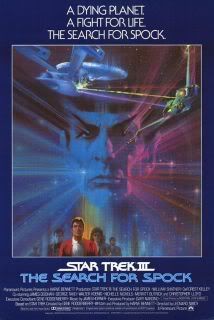 I'm losing all the optimism I had for this series, and I have eight more films to go. At this point, it's sort of like when a multinational company builds a new restaurant in a really small town to try out that market, but the market isn't big enough and there aren't enough people there to justify it, so they shut down the restaurant. At first they make another restaurant which is pretty successful for a few years but then they get a McDonalds and no one wants to go to the real restaurant anymore, so homeless people start living in it and eventually it becomes a halfway house and enjoys a bit of use before some dude starts selling watermelons out of it on Tuesday mornings. Eventually the multinational company demolishes it with the watermelon dude still in there and rebuilds the restaurant just so that they don't have to feel bad about giving a bunch of hill folk the technology to join modern civilization only to have them use it to sell watermelons. The restaurant becomes a big success and tourists flock to the town to take pictures of the inhabitants in black and white and make a gallery of pieces about the breadbasket of America.
 And Christopher Lloyd seems like a funny guy with good stage presence and all that. I bet he's a nice guy who could give good advice to young actors. I bet he gives money to charities that no one has heard of and no one donates to like "computers for political refugees" and "flags for the foreign". You know what's outside of his range, though? Playing a Klingon warlord. Yeah, that's right. Christopher Lloyd plays an alien warlord in Star Trek III: The Search for Spock, and he looks positively cartoonish. All too recognizable under his stapled-on prosthetics and animated eyes. Whose idea was that?
But that's just the beginning. I'll bet you want to know the plot, don't you? Spoilers ahead, weary world-travelers. At the end of Wrath of Khan, Spock dies to save the crew of the Enterprise. Kirk, as he tends to do, gets upset, probably gets pretty drunk, and steals the decommissioned Enterprise on a whim and flies to the Genesis planet, born out of ashes of the conflict with Khan. There, he encounters Klingon warlord Kruge seeking the "secret of Genesis" (what that could possibly be is never even touched on). When they get there, Kirk's blows up the Enterprise for no fucking reason.
Yeah, that's right. If you thought that Kirk was an impulsive dickhead with no regard for the lives of his crewmembers BEFORE, wait until you see this one.
Also, the fact that Spock and McCoy are out of commission through the majority of the film, I realize what a sickening rainbow of political correctness and oldness the cast is, but I'm surprised they were never sued for not including a blind cast member.
None of those are the serious crimes that the film commits, though. The serious crimes the film commits are things like making the entire plot about Kruge completely expendable. There's nothing ideological at stake and we really don't even understand why he wants the failed Genesis project. It's just time-filler. It's just an obstacle for the crew to overcome so that they don't just fly to Genesis, pick up Spock's body and be on their way, and it feels very stamped-on. There's no reason why the Federation shouldn't be pursuing them for stealing the Enterprise, because then we'd be pushing Kirk and co. to their limits, testing their loyalties. Hell, you could even throw in a few things about them trying to control Genesis and tie it into the theme of rebirth the same way Kruge's subplot was tied to the theme of rebirth.
The only reason I can think of that they wouldn't use that story is that they wanted aliens for the villains instead of humans, clearly forgetting the recent success of Wrath of Khan.
Also, Leonard Nimoy shows very little directing competence. Not his fault, really. The studio should have known better than to have put an inexperienced director behind something this large. On the other hand, he is a bit of an improvement over Nicholas Meyer. He seems keen to throw in some nice imagery, but there's a very stilted fight scene at the end. At this point, Raiders of the Lost Ark had been out for three years. People had already grasped how to shoot and edit fight scenes much better on a relative budget. Leonard Nimoy was having none of it and instead opted for no sound effects, editing it with fingernail clippers, and putting hilariously cheap stage effects in the middle of the fight. Of course, that's my frothy action-junkie alter ego talking.
There are some nice things I can say about this film, though. The filmmakers seemed to have found the "accountant" listing in the yellow pages so they didn't blow the budget on special effects and only have enough money to redress a PA's apartment as the bridge of the Enterprise, so we spend a little bit of time exploring Genesis and taking the crew out of their element.
I realize now why that's appealing. We know that these dudes can pilot ships. That's their job. They went to school for it. Watching them pilot a ship is like watching my dad hook up the VCR. Fine, but he does it with a vague disinterest because he does this sort of thing every day. It's not something you have to be there for, it's actually a good time to make an english muffin pizza. Taking them out of that element and forcing them into situations they may not have the skills to deal with over the phone is a lot more dynamic and pushing characters to their limits and putting them in difficult situations is what gives them an arc or endears them to you. You don't learn about Travis Bickle when he's applying the parking break, you learn about him when he's interacting with other people, something very painful for him.
Another nice thing I can say is that I quite enjoyed the performances. I didn't think about it, but having Leonard Nimoy direct is the best possible way to get the best work out of the cast. William Shatner in particular is actually pretty damn good. He gets some scenes that are written specifically to his strengths and plays them admirably. The guy has stage presence, but isn't much of an actor, so it's nice to see him really take a role with some meat to it now and again. The last two films haven't focused on Kirk nearly at all; in fact, aside from blowing up his own ships and fusing his first officer to antiquated scientific equipment, Kirk has been a bit of a blank slate. We didn't learn that much about him; he's still the strapping hero and all that, but he gets something to chew on, at least.
It's not a good movie or even a mediocre movie. It's actually pretty incompetent and lazy. I'm beginning to think these things are being thrown out there because the Trekkies will eat up anything with the original cast in it.
This film has a pretty bad reputation, though, so we'll see about The Voyage Home, which seems to be a very popular, accessible film for people who date women, like me.
3/10
Saturday, August 22, 2009
Here's some money. Make me a Star War.
You have two characters as great as Kirk and Spock. You have a villain played by Ricardo "Fantasy Island" Montalban. You gave him fucking super strength and gave him a bunch of genetically engineered super soldiers to follow him around doing his evil bidding. Collect your money.
Right?
RIGHT?
Here's my impression of one of the Wrath of Khan script meetings:
WRITER #1: So we decided to use the genetically engineered superhuman Khan for the villain. He was in the Original Series episode Space Seed...
WRITER #2: Wait, whoa, whoa whoa. You said he's genetically engineered?
WRITER #1: Yeah...
WRITER #2: A superhuman? As in super strength?
WRITER #1: Yeah, that's what he's like in the original episode.
WRITER #2: It's just...
WRITER #1: What?
WRITER #2: It's nothing.
WRITER #1: No, tell me.
WRITER #2: Well, it's just that... I always thought that if you were super-strong, you'd also get super-tired and also do a lot of super-resting when you used your super-strength.
This movie could have been called "SITTING: The Motion Picture" and had the same effect. For a movie that boasts exploration of strange new worlds and a villain as great as Khan, we spend an awful lot of time sitting in the bridge. Ricardo Montalban is an intimidating guy, but he never stands up. Not to get a cup of fucking coffee and not to exact his revenge.
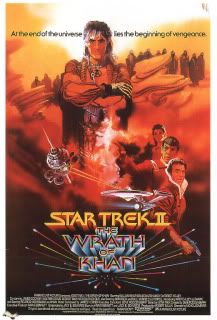
That poster makes a million promises of adventure and excitement, with Khan standing, as if to say "I might walk somewhere at some point", and Kirk with his phaser as if to say "I might get into a close-quarters confrontation where I have a conversation with someone", and some dudes in hoods in the background as if to say "we might do something dynamic, like put tape over the cracked hull in a ship or repair the broken air conditioning on the USS Reliant" and some words exploding as if to say "nobody does anything boring like read in this movie, because every time they try, the words fucking EXPLODE".
Nah. The whole movie is sort of aimless wandering, and nothing ever seems like it's at stake because no one even bothers to stand.
Montalban plays the supervillain Khan Noonien Singh, fifteen years ago exiled by the crew of the Enterprise to the dying planet Ceti Alpha 5. There, Khan has spent a lot of time reading, playing with giant insects and doing push-ups. When the USS Reliant docks nearby, Khan and his race of genetically engineered super-soldiers kill the entire crew and take over in the best scene that they don't show.
Kirk and Khan sitting in their chairs chatting it up over the view screens is not particularly exciting. It was the first time, but after a while I was just really crossing my fingers that they would get a face-to-face confrontation. The dude has super-strength and Kirk is, well, motherfucking Kirk. He'd probably blow up Earth if it meant he took out a handful of his enemies, and he's probably blow up a star system if he came face-to-face with someone as excellently evil as Khan.
And let me underline that Montalban totally deserves his legacy as a great villain. Is he a fantastic villain, even if he sits the entire fucking movie? Yeah. Can I imagine the Trek universe doing better? Absolutely. Maybe if Matthew McConaughey played a man that fused with the moon, and he grew anthropomorphic features like eyes and a mouth and a little stubby, nightmare-inducing torso and floated around the galaxy fusing himself with other planets. Man, I wish I had $40 million for these things.
Instead, the whole film feels rather lethargic. The special effects are nowhere near as impressive as they were in The Motion Picture and the space battles are staged with very little flair or suspense. Again, rather lethargically. They seem to move at a crawl.
I loved Ricardo Montalban's performance just as much as everyone else who sees this movie does, but I can't get over how lazy this film feels. When I see a Star Trek film I want to see great special effects and alien worlds and Kirk and Spock using their whiles against a superior threat. Instead what I got was Kirk and Spock with the infinite resources of Starfleet blowing the holy fuck out of a small insurgence of impoverished rebels using stolen Starfleet technology to try and appeal their sentence. For the record, I don't think trying to steal a spaceship is worth spending an eternity on an inhospitable, god-forsake planet.
I rooted for Khan from start to finish. Kirk was just being an asshole.
4/10
Sunday, August 16, 2009
Made in His Image
 As a child, I was fixated on Star Trek. There are scores of home videos of me, around the age of four, where my parents desperately try to engage me over my trance-like state. One video in particular features me at three years old, sitting in the hospital after my sister is born. I don't give a shit about my new sister as long as Patrick Stewart's glistening head is within my field of vision, and I only acknowledge my father once he threatens to turn off the TV if I don't give him some sort of sign of life.
 Eventually Star Trek and I grew apart. I have vague memories of watching Deep Space Nine with my mother when I was five or six, but around that time the outlet for my elementary nerddom became Star Wars.
Also around this time I remember my parents renting Star Trek: First Contact, which scared the CHRIST out of me. I spent the majority of that film's running time running into the next room and hiding my eyes on the staircase. I have particularly traumatic memories of Patrick Stewart snapping the Borg Queen's spine over his knee and hanging it up on his mantle.
But that's about it for my knowledge of Star Trek. I remember very, very little from my time as a kindergarten Trekkie outside of Patrick Stewart's sun-reflecting scalp and I don't think any amount of Star Trekking is going to pull me away from my beloved Star Wars.
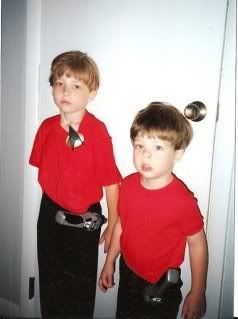
But I was recently compelled to do a retrospective of the entire series for two reasons. One was that as I gave more and more thought to J.J. Abrams' recent Star Trek reboot, I realized that it was god damn brilliant and it was the most fun I'd had at the theater since The Dark Knight. I fully regret not giving it a 10/10 and must make amends. The other was a large stack of photographs my grandmother gave to my mother recently contained this:
So with that, I dive into a film with a largely negative reputation. Often referred to as "The Motionless Picture" by the dirty Trekkie scum, the serious, deliberate pace was very well-suited to the story.
As for the story, I'll give you a quick rundown. Kirk is doing what he always does, being an impulsive, selfish asshole and letting everyone else clean up the mess, only this time he's doing it as admiral of Starfleet. He essentially strong-arms Starfleet Command into giving him the Enterprise to handle an apocalyptic astro-threat over the far more qualified Captain Decker. What's this astro-threat, you ask? A giant cloud, about as threatening as a bit of morning fog. Perhaps Starfleet was worried about unsafe traveling conditions, but the more likely scenario was that every now and then they tell Kirk to go blow up a cloud or something, just to see if he will, and just to see how many of his crew he manages to get killed in the process (spoiler warning: 2).
According to Starfleet, the cloud is incredibly dangerous, and as the Enterprise gets closer to it, they realize it's also sentient. It would be a shame for me to go any further, but it's an interesting, if not exactly perfectly logical story.
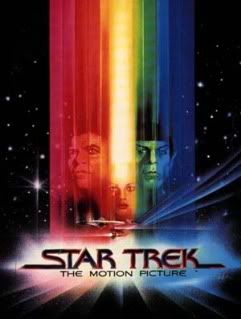
The film came out ten years after the original series had been canceled and my first impression upon finishing the film was that it was Gene Roddenberry's ultimate vision of the Star Trek universe. Free from the pressure to have explosive climaxes, Roddenberry was free to use the film as a conduit to explore more hard sci-fi territory. This is surprising, because I tend to think of any science fiction film to come out between 1978-1983 to be mere cash-ins on the success of Star Wars. Good for Star Trek: The Motion Picture for holding on to its original vision and providing a stark contrast to the more shallow fare filling the theaters at the time (by God, though, shallow doesn't necessarily mean bad; we got Alien out of the post-Star Wars sci-fi boom, so I never have any intention of speaking negatively about it).
The real star of this film, though, are the visual effects. I've never liked the look of CGI and have always admired filmmakers like Christopher Nolan who avoid using it when an alternative is possible, and Star Trek: The Motion Picture is just further proof that I'm always fucking right. The model work in this film is second only to 2001: A Space Odyssey, and while the film catches a lot of flak for lingering on these shots too much, I couldn't get enough of them. The design of the ships were positively epic, and you can practically hear the 1979-oids gasping as some of the more ambitious shots come on the screen. The only thing that didn't look magnificent was the animated bits, which are the pieces that CGI can fill in for these days.
As for the acting, this is a film headlined by William Shatner, which is all you need to know about the acting.
Additionally, it IS a slow-moving film tat doesn't always justify its existence with a story that makes complete sense. At times it reeks of a script that was re-written several times during the shoot.
It's a strong film thematically, and I was engaged throughout. I'm not terribly familiar with Roddenberry's original series, but from what I gather this is exactly the sort of thing he was going for. For a film without a single shootout or spaceship blowing another spaceship to hell, it was surprisingly rousing and exciting in the only way that hard sci-fi can be rousing or exciting.
It's not perfect or great, but it is good, and I enjoyed my time with it more than I thought I might.
I gather that this experience may be less punishing than I had originally thought, and I'm looking forward to The Wrath of Khan.
7/10
Subscribe to:
Posts (Atom)