Showing posts with label Miranda rights. Show all posts

Tuesday, April 27, 2010

Take Names.

About a year ago I took an interest in comic books. It didn't really last long and it only started because I read Watchmen and brashly assumed that there would be other books that might meet that standard of quality. I was wrong, but I did observe an interesting phenomenon spending so much time talking to strangers in the comic book store. Obviously there's only so much you can mine out of the superhero genre before it's totally tapped, but these people go back to the comic store every week and buy more comics supporting an industry that's thrived for almost a century. The limited story possibilities lead to a lot of formulas and retreads in the comic world, to the point where almost nothing is interesting or original. Only when someone like Alan Moore writes a book, not out of unconditional affection for a character but out of the creative aspiration to do something interesting with the medium do we get anything interesting. Comic book fans, therefore, tend to lead an existence of bare incident, where everything is preordained and they don't even expect the entertainment that they invest so much in to surprise them. Take All-Star Batman and Robin the Boy Wonder for instance. If I had to guess at Frank Miller's feelings towards comic book fans, it would be that he went into the industry optimistic that he could shake things up and move comics away from their formulaic qualities by introducing a darker imagining of Batman, but all this did was change the standard Batman comic into a gravel road of violence and homoerotic frankness. Depressed and/or a little bit blinded by his success, Miller spent the intervening years applying his skills to graphic novels that he at least had artistic control over. When asked to return to Batman and write something with universal appeal, though not as a continuation of his Batman series, he went balls-out, playing fast and loose with canon and turning Batman into a malevolent thug and having him abuse the fuck out of Robin and Alfred. It was genuinely interesting, well-written, subversive and offensive in the way that good satire should be, but comic fans lost their shit. Knowing they could easily go back to the warm comfort of lukewarm writing, they instead decided to buy the book in massive quantities and complain endlessly that their patron saint, Frank Miller, had abandoned them. And he had. Still has. The demands of the comic world are too shallow for someone with creative ambition to stay in the industry more than a few years without becoming resentful. (There's an argument for Frank Miller being one of the best living satirists here, but it's not an argument that's terribly pertinent to Kick Ass).

That's the feeling I got from Kick Ass, the new film from Matthew Vaughn, who still hasn't convinced me that he should be helming feature films or if he should be chased through the streets and punched to death by a dumpster. It's the most standard formula, dressed up and spun around and fed tequila shots a bit, but in the end it's a perfunctory action film with very little to distinguish itself from the dozens of similar films pumped out every year. Actually, I take that back. This film is more bland and standard than almost any major action film, because they at least have the decency to shake things up even a little bit, but Kick Ass is dicey and poorly executed in ways that the most atrociously bland movie one could assemble wouldn't be.

The film concerns a teenager named Dave played by Aaron Johnson, who's going through the "why aren't I a superhero?" stage of puberty that comes after the pubic hair but before the nipple worms, but he takes it a step further and actually dresses up as a superhero, buys himself some batons and manages to get himself knifed in broad daylight the first time he tries to fight some crime. When he recovers, he dresses up again and quickly encounters a group of men beating the fuck out of some pussy. Dave steps in and a brilliant action sequence ensues. It's exciting, tense, perfectly staged and scored (to a Prodigy song called Omen) and Johnson gets a little speech that really builds up the audience's emotional involvement in the scene and gets them hopped up and ready for a triumphant, crowd-pleasing action scene and then...it ends. Like that. The bad guys just walk away. It was a tremendous disappointment that set the tone for the rest of the film, and really, after all the hype about how it was going to be porn for action film fans, I wanted to push an active volcano into the theater and erupt it all over your seat. YES, YOUR SEAT AND YOU KNOW WHO YOU ARE. The only truly excellent action scene is a short one that falls in the middle of the film and doesn't add much to the plot, but it's shocking for its frank use of violence, whereas earlier in the film people were getting legs sliced off and things like that, which really took away from the "normal people as superheroes" angle, and it was nice to see an action scene that wasn't cartoonish but contained some shocking violence. Oh, and it's on Youtube. So you can send me whatever you were planning on spending on a ticket. Paypal is okay, but I'd prefer cash in an envelope left under a tree in the park. You know the place. The one where you left your girlfriend's ransom money last summer. I MADE HER INTO A HAT. I believe the success of the scene has a lot to do with its status as a throwaway scene, most likely inserted into the film to keep it moving along at a steady pace and not really subject to Vaughn's recurring aesthetic. It's simpler, and it works a lot better for that.

The film also concerns a few other heroes, specifically Big Daddy (Nicolas Cage) and Hit Girl (Chloe Moretz) who introduced retardedly late in the film so that they won't outshine the main character for the entire film. Without those characters, not only would the studio not have its retarded marketing campaign, but it wouldn't have a film. The entire film is so dependent on them to work and so disinterested in Dave that the entire thing could have not only been successful, but been greatly improved by the exclusion of Dave, who only seems to have been included to give the 18-35 demographic an easy point of reference. His arc is done after he meets Big Daddy and Hit Girl, when he realizes that he's fooling himself and that he'd rather be a Myspace celebrity (really, Hollywood? Myspace?) and the film suffers greatly from his stupid narration. While I've never seen the original cut of Blade Runner, I'd imagine that the narration sounded like this, underlining every little thing that happens, spelling out motivations and themes for stupid people, and generally being a useless asshole.

Most people I know were pretty into the Hit Girl thing, but I don't see how a little girl killing people and saying fuck is very original. You guys should come hang out at my parents' house or something. At least Moretz plays the role with straightforwardness as opposed to the jokiness that I thought she'd employ, and it gives her a bit more credibility as a character who's meant to be a human being made out of flesh and blood and not titanium alloy and wizard poop, which is what Vaughn seems to have been going for.

So what did I think? It sort of sucked. It missed almost every possible opportunity and even Nicolas Cage wasn't that good (which, going by the Cage Curve, should earn him an Oscar). The humor, which really got hyped up by the ad campaign, really fucking bugged me. Most of the jokes were totally throw-away or "little girl says fuck". The only thing that made me laugh was the guy in the back who thought the movie was fucking hilarious, and when a cinema audience on a Tuesday night is more interesting than the movie, go fuck yourself.

4/10

Saturday, January 30, 2010

Best Friends Forever

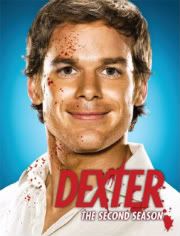
I'm not a psychic, but I am more perceptive than you. When I say that I fucking knew that Dexter would shit itself inside out when the first two seasons' cocaine barrel ran dry, I'm not bragging, I'm just using my powers for the good of the land.

The first season tracked Dexter's interactions with another serial killer, getting into his head in a very talky, meticulous way while the second season made Dexter the protagonist of a thriller, engaging his character with more action and suspense (more my syringe of poison). Now we're apparently out of angles to go at Dexter's character with, and like so many dramas the writers need to find new things to keep the audience's attention. Cheap gimmicks and violence porn will take the place of the well-written, meticulous character study we've all gotten used to streaming off the finest television pirating websites that 1997 can buy.

The writers' and producers' gimmick is the best friend one. A best friend that Dexter can go golfing with and talk about power tools with and make friendship bracelets with and slit throats with and one that he can eventually drive to the brink of sanity with violence and secrets. Which actually sounds like a good way to approach a story, but there were fundamental flaws in that idea that the show was never going to get around. It's my inclination that Miguel Prado (the best bud in question) being more sympathetic and wanting to help Dexter control his urges but eventually being driven mad by the evil that is only just below Dexter's skin would make for a far more interesting arc. It's unfortunate that the writers opt to make Prado a scheming villain instead, presumably as a quick way to ultimately dispatch the character once the season is over. That gives us nine or so episodes of Prado being a good guy and getting through to Dexter's inner demons, and then throwing him away by making him evil, even contradictory towards his established character once his character has run its course, which strikes me as terribly cheap. For one, it's hard to buy Prado's deception when he's been more like a little kid than a brilliant assistant district attorney. Also, he doesn't seem to understand how being a district attorney works, or at least he has a thirteen-year-old's view of it. After fourteen years of being an ADA, he still hasn't figured out why defense attorneys are there and thinks that district attorneys are the untouchable kingpins of Miami that cannot be stopped even by death.

There's a completely separate case that all our favorite Miami Metro Homicide team is on while Dexter dicks around at sleepovers, and it could not be more lame. It's like an episode of CSI Miami stretched out over twelve episodes. There's just nothing of value or substance in this plot line and it's the worst, most obvious sign that the writers were out of material. They're hunting a serial killer who is looking for a drug dealer that disappeared (Dexter killed him, setting off a string of murders that effects him in no way! They never even mention it!) and that's it. There's nothing else to it. They talk to witnesses who give them clues that, with their police resources, they use to tighten the gap between them and the killer, which like listening to someone describe an episode of Law & Order for two hours. And when they run out of boring police procedural shit, they go to Deborah, who's having a retarded interracial romance with some punk, which is cool because last time we saw her she was balling a Peter Fonda lookalike.

The show is aiming to make Dexter more normal, which is at least an arc for him to go through, but I'm not convinced it's for the best. It's easy to relate to him getting married and having a baby, but him pretending to be normal or doing routine stuff has never been what makes this character interesting. Thankfully, Michael C. Hall is still up to the task of making his character compelling. I've realized that the way Dexter interacts with people when he's preparing to kill someone requires an actor with a complete and comprehensive knowledge of every social grace of every group, ethnicity, age and whatever. Hall understands his character very well. It's a performance with a lot of ticks and sudden changes in demeanor. There are shades of classic movie spies in it, strangely. Also, and I don't know whether to accredit this to Hall's performance or his anonymous looks - I suppose both - but the scenes where he kills are by far the best things about this season. It's a shame there are fewer of them this time, but Hall's performance is very intense. So many of his emotions are faked, and faked so well that we often forget he's faking, but one of the few times we get any real, genuine emotion from Dexter is when he has someone on his table and his words come out in a controlled hiss of pure fucking evil that plays so well against his happy family man/mild-mannered blood spatter analyst image and for just a few moments the show lets Dexter become the villain. There's something deliriously macabre about his apron and his clothing in those scenes, with their muted greens and grays and crisp, freshly laundered look.

I don't know if this season really is host to better acting from Hall or if I just never really grasped that aspect of the performance before now. I'll lean towards the former so that I can credit this ass train of a season with less and I can end with a statement to the writers.

If you run out of story ideas for your show and you don't want the swimming pool to stop getting filled with cocaine-basted roast chickens every morning, you're going to have to make the executives in charge understand that your show needs to stay on the air. And since you've been freebasing Oxycontin off script pages all morning, you're going to have to come up with something fast, but that thing you come up with fast should no longer be "we'll waste such great performers in such great roles", because a savvy studio executive will see through that and have you fed to alligators and your former body parts will spend the rest of their existence being set dressing in Australian comedies. Although I wonder if I could get another Jurassic Park film made with that logic.

3/10

Wednesday, January 20, 2010

Isn't It Good

It's a curious thing to watch something slowly but swiftly move into greatness, and there's nothing more satisfying than seeing a great creative individual or team turn their failures or missed opportunities into greatness. Every shortcoming of Dexter's first season has been used as a trampoline to grab onto the treebranches of excellence, and the excellent second season would not be possible without those very specific shortcomings. I know in my boners that the writers and producers of Dexter knew that their first season would be their weaker season, but if they could succeed at making it a hit, the second season would be their great achievement.

That said, it has a great deal of surface flaws that could have been fixed quite easily. That it's rife with flaws is just something one has to learn to respect about serialized drama, and that these flaws are so wildly specific to the need for twelve hours of drama lest ye die is disappointing. It's the eternal reminder that, as a product, film and television is always going to be hamstrung by its need to meet certain requirements for the sake of marketability and longevity of investment. I'm more willing to forgive these flaws, though, because television offers a venue for serialization at the same time as long-form drama and while certain concessions are necessary, they're not concessions made by the creative team but rather by the medium they're working in. Television is a flawed medium and that's not going to change until televisions themselves are entirely replaced by the more malleable streaming content or until a mad genius figures out how to work commercials into a narrative.

For those of you who haven't seen the first season, I'll be discussing plot points for the second season that tie into the end of the first season. Also, you may want to know that the show is about a blood spatter ANALyst and sociopath who murders bad guys. In faggot's terms, spoile4s hehe.

After dispatching the Ice Cream Sandwicher, Dexter has become distraught. For almost a year the personal mindgames he played with another serial killer gave his life verve and meaning. His sister is a shaken mess and living with him after her intensely intimate encounter with the Ice Man Cometh and Sgt. Doakes is suspicious of Dexter and following him at night. Oh yeah, and a scuba diving team uncovered the dozens of dismembered bodies Dexter has been dumping in the ocean for years.

On the lame side of things, Dexter's girlfriend Rita thinks that Dexter is a heroin addict and sends him to Narcotics Anonymous where he meets a fox named Lila who, like all attractive women, is totally out of her mind. This is where the series shows its allegiances. When given the choice between being an intense thriller slash dark comedy and being a soap opera, it jumps into the neon jean shorts of soap opera with no shame.

And god damn the writers for taking the easy way out, because they strike dogs about halfway through the season only to give it all up like they couldn't wait. As the first season flirted with dark comedy and horror, the second season becomes a full-fledged black-as-the-heart-of-Africa comedy and we get a scene or two of such knee-shattering horror that it became heartbreaking to watch the writers and producers cop out for the sake of tits. Everything aside from its meandering narrative is an improvement over the first season. Every character is fleshed out and given dark, rough angles, especially Angel, the loveable brown spot on Dexter's rainbow of political correctness who gets a comic and tragic angle and goes through a very sympathetic arc. Deborah, Dexter's sister, is given the most complete arc that also falls victim to some soap opera writing towards the end, but her story is incredibly true to her established character, which goes against the time-honored tradition of destroying a well-established character and rebuilding it for the sake of the plot.

But really the best character on the show was Sgt. Doakes, the endlessly intense, borderline psychopathic police officer who is obsessed with proving that Dexter has some kind of secret. This is the dynamic that allows the second season of Dexter to become the best thriller I have ever watched on television. All those stupid asides that focused on Doakes last season that I complained about are given purpose. Without his character fleshed out, and without his background probed, we would never understand the transformation he goes through and we'd never sympathize with the horrors he goes through.

What makes Doakes such a spectacular antagonist is not only the way Dexter's heroism (in that he's the character we follow, and therefore the hero of the story even if someone else has the moral highground) is established against the Ice Tray Cracker (who is pure, swamp monster evil) in the first season and then challenged by Doakes in this season. Doakes is an asshole, for sure, but he's also a good cop who plays by the rules and gets the bad guys the right way. Dexter is an evil little bastard who hopes Doakes fails so that he can kill the criminals that slip through his fingers. Like all great hero-villain relationships, the conflict is tied to our own sense of morality and we choose sides based on that. If a film or television show understands that, they have the viewer by the balls.

I misjudged Dexter based on its first season and want its forgiveness. I take back everything mean I said about the first season and only stick by my criticisms of the second season. It's a strong argument for not passing judgment until you've seen every episode of a television show, but mostly I'm pleased that Dexter called me out on my lack of patience. It's a show with patience and I'm glad I stuck with it. I encourage anyone considering starting with this show to approach it with the same patience.

9/10

Friday, January 15, 2010

The Tightening Noose

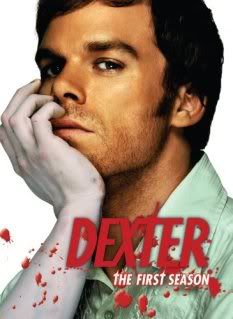
I've just finished the first season of Showtime's Dexter, which I started watching shortly after I discovered how much was available to watch on Netflix Instant Watch, and holy shit there's so much to watch on Netflix Instant Watch. I was completely unprepared for it. When the option was first presented to me, I quickly looked through the available films, saw a handful of good titles and even watched the first few seasons of The Office on a bender with a friend's Xbox.

So Dexter became the ultimate test of this Instant Watch service. And what can I say? It's streaming content, so it's certainly not HD quality or anything, but that's a worthy sacrifice if, like me, you tend to want to ingest TV shows all at once instead of waiting for individual discs to arrive in the mail, and especially if you're sharing an account with a family of seven and you have the two-at-a-time service and every time you get something you're renting a Michael Bay film.

I'm sure you all know that Dexter is about a blood spatter analyst cum serial killer played by Michael C. Hall, but he's a serial killer with a catch: he only kills bad guys. How does he determine who's good and who's bad? Cold logic. He's a sociopath, after all. And why is this film so different from all those shows and movies about subverting the law and murdering to satisfy your personal code of morality that I hate so very much? Not enough, honestly, but Dexter is a sociopath who kills first and foremost to satisfy his desire to murder; I just wish the show would keep that in mind when they deviate from the main story line to have Dexter pornishly execute a drunk driver. Dexter is a sociopath who has the same relationship with a code of morality that I do with the process of making a tequila sunrise. If I mix all these things together I can have a tequila sunrise, which has tequila in it, so hooray. I could drink the tequila straight, but that's not how it's done, I'm supposed to have something larger and I'm supposed to take it slower. The writers take a more commercial approach to the murders, trying to appeal to the audience's love of violence and disgust with criminals. The more interesting approach would be Dexter's hatred of the code, but continued obedience to it out of respect for the man who taught it to him.

Aside from the show's antiquated hatred and misunderstanding of marijuana, there's one scene that's very tellingly constructed from a morally conservative standpoint. Spoilers for the rest of this paragraph. One episode follows Dexter's disposal of a couple who bring Cubans into America and kill the ones whose families can't pay the activation fees. A child hiding in a car trunk gets a front-row viewing of Dexter sedating and dragging the wife off. Dexter has to investigate his own crime scene (rote and you knew this would happen from the moment you heard the premise, but come on, it's still pretty cool) when the police discover the child. They get him to talk to a sketch artist and together they produce an immaculate drawing of JESUS CHRIST. It's like having sugar poured directly into your tear ducts by Glenn Beck. I almost stopped watching the show right then and there. If Dexter was going to become the symbol of the heroic that catch the wicked on behalf of those damned liberal courts that never seem to catch them themselves, I wasn't going to be a part of it. I pressed on, mostly out of curiosity for Dexter's character. Despite what happened in that episode, I was getting invested in the character, despite how hard large portions of the show were working against it.

And in spite of all that they did, the character, remains intact and interesting. The most interesting portions of the show are his interactions with the police officers he works with as a blood-spatter analyst and his personal interactions. Now, those personal interactions are best when he's with his girlfriend Rita, but I'm not convinced they couldn't be better with his sister, a detective who he also works with. In fact, Rita and Dexter's relationship is a sub-plot I'm not entirely sure I like. Rita's a well-written character, but her relationship with Dexter is played out, especially since we get the same pieces of character from his relationship with his sister, and his relationship with his sister tends to be pertinent to the plot.

But what would they do with forty hours of freed-up time getting rid of Rita would give them? More introspection and more fantasy sequences. Being a sociopath, it's difficult to get to know Dexter through his interactions with others, and the writers, for whatever reason, only use his narration and fantasy sequences in conjunction with his interactions with others, rarely to reflect on the world around him. He even says he lives his life in his head, and being in there with him would be a billion times more revealing than trying to figure out what he's thinking while he interacts with people and pretends to be normal.

The biggest offense I think the show commits is to take us out of Dexter's head and give us entire subplots about the world around him, especially the fucking cops he works with. Every time we have a subplot about them, it drags us away from the best part of the show and into the land of boring, Law & Order police procedural bullshit. I don't see why the show needs to create all these salt-of-the-earth characters and put us in their presence for so long. I assume it's because they think we won't be able to relate to Dexter and need to fall back on boring stock characters. And they're right. Most of their audience aren't sociopaths and can't relate to what Dexter is going through, but that's only one way to connect to a character. Just because he's not relateable doesn't mean he's not sympathetic or interesting. And if we can relate our everyday struggles to a character, chances are he's not terribly interesting. Dexter's head is an interesting place and nothing else the writers come up with really compares.

Excel though it may when we're inside his head, the show's approach to the mind of a serial killer isn't exactly original or unique. It's seriously indebted to the writings of Bret Easton Ellis, and even manages the most excruciating homage to his work in one scene that's like being hit over the head with a pole made partially hydrogenated stupid. After all, Ellis' stuff has been brought to life on film really well only once and I think it has a lot of life left in it.

In any case, I just watched the first season. Perhaps all the problems I have with the show are solved further down the line, but based on what I've heard, they aren't.

6/10

Monday, December 28, 2009

The Devil May Care

Like so many movie faggots, I have a specific area of interest. Some are interested in crappy horror films, some love middlebrow Oscarbait, and I love action films, so when I see an action film I may have a completely different reaction to it than most people. For most people, the worth of a film isn't teetering on the edge a cliff above a fiery abyss made of cancer, and they judge action films on weird garbage like "is the story original", but they all run screaming from the room when I pull out a David Lynch film, but I digress.

My point is, for me, action films are graded on a curve. I have to use every bit of strength in my body to resist giving Spider-Man 3 a 10/10 based on its action sequences, some of the best ever filmed, and remind myself of that film's narrative nightmare and the fact that it's an hour too long and features some really shitty performances. I'll dismiss an entire film in minutes if the action is done poorly, despite whatever assets it may have.

And Sherlock Holmes has assets pouring out of every orifice. The most obvious is Robert Downey Jr., if not, surely, the best working actor, at least my favorite. I can name a dozen actors that could out-act him in community college reproduction of Transformers 2, but not one man alive that is cooler than him. And casting him as Holmes was a stroke of absolute genius. Plus, we get Jude Law as Watson? And Mark Strong as the villain? How could this go wrong?

Guy Ritchie is how it can go wrong. I quite like Snatch., despite my pretentions towards serious film criticism and even Rocknrolla was a fun movie, so initially it didn't seem like such a problem. There was even a totally awesome, hyper-stylized chase scene in Rocknrolla that made me think Ritchie was a man who could handle action. But we'll get back to that in a moment.

Sherlock Holmes is a character I know you're all familiar with. When you're lazily insulting people for being unobservant, you're probably conjuring the great detective's image. In this instance, he's being filtered through Robert Downey Jr.'s persona, which is to say "eccentric genius", so it's a spectacular fit. He's being rewritten as an action hero, which is okay, because it was bound to happen eventually. And Watson, the original sidekick, is played pretty spectacularly by Jude Law, giving the film two excellent central performances that it doesn't deserve. Holmes and Watson play a bickering old Jewish couple who spend a lot of time getting into fistfights and stopping evil plots like most dynamic duos do. In this particular instance, we get that hoary old trick of establishing them as best buds in the whole world while they casually bring down a terrifying menace, only to send them home and into some lame marital problems. The whole opening is lazy and poorly realized, and it's probably the best part of the film overall.

The evil menace in this case is a certain Lord Blackwood, played by the brilliant Mark Strong who sadly doesn't get to be that brilliant in this film. He's been dabbling in black magic and murdering young women and thanks to Holmes and Watson, is hanged for his evil deeds. But before being hanged he promises to rise from the grave and take England for his own, and when he does it's up to Holmes to use logic to stop this seemingly supernatural menace.

So there's your plot, and it sounds okay. The only real question I have is why the filmmakers didn't get their teeth into the "logic vs. superstition" thematic territory that the film flirts with, but Sherlock Holmes commits worse crimes, so I won't dwell on that.

I know this is bad blogging (holy shit, I'm a faggot), but allow me to return to some earlier points, specifically the action scenes and the opening. From the first fight scene I thought that they had taken the action too far. For turn-of-the-century England it was far too bombastic and explodey, and was totally inappropriate for the story. The first fight scene in an action film generally serves as a teaser, usually being the tamest fight and as the film goes on the action will get bigger and more bombastic and explodey. I knew the film was going to fuck everything up from the outset, then, when the opening would barely be appropriate for the climax. The film would have been best served by a series of Indiana Jones-style brawls between Holmes and a small number of combatants. And maybe some fast-paced footchases. The action scenes are way too big a deal for a film like this, and I couldn't stand some of the setups. For instance, the climax is set up on a bridge under construction, but the characters don't go up there for any fucking reason. They just go up there. And then they fight. It leaves us with characters uninvested in their environment and looking like they're swordfighting between shots of absinthe.

The biggest violator of everything great about action films, though, is what's meant to be the showstopping setpiece at the center of the film. Holmes and Watson run into two men and a bloody giant in the slums of London. From its setup, it promises to be an exciting brawl as Watson fights the two men and Holmes uses his brainpowers to outwit the skyscraper. But the film's definition of "outwit" is "pick up a magical electric device that zaps the enemy to death and zap the enemy to death". That is, of course, until the redwood starts running away. Imagine the giant guy in Raiders of the Lost Ark running away from Indiana Jones and Indiana Jones chasing after him, rubbing sand in his eyes and taking his lunch money, and you'll get an idea of how this scene plays. Except he only runs away to set up a boring fight at a dock in the most contrived manner possible. So let's break this down really fast: exciting setup that has all its suspense sapped from it when we give our hero a magic weapon, and then the suspense is further sapped when the rhinoceros he's fighting fucking runs away and then we're supposed to be invested in the fight again when the tyke starts smashing everything for ten minutes while Holmes daintily steps out of the way. As a general rule of thumb, don't have your Robert Downey Jr.-sized man chase down a behemoth if you want the audience to be invested in your film.

And I haven't even commented on the insane editing yet. As I said before, there's an action scene in Rocknrolla that is some sort of post-modern action masterpiece with all its camera shakes and crazy angles, cameras mounted on the actors, etc., and the editing is the glue that holds the whole scene together. In this case, the editing is loose and confusing and serves only to sap any suspense or excitement from the fights. I can't say enough about how bad the action is, but I'll move on because there's so much more to discuss as it is.

The most obvious error the film commits is to include Rachel McAdams, who's a doll for sure, but has no business in this film and who I still harbor ill will towards. Aside from her character being totally useless to the plot and only being present so the teenage boys the film is targeted at can have something to look at (which is fine, she's great to look at), her primary function is to drop Moriarty's name. Moriarty's presence in this film could be fun, but it's so unsubtle and stupid, which could also be fun if played as affectionate kitsch, and unnecessary in doing anything but setting up the inevitable sequel. I'm surprised that they didn't look to another recent film that namedropped the universe's main villain in a way that was subtle and exciting and set up the film for a sequel without being overbearing.

Argh. This movie just has so much wrong with it. It's such a fucking shame because they hired the coolest man alive to play the part of the coolest man of the turn of the century, a time period with really cool clothes. The only parts where the film gets to shine are where it totally focuses on Downey Jr., namely the bits where Holmes explains his deductive method, and even more specifically, a scene in the opening where he plans out in his head exactly how he's going to take down an adversary and then executes it flawlessly.

There's no reason that this shouldn't be the best action film of the year, but it just fumbles on every occasion. It's worth seeing if you have the same homoerotic feelings for Robert Downey Jr. that I do, and especially if, like I do, you think that Jude Law is a certifiable badass and would consort with gypsies and dabble in the black arts to put them in a movie together. I get so frustrated thinking about this film because it's such a waste of such talented people.

But I have one shiny ray of hope. Guy Ritchie, in the past, has responded well to criticism. After the success of Lock Stock and Snatch and the subsequent failures of Swept Away and Revolver, he turned in the very fun Rocknrolla that was an answer to all his fans' criticisms. I hope that he heeds the critics' warnings in preparing his sequel, because there's no reason that this film shouldn't be the most fun thing in theaters.

4/10

Monday, December 14, 2009

Lie To Me

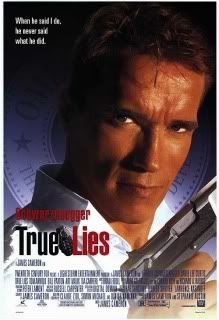
When I mentioned that Cameron's films get lite and poppy after The Abyss, I specifically had True Lies in mind. While it is made with consummate professionalism and has some really swell performances, it's the sort of film that can only disappoint you if you've just watched four films of such high quality as The Terminator, Aliens, The Abyss and Terminator 2. But who could keep that up?

If it weren't for Cameron behind the camera this would be an utterly disposable, forgettable mid-90s Schwarzenegger vehicle, but it's to Cameron's credit that the film works so well. Specifically his rapport with Schwarzenegger and his natural ability to direct women. Frankly, though, it strikes me as the first film since Piranha II that Cameron didn't give his heart and soul to. The action is too similar to Terminator 2's for me to get too worked up over it, featuring lots of car chases with exploding cars and big ol' shootouts, but it lacks the sci-fi angle of T2 that made it so unique and ultimately loses a lot of its value. It just becomes more mundane.

So the story goes something like, Schwarzenegger is Harry Tasker: Secret Agent, but his wife, Helen Tasker (Curtis) thinks he's a boring computer salesman. When their marriage seems to be on the rocks and Helen appears to be having an affair with a used car salesman pretending to be a secret agent, it can only be rescued by some sitcom-style antics and some high-flying adventure.

The angle Cameron seems to have approached this film with is "comedy", which brings me to the movie's biggest fuck-up: Tom Arnold. He plays the comic sidekick and holy shit do I hate Tom Arnold. Tom Arnold is listed as a natural disaster and every time he releases a movie the National Weather Service issues a warning. Tom Arnold can't tie his shoes and every morning has to visit the knot store. The #1 presser of Tom Arnold DVDs are craft rooms at nursing homes. If Tom Arnold were a planet, he would be the sun, expanded to red giant and sucking up Mercury, Venus, Earth and Mars. Tom Arnold is one of history's (and Middle-Earth's) greatest villains.

Phew. Now that we've gotten that out of the way, let me talk about the things that do work. Aside from Tom Arnold raining Hellfire on the film, most of the actors are really funny, and oddly enough, none of them are noted for their comedy work (unlike Tom Arnold, noted for his comic terrorism). Schwarzenegger, Jaimie Lee Curtis and Bill Paxton are great, Paxton in particular giving a performance only topped a few years later by A Simple Plan. These are the only two performances where I don't think his presence is a detriment to the movie. I always laugh when we're first introduced to him in this film, where he's dolled up like a sex offender with his mustache and over-combed hair. He makes a great counterpoint to Schwarzenegger's cartoon secret agent as a cartoon secret agent in the same tradition, but with an added sexual predator and somehow less credibility.

Best in show is clearly Jaimie Lee Curtis, who gives an inspired comic performance. She has the perfect look for a mid-90s, unsexualized, middle-aged office worker and her appearance perfectly encapsulates the word "goofy" for me. She's clumsy and physical without being an inane comic figure and she's snarky and sarcastic without coming off as an insufferable bitch. She's given all the best lines and the best arc, and sometimes she threatens to overshadow Schwarzenegger's domineering screen presence and Tom Arnold's fuckmouth.

And Schwarzenegger himself obviously handles the action in the same way he always does: like he's ordering a sandwich. It rarely works in more serious movies (and your enjoyment of a classic like Commando specifically depends on the sort of mileage you get out of standing behind Schwarzenegger at a Jimmy John's) unless he happens to be playing an emotionless robot. Thanks to Cameron, though, Schwarzenegger pulls off what is easily the best performance of his career where he isn't powered by hamster wheels. He plays a James Bond figure but with that trademark Austrian awkwardness. Look, if Arnold Schwarzenegger wasn't a huge star and was a cook at IHOP or something, he would still sort of catch the eye. He's not exactly inconspicuous and if you needed to quickly hide him it would be hard to find a broom cupboard that he would fit in. He would make a shitty spy, and the movie knows that. He could never pass as a regular family man or a computer salesman - he looks totally out of place at a dinner table. And the movie knows that. I suspect Schwarzenegger doesn't, though, and the entire juxtaposition becomes very funny.

The action is pretty standard 90s fare, making it a bit disappointing that Cameron was behind the camera. There are a few scenes that stand out, usually when the film gives itself over to physical gags that work surprisingly well.

Can I talk about Tom Arnold again for a minute? Of course I can. I don't see any other bloggers around. Imagine if James Bond had a sidekick named Reginald Bagley, whose gut hung out over his pants and none of his teeth faced the same direction. And imagine that he seemed to love that Bond made him look like a blubbering fuck-up by going into space, banging a dozen moonladies and stopping a world-threatening crisis without ever setting down his martini while Reginald sat on his ass and gave him helpful hints from inside an oversized bag of Cheetos. And Reginald has no impact on the plot. And imagine that this character isn't meant to appear totally pathetic and worthless next to Bond, and you'll get a good idea of the character Tom Arnold plays BEFORE Tom Arnold the war criminal even becomes a factor. It's a personal issue that kept me from enjoying large parts of an otherwise highly enjoyable film.

And that's pretty much all there is to say about True Lies. It's fun, well-made, features some great performances and just doesn't hold up to the crazy ambition of Cameron's last four films. I can't help but feel like he's floundering here, even if it's just momentary. It will only take three years for him to release the most expensive movie ever made up to that point, a film of such crazy ambition and such unbelievable success that it begs me to watch it again for the first time since it was released (when I was seven).

8/10

Wednesday, December 2, 2009

Scooby Doo Meets the Boondock Saints


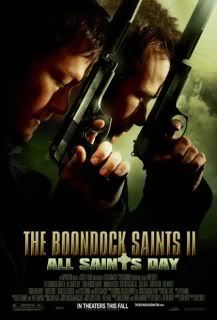
I've never made any sort of secret out of my hatred for the original Boondock Saints. I've often said it's the worst film I've ever seen, and I stand by that. There may be worse movies out there and I'm sure I've seen some, but all those are widely agreed to be horrible movies. None of them have the stark-raving, drunken, tattooed fanbase that The Boondock Saints boasts. Piranha 2 is dismissive material. It was made with no ideals and no pretensions towards being anything but a quick Italian cash-grab. Calling it the worst movie of all time is par for the course. It's not a serious criticism because it's not a serious film. The Boondock Saints is clearly a labor of love, boasting some really profound morals that cater to peoples' stupidity and base instincts. People were passionate about this film when it was made.

In retrospect, I'm not even really sure why the hell I saw this movie. I suppose for the same reason I saw New Moon. It's the sequel to what is essentially 9/11 with Nickelback playing over it (I wrote that sentence, and then it got me thinking: does such a video exist?), but everyone thinks it's just the bees knees. So much so, in fact, that it's the most advertised film I've ever seen in the way of posters, t-shirts, etc. and The Boondock Saints is probably the film I've most often seen on other peoples' DVD shelves. Even my older brother is a heathen to my cause, and many intelligent, well-spoken men of film honestly defend it as a serious film. I feel like Zorro these days, but without the moral and legal impunity that apparently comes with vigilantism. And without the sword. You guys could use more sword through your chests.

The Boondock Saints II picks up eight years after the original. The MacManus brothers went on a murder spree that gave millions of people worldwide huge murder-boners at the end of the last film and have since been hiding out in Ireland. Then a priest is killed in the same style the MacManus brothers killed people, and they're off to solve the case. Along the way they meet a wacky Mexican comic relief character/sidekick played by Clifton Collins Jr., an actor I was starting to quite like before this, and an FBI agent who is a woman and so therefore must be attractive. She also does things like see clues at a crime scene with her eyeballs and make all the other detectives jealous of her keen deductive intellect (otherwise known as eyeballs). And there's something about Il Duce, who I can't really remember from the first movie, and his past making vests. A noble profession.

So how does it hold up to my expectations? Well, since it's the exact same fucking movie, I'd say "pretty good". World-famous cocksucker Troy Duffy, writer and director of these two films and no others, has spent ten (10) years writing this movie. Ten fucking years. In the time he spent farting and writing jokes about it, I doubled in mass, graduated from high school, dumped a handful of girlfriends, had my first #9 with no tomatoes from Jimmy John's and watched over 1000 movies. Yeah, that doesn't sound like much, but it's more than creating a script out of pure fart and then filming it.

So let's dive into the dicks and docks of what makes this movie horrible, and let's get the easy stuff out of the way first. The acting is horrible across the board, but it's a little less stressful on me this time because they aren't robbing Willem Dafoe, one of my most beloved actors, of his dignity. In particular, Julie Benz is a fucking fever dream as the character with the eyeballs. She's playing exactly the same character that Willem Dafoe played in the original film, and that's a role that not even goddamn Willem "God Damn" Dafoe could manage, let alone an actor who has a hard time maintaining an accent. It's one of those roles where you wonder if, as research, the actor watched footage of air-raids. Though I'm sure she was doing her very best with a script that thinks it's funny to have her say "fuck" because she's a woman and thinks that eyeballs are all it requires to outclass local law enforcement.

Troy Duffy directs this movie like he woke up with his skull cracked and bleeding and a big sack of money attached to a time bomb was laying next to him every morning during production. He applies style simply because it looks cool, never because there's any reason to apply style. This is filmmaking 101 and one of the most important rules of filmmaking that I have yet to see a good excuse for breaking: style depends on content. Similarly, you cannot mate a cat with a dog. Actually, a more apt metaphor here would be "you cannot mate an earthworm with a toaster". So when Troy Duffy suddenly starts shooting the movie like a grindhouse film, is he doing it because he's illustrating the content of the film visually, or is he doing it because he's not exactly sure why Guy Ritchie and Quentin Tarantino do it, but it sure looks cool in their movies? Fuck you, Troy Duffy.

So let's get down to business. I've been putting off revealing why these movies REALLY suck.

I don't flinch at violence, twisted codes of ethics are nothing new (I live in Indiana) and my blood, 2/3s of it greener than...something green and Irish. I don't have to cater to you assholes. Go to hell.

I'd like to point out first of all that Troy Duffy's sadistic philosophies are nothing new. But here's the gist of them: bad guys deserve to be executed. Okay, we already do that. What the fuck else do you want? Oh, yeah, the court system and trial by a jury of your peers thing needs to be removed. And who do we replace them with? Two psychopathic Irishmen. I don't see how this could go wrong.

Look, we all know the court system is flawed. But can you imagine how much more awful things would be if we gave a few men impunity to carry out the law in whatever way they liked? There's a philosophy that says the best form of government is a tyranny, but it's the most easily corruptible, and a corrupt government is the most dangerous and ineffective government of all. The same philosophy argues that a Democracy is the worst form of government, but the most difficult to corrupt, therefore a Democracy is the most effective form of government simply because it's a convoluted mess. The same thing applies to the court system. The system itself is bad, but already so susceptible to corruption. If something as convoluted as the United States justice system is still eminently corruptible, making it more corruptible is not the solution.

The film offers violence and sadistic fantasy (both things I'm fine with--I'm sickened by the context) in lieu of serious discussion about the issues the film tends to just shoot at.

"But Oliver," I'm sure you're asking "how can you condemn a film like this and not The Dark Knight, which you still slobber over like a twelve-year-old girl at a Jason Mraz concert?". Good question, reader I just made up. The difference between the two films are thus: The Dark Knight takes place in a make-believe world, in a make-believe city and featuring make-believe criminals. The Boondock Saints takes place in a world clearly modeled on our own (when Troy Duffy isn't muddling his intentions with retarded stylistic tricks) in a city called Boston which is real, but sometimes seems like an abstraction, and featuring criminals based with no pretense of fiction on real criminals. Not a bullet-proof argument by any stretch of the imagination, but it's something that factors in. Second, Batman isn't a murderer (again, not bullet-proof, but work with me here. This is going somewhere.). Third, and I think most importantly, Batman is portrayed as a mentally ill, flawed human being who knows what he is doing is a throat-jab to the fine men and women who work to bring down the bad guys using entirely legal means. Christopher Nolan never tried to push a one-man judiciary system on us and call it a legitimate philosophy. Troy Duffy has spent two films telling us how cool it would be if we shot mafiosos.

I can't think of another film that's violated my moral code ever. I barely even have a moral code. I could care less if they release a Columbine video game. No one is honestly trying to sell us on Eric Harris and Dylan Klebold's personal philosophies, and if they did no one would fucking buy it. But people talk about The Boondock Saints as if it's a paradigm of moral straightforwardness. People buy this philosophy.

If anything has become clear to me here, it's that maybe I don't hate The Boondock Saints. Maybe I hate that it represents a group of people stupid enough to love it and large enough to demand a sequel.

1/10

Wednesday, September 9, 2009

Cops!

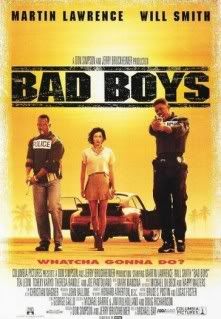
One movie in and I'm ready to just agree with everything everyone has said about Michael Bay. Not out of anger, or because I really hated Bad Boys, but because I can't remember anything about the movie and I watched it two hours ago.

Let's see if I can recount the plot. Will Smith is Mike something, and Martin Lawrence is someone else. Mike and ? are narcotics officers in Miami (I think) and best buds. Every day they get into some wacky predicament that they have to shoot their way out of, because due process is for squares.

Actually, while I'm here, I'd like to comment on a scene that could have been really cool. Why is Mike such a loose-cannon cop who doesn't play by the rules? Because he has a trust fund and, thus, nothing to lose. I'm just joking, the film doesn't make that connection. They just use it as a device to show how dedicated Mike is, but it would have been more interesting if he really WAS an adrenalline junkie who got off on violence and didn't have to play by the rules because if he got fired, whatever. No, that would have been too interesting.

Anyway, one day the Miami (I think) police department has a Mt. Fuji of heroin stolen out of the evidence room and Mike & ? are brought in to get it back. Do they shuffle out of bed, take twelve Asprins and a shot of Jack Daniels, pin their badge to their bathrobe and hop on the city bus? No, they hop into their stylish sports cars and have their clothing robots put on their designer suits, speed on down to the police station where the no-nonsense police chief wags his finger at them for being too stylish and sexually desirable.

Argh, fuck. I keep forgetting what I was talking about. So a bunch of heroin gets stolen. Yawn. There's nothing more boring than a villain who's just trying to make a deal and get paid. There are no fucking stakes. No one gives a shit about some dude selling some heroin, he just wants to be as stylish as the main characters. I sympathized with the guy. He's trying to scrape together a living, and here come the cops with their gold-plated Ferraris and diamond-encrusted handguns to bust a silver bullet in his ass for selling something that shouldn't be illegal in the first place. Not to mention he's characterized as a villain because he's European, clearly having had his world domination plot ignored by James Bond and sulking off to sell some heroin and buy a new Moon Laser.

Shit, what was I talking about? Some guy gets shot, I think he's a cop. Some hookers see it, one of them gets shot, the other gets away. ? has to pretend he's Mike so that the girl will talk to him for some convoluted reason (a simple explanation would have cleared the whole situation up in about fourteen seconds, but then we wouldn't get to see an episode of Family Matters where Carl Winslow shoots forty people). There's some sexual tension between ? and the Hooker Witness, but oh no! ? is married!

So the whole plot makes no sense, is boring as shit and then they drive around shooting stuff and talking jive. Every thing about this film is pre-packaged and boring. Every joke is a joke you've heard before. This is at least half comedy and I didn't crack a smile once. The villain is the same as every Bond villain in the 80's. The score sounds like ever score from the 1980's. Even the formula was a joke by then. Maybe it's because my heart is a little black hole of despair, but I derived next to no pleasure from watching this film. It's a thin, dated retread of things we've seen a million times before, and it belongs on cable TV, not on a DVD.

3/10