Showing posts with label the political landscape. Show all posts

Wednesday, December 2, 2009

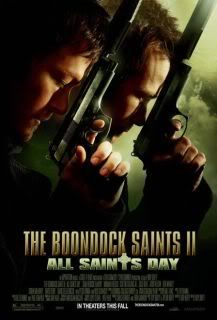
Scooby Doo Meets the Boondock Saints


I've never made any sort of secret out of my hatred for the original Boondock Saints. I've often said it's the worst film I've ever seen, and I stand by that. There may be worse movies out there and I'm sure I've seen some, but all those are widely agreed to be horrible movies. None of them have the stark-raving, drunken, tattooed fanbase that The Boondock Saints boasts. Piranha 2 is dismissive material. It was made with no ideals and no pretensions towards being anything but a quick Italian cash-grab. Calling it the worst movie of all time is par for the course. It's not a serious criticism because it's not a serious film. The Boondock Saints is clearly a labor of love, boasting some really profound morals that cater to peoples' stupidity and base instincts. People were passionate about this film when it was made.

In retrospect, I'm not even really sure why the hell I saw this movie. I suppose for the same reason I saw New Moon. It's the sequel to what is essentially 9/11 with Nickelback playing over it (I wrote that sentence, and then it got me thinking: does such a video exist?), but everyone thinks it's just the bees knees. So much so, in fact, that it's the most advertised film I've ever seen in the way of posters, t-shirts, etc. and The Boondock Saints is probably the film I've most often seen on other peoples' DVD shelves. Even my older brother is a heathen to my cause, and many intelligent, well-spoken men of film honestly defend it as a serious film. I feel like Zorro these days, but without the moral and legal impunity that apparently comes with vigilantism. And without the sword. You guys could use more sword through your chests.

The Boondock Saints II picks up eight years after the original. The MacManus brothers went on a murder spree that gave millions of people worldwide huge murder-boners at the end of the last film and have since been hiding out in Ireland. Then a priest is killed in the same style the MacManus brothers killed people, and they're off to solve the case. Along the way they meet a wacky Mexican comic relief character/sidekick played by Clifton Collins Jr., an actor I was starting to quite like before this, and an FBI agent who is a woman and so therefore must be attractive. She also does things like see clues at a crime scene with her eyeballs and make all the other detectives jealous of her keen deductive intellect (otherwise known as eyeballs). And there's something about Il Duce, who I can't really remember from the first movie, and his past making vests. A noble profession.

So how does it hold up to my expectations? Well, since it's the exact same fucking movie, I'd say "pretty good". World-famous cocksucker Troy Duffy, writer and director of these two films and no others, has spent ten (10) years writing this movie. Ten fucking years. In the time he spent farting and writing jokes about it, I doubled in mass, graduated from high school, dumped a handful of girlfriends, had my first #9 with no tomatoes from Jimmy John's and watched over 1000 movies. Yeah, that doesn't sound like much, but it's more than creating a script out of pure fart and then filming it.

So let's dive into the dicks and docks of what makes this movie horrible, and let's get the easy stuff out of the way first. The acting is horrible across the board, but it's a little less stressful on me this time because they aren't robbing Willem Dafoe, one of my most beloved actors, of his dignity. In particular, Julie Benz is a fucking fever dream as the character with the eyeballs. She's playing exactly the same character that Willem Dafoe played in the original film, and that's a role that not even goddamn Willem "God Damn" Dafoe could manage, let alone an actor who has a hard time maintaining an accent. It's one of those roles where you wonder if, as research, the actor watched footage of air-raids. Though I'm sure she was doing her very best with a script that thinks it's funny to have her say "fuck" because she's a woman and thinks that eyeballs are all it requires to outclass local law enforcement.

Troy Duffy directs this movie like he woke up with his skull cracked and bleeding and a big sack of money attached to a time bomb was laying next to him every morning during production. He applies style simply because it looks cool, never because there's any reason to apply style. This is filmmaking 101 and one of the most important rules of filmmaking that I have yet to see a good excuse for breaking: style depends on content. Similarly, you cannot mate a cat with a dog. Actually, a more apt metaphor here would be "you cannot mate an earthworm with a toaster". So when Troy Duffy suddenly starts shooting the movie like a grindhouse film, is he doing it because he's illustrating the content of the film visually, or is he doing it because he's not exactly sure why Guy Ritchie and Quentin Tarantino do it, but it sure looks cool in their movies? Fuck you, Troy Duffy.

So let's get down to business. I've been putting off revealing why these movies REALLY suck.

I don't flinch at violence, twisted codes of ethics are nothing new (I live in Indiana) and my blood, 2/3s of it greener than...something green and Irish. I don't have to cater to you assholes. Go to hell.

I'd like to point out first of all that Troy Duffy's sadistic philosophies are nothing new. But here's the gist of them: bad guys deserve to be executed. Okay, we already do that. What the fuck else do you want? Oh, yeah, the court system and trial by a jury of your peers thing needs to be removed. And who do we replace them with? Two psychopathic Irishmen. I don't see how this could go wrong.

Look, we all know the court system is flawed. But can you imagine how much more awful things would be if we gave a few men impunity to carry out the law in whatever way they liked? There's a philosophy that says the best form of government is a tyranny, but it's the most easily corruptible, and a corrupt government is the most dangerous and ineffective government of all. The same philosophy argues that a Democracy is the worst form of government, but the most difficult to corrupt, therefore a Democracy is the most effective form of government simply because it's a convoluted mess. The same thing applies to the court system. The system itself is bad, but already so susceptible to corruption. If something as convoluted as the United States justice system is still eminently corruptible, making it more corruptible is not the solution.

The film offers violence and sadistic fantasy (both things I'm fine with--I'm sickened by the context) in lieu of serious discussion about the issues the film tends to just shoot at.

"But Oliver," I'm sure you're asking "how can you condemn a film like this and not The Dark Knight, which you still slobber over like a twelve-year-old girl at a Jason Mraz concert?". Good question, reader I just made up. The difference between the two films are thus: The Dark Knight takes place in a make-believe world, in a make-believe city and featuring make-believe criminals. The Boondock Saints takes place in a world clearly modeled on our own (when Troy Duffy isn't muddling his intentions with retarded stylistic tricks) in a city called Boston which is real, but sometimes seems like an abstraction, and featuring criminals based with no pretense of fiction on real criminals. Not a bullet-proof argument by any stretch of the imagination, but it's something that factors in. Second, Batman isn't a murderer (again, not bullet-proof, but work with me here. This is going somewhere.). Third, and I think most importantly, Batman is portrayed as a mentally ill, flawed human being who knows what he is doing is a throat-jab to the fine men and women who work to bring down the bad guys using entirely legal means. Christopher Nolan never tried to push a one-man judiciary system on us and call it a legitimate philosophy. Troy Duffy has spent two films telling us how cool it would be if we shot mafiosos.

I can't think of another film that's violated my moral code ever. I barely even have a moral code. I could care less if they release a Columbine video game. No one is honestly trying to sell us on Eric Harris and Dylan Klebold's personal philosophies, and if they did no one would fucking buy it. But people talk about The Boondock Saints as if it's a paradigm of moral straightforwardness. People buy this philosophy.

If anything has become clear to me here, it's that maybe I don't hate The Boondock Saints. Maybe I hate that it represents a group of people stupid enough to love it and large enough to demand a sequel.

1/10

Thursday, November 12, 2009

The All-Seeing Eye

The hardest thing to review is mediocre films because there's nothing to say about them. They don't excel and they don't fail. They just exist. An interesting premise is rarely squandered by a mediocre film, it's just not given an especially good treatment. It's a victim of filmmaking by committee that waters it down, or maybe a creative group that whose brains were homogenized (with a blender) to keep them from coming up with an exit strategy for Iraq.

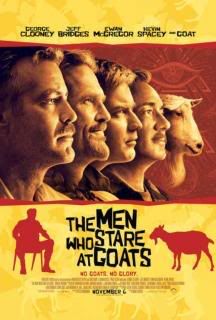
The Men Who Stare at Goats is one of the most perfectly mediocre films of the year. I didn't love it, I didn't hate it. It occupied an hour and a half of my time and then I went home. I laughed at a handful of parts, but no scene struck me as particularly unnecessary. It almost defies analysis just by being so damn inoffensive.

The tale The Men Who Stare at Goats weaves is that of a reporter, Bob Wilton (Ewan McGregor at his blandest and most mediocre) who is following alleged psychic soldier Lyn Cassady (George Clooney) en route to a black ops mission. Along the way we frequently cut to Lyn's past in a secret government training facility where a man named Bill Django (Jeff Bridges) taught them to fight with their minds using New Age techniques.

One of the simplest mistakes it makes is that it goes from meandering and plotless (it's a roadtrip movie for the majority of its running time) to an anti-war parable with the heroes saving prisoners from a villain that seems like a little third-act studio revision. Trying to change your narrative style mid-film is such a rookie mistake, and while this is Grant Heslov's first film as a director, he was responsible for the pretty great screenplay for Good Night and Good Luck.

The second is that Ewan McGregor's entire character needed to be excised from the screenplay. He's not just useless, he's detrimental to the impact of the film. Having a cipher for our skepticism rarely works in a movie like this, and here Bob Wilton is the peak upon which we sit to view these characters in action. We never get deep into the absurd rivalries of these loopy, eccentric character because we're viewing it all through Bob Wilton's rolling eyes. It's like we're being told every few seconds not to forget that these characters are clownshit, but the drama and the comedy would have been more effective if we had started sympathizing and relating to the characters, instead of relating to them in a "look at how stupid they are, and the poor fellas don't realize it" sort of way. Yeah, these guys are as crazy as that Bill O'Reilly-Ann Coulter-Glenn Beck Cerberus I keep drawing subconsciously, but the whole film is akin to reading an article rather than watching a film.

That's not to say that the film doesn't work occasionally, it's just that it putters through the portions that don't work, as if it was written on a scene-by-scene basis and then the remaining scenes were written to connect the good ones together. The best portions of the film are when Bob's (and our) skepticism begins to melt and we begin to wonder if Lyn really is crazy or if he does have some psychic powers because, as I stated above, these are the parts where our skepticism doesn't get in the way of our relating to the characters and participating in the drama (and drama being the essence of comedy--by extension, the comedy).

Heslov strikes me as a man who never intended to be a director, but rather to be a writer (he was an actor before he was a writer, I believe). If I were to speculate (which I always do), I would say he accepted the directing job because he perhaps had a difficult time in the trenches as a writer on Good Night and Good Luck and decided that the best way to gain more control over future projects was to at least have some experience directing, if not direct those future projects himself.

Furthermore, he was guaranteed a huge star (with barely a hit to his name--isn't 21st century movie stardom so strange?) in George Clooney which would surely get his project greenlit and he's guaranteed a tidy little sum which will help him get future projects produced. Good for him. I can only hope those future projects are more along the lines of Good Night and Good Luck, though.

So as I said before, there really isn't much to be said about this film. It works sometimes, it has some good gags, but it's not really worth seeing in theaters. I will say that I do believe this film is based on true events, because it's a touch easier to believe than this.

5/10

Tuesday, November 3, 2009

Further government-sponsored attempts to find the galaxy's last Bob Evans

If the Star Trek films were to wrestle, Star Trek VI: The Undiscovered Country would lose because all it would take is fresh crab cakes on the buffet to distract it. If Star Trek VI were to play chess, it would look like this.

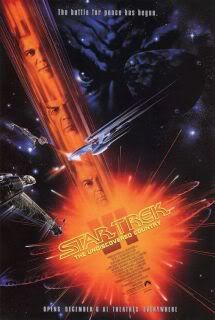
Star Trek VI: The Undiscovered Country is a pair of suspenders and a flannel shirt. William Shatner had his ass airbrushed in several scenes. Leonard Nimoy's gut conspires to make him look less alien-like. At this point they had the virile young Next Generation cast to drag mercilessly through the Trek fanbase, who, after viewing this film, I can only assume look like an angry mob or spectators at gladiatorial games. Why they aren't mobbing and using their teeth to tear off their Starfleet uniforms is beyond me; a morbid sense of humor springs to mind, as this is easily the most physically intensive the series has been since it was still a TV show.

On a similar note, the plot of Star Trek VI:

The crew of the Enterprise are set to be decommissioned and ground into meat (?) for the hungry masses. When Kirk is asked to escort a Klingon ambassador to Starfleet Command he responds like anyone would, by loading his racism into his holsters and assembling his grouchy old crew to be cartoonishly ignorant and murderously hostile.

If you haven't guessed already, the Klingons are a pretty obtuse metaphor for the Soviets and the film is a pretty obtuse metaphor for the end of the Cold War.

So they're enjoying the sort of dinner party where everyone is secretly armed and every dish has been so thickly laced with nanobots that it can be passed off as a sauce. Afterward, the Klingon high command beam back to their ship and are greeted with the traditional Klingon lullaby of having their ship blasted with torpedoes and their crew shot at point-blank by men in Starfleet uniforms. Kirk is sent a subpoena in his weekly shipment of alien sex toys and sent to a Klingon court, which is surely based on Texas courtrooms. He and McCoy (who is once again being dragged along because Kirk doesn't feel like being sentenced to death alone) are easily found guilty by Kirk's famous racism and enthusiasm for launching small pox-infected blankets into Klingon teepees. They're sentenced to live out the rest of their lives on a penal mining colony, despite their pleas of innocence.

Meanwhile, Spock has taken control of the Enterprise and is attempting to unravel the mystery of who is responsible for the attack, and it's here where the film really stands out. First of all, Spock makes such a good captain that I can't figure out how Kirk got command in the first place (although if we're going off Abrams' film, he got it by making fun of Spock's dead mom) and it's a crackling, locked-door whodunit.

This is easily the best film in the series since the first one, and the most purely enjoyable. My attention never wavered for a moment, despite the cast's constant looks of confusion or excitement when they realized it was medicine time. It finally incorporates the things that I've said Star Trek has needed for a long time: either a villain with a serious ideological clash with the crew of the Enterprise or a politically-driven narrative, a definitive sense of scale, the compartmentalizing of the crew in order to give them their own moments to shine and independent story arcs, the crew out of their element or dealing with a serious danger that the audience feels is a real threat and some damn adventure, already. None of these things have existed (and if they have, only in spurts) since the Original Series. The Motion Picture offered some 2001-style postulating and some really incredible visuals but generally seemed divorced from the liter tone of the series and it didn't feel like an essentially Trek film; it could have been any cast of characters on that ship. Here, I feel (and I'm no Trek purist, but I have been enjoying the series), we are given the best of Trek lore and the best characterizations any of the films have offered thus far. Also, the pacing isn't all over the place like it's been for several films now, hinting at some more disciplined editing (ie: an editor ready and willing to cut scenes that were included to jerk off the fanbase--one of the serious advantages to hiring a non-fan to helm a film bogged down in lore and fandom).

The actors, despite their age, are in fine form. Specifically DeForest Kelley who's never been in better shape. He gets the best scene of any of the films in this one, when he attempts to resuscitate a dying Klingon despite his inadequate knowledge of Klingon anatomy.

And now that I've softened you up, here's the killing blow. Star Trek VI: The Undiscovered Country suffers from the time it was produced. Commercial filmmaking in the early 90's popularized some goddamn weird stuff. The example I'm about to illustrate is a pretty big spoiler, so look out.

After Kirk and McCoy are sent to the penal colony, the Enterprise crew manages to rescue them, despite a Klingon declaration that any attempt to rescue them will be considered an act of war. After blowing the shit out of a Klingon ship and killing some high-ranking officers in the process, they beam down to a Klingon-Federation peace conference, armed to the fucking teeth and starts killing Klingons.

That's all fine and good (I guess), but the really weird shit hits the fan when Kirk starts giving a speech about tolerance while his boots are inch-deep in alien blood. And then everyone in attendance claps. I don't doubt that the best way to get the floor or end a filibuster in Congress (or Kongress HAHA) is by shooting someone, but I don't imagine there will be much clapping afterward, just terrified urinating. And this sort of thing was standard practice in commercial filmmaking in the 90's! The madness!

When it's all boiled down, I guess it's kind of disposable, but I certainly had a good time watching it. Hell, it's the first film in the series I could imagine being enthusiastic about watching a second time (although I have been curious to revisit Wrath of Khan, if only for Ricardo Montalbon's performance).

I wouldn't recommend it to anyone but Trek fans, but I'm certainly happy to see the original cast sign off with an actual good film.

7/10

Sunday, October 18, 2009

Jerkoffs finish first

Before I go any further I want to say a few things. First:

If you think Michael Moore is an inflammatory liberal pundit and you roll your eyes when you hear his name (as so many do), I trust you already have Bill O'Reilly, Anne Coulter and Glenn Beck in deathmatches with genetically engineered polar bears on the moon.

Michael Moore is far, far, FAR more tactful than any of those morons, and that's astonishing because Moore can display a sad lack of tact a lot of the time. It does the conservative party a great disservice when they can't find anyone competent to wave around their propaganda. It's not like finding someone like that would be impossible, or even hard. The closest thing liberals have to someone like Anne Coulter (whose job it is to scream at everyone, talk about how liberals should be hung and be a drawing of a person) is Michael Moore, who's basically a big teddy bear. And I can't help but feel like Glenn Beck is the Republican party's sad, sad answer to Stephen Colbert.

Early on I made a decision to avoid politics on this blog. People have a hard time looking at politics objectively. They cling to the things their parents told them to believe and scream and cry when someone disagrees with them. It's something I see too much of, being a centrist living in Indiana (which makes me a raging liberal, I guess).

Enough about that. Here's the film:

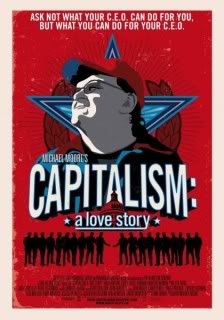
Financial collapse! When Wall Street came down, who got rich? And who got fucked? Michael Moore is on the case. With a series of interviews with reg'lar folk, hoity-toity business man types, insiders willing to spill their guts and a healthy supply of stock footage, Moore attempts to trace back the financial collapse and figure out who's responsible.

His answer, although not %100 clear, seems to be "every president since FDR". I'll contend with you on that one, Mr. Moore.

Why did the economy collapse? The consumer. We're the ones who said fuck the small business, we only trust multinational brand names. We only want products produced quickly and cheaply, who gives a fuck about quality. QUICKLY AND CHEAPLY. Everything else be damned we want it QUICK and we want it CHEAP. So we threw our money at the same dozen corporations because they were able to provide the quick and the cheap. Eventually they got big enough that they could either buy out or corner every market and they swelled big enough to command the vast majority of the money and power in the country. As Moore says, America became a plutocracy.

But then the balancing act kicked in. Financial ruin! The guys that had all the control were coming down and things were preparing to level out. There would be collapse, but new powers would rise from the ashes. Consumers would have to rethink their buying habits. Then Congress did exactly what the US government is never supposed to do: they bailed them out. They gave them hundreds of billions of taxpayers dollars that we don't have to do fuck knows what with.

Moore blames the government, I blame the people. We allow all these things. It's up to us who gets the money and who gets the power, and the only reason that these dickwads have the money and have the power is our complacency.

So as is his signature style, Moore interviews some very sad lower and middle-class people to bring the audience to tears and make them say things like "Those dastardly corporations! My whole life I thought they had the employer's best interests at heart!". That's all okay, emotional manipulation and political documentaries are like me and really long metaphors. You just have to remember to ask yourself what the family crying about their dead mother has to do with capitalism (not that much).

In other words, it's scattershot, like most of Moore's films. I agree with the points, but not the thesis, like most of Moore's films. He and I have different philosophies, which is fine, because he at least tries to make a coherent argument (unlike some people I could mention).

But his arguments tend to get convoluted amongst all the stunts and interviews. His goal isn't even terribly clear. I think that's the worst thing I can say about him. He puts on a good show but there isn't usually that much substance to them.

His stunts are fun, but they're fluff and he knows it. They're there so that he can put them in the trailer and get asses in the seats. He's a likable guy and I'm always game for one of his films.

For a more informative documentary on a similar subject, check out Enron: The Smartest Guys in the Room.

7/10

Friday, August 14, 2009

Diversity Day

Traditionally I hate movies that identify "racism" as their central theme. It's something that's been done hundreds of times and there's really very little territory that hasn't been mined, strip-mined and blown to pieces with a bunch of miners trapped inside.

Anyone who has been educated has been taught to treat other races with dignity, despite whatever feelings you have towards them. It's something that we've all figured out by grade school and it's not something that needs to be explored anymore.

There's something peripheral to that hackneyed theme that District 9 explores: our fear and distrust of things we don't understand and the way a simple language barrier can give us an asshole sense of superiority.

And District 9 never gives easy answers to these problems.

Also I think that the real theme of the film is the unifying power of cat food.

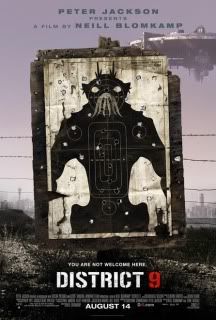
For those of you who don't know, District 9 is a part fictional documentary, part narrative feature about an alien spaceship that has been stalled in Johannesburg, South Africa for twenty years. Alien affairs have been handed over to a private organization called MNU, who have ferried the aliens off the ship and into a shantytown below. There, the aliens, called by the derogatory "prawn", have developed a society with a group of Nigerian criminals who are hoping to learn how to operate the advanced alien weaponry.

Our lead is an MNU officer named Wikus who is in charge of an operation to move the aliens to a smaller, isolated and heavily guarded location away from the general population. There he comes in contact with an alien contaminant that has strange and sickening effects. I won't go any further than that, because the twists and turns the plot goes through are one of the chief pleasures of the film.

It's weird to get good performances out of entirely CGI characters that speak in an alien language with no discernable emotions, so by using CGI not just well, (like so few films do) but extraordinarily well the film immediately endeared itself to me.

This is the sort of filmmaking that makes me wonder if the director had to negotiate with the devil (trade some PAs' souls or something) to give these characters life. This is the SECOND film this summer to use a small budget (District 9 was shot on $30 million) to outclass the big-budget films that cost the studio executives their first-born children and all their body hair to make, and which would probably have a hard time turning a profit against a budget inflated enough to keep Paris Hilton busy for a week. Every alien in the film is CGI-rendered and they all look fantastic.

The lead performance is great, the direction is excellent and would never suggest that Neil Blomkamp hadn't been directing films for decades and the script is quite strong.

What's most interesting to me is the way the aliens are treated by humans. Despite their pretentions towards giving them a safe place to live, they constantly raid and harrass them, don't accommadate their lifestyle and in one scene, burn down a nest to keep the prawns from being born, all the while laughing and joking.

But what's new about that? The interesting part is that they don't paint the aliens as victims. The best example I can give is a scene where an alien starts to pull apart a tire, and as the cameraman explains that the aliens like to eat tires because of the texture, a soldier walks up and begins to prod the alien. Wikus shouts not to prod the alien, but it's too late. The alien grabs the soldier and tears his arms off.

With behavior like that, it's not surprising that the general population fears and distrusts the aliens, and it's not unreasonable for them to want them sent somewhere that they'll never see them again. Despite one species' extreme mistreatment of the other, it's hard to sympathize with either side. Even Wicus is a scheming, selfish bigot who only has a small revelation at the end, fueled by his own selfish, but understandable reasons.

It's not all perfect, though. I'm not convinced that the documentary aspect worked all that well, or was necessary in the least, considering how schizophrenic the viewers window into the story tends to be (sometimes we're watching it through the lens of a documentarian, other times we are watching it from a third party perspective like a regular movie).

In the end, though, the film has a great story and that can do a lot to work against some unsuccesful narrative choices. The effects work is simply spectacular given the budget. It's a lot of fun watching how the alien society would operate under those conditions and how people would react to the situation. It's very believable and compelling, and we're all expecting great things from Mr. Neil Blomkamp.

8/10