Showing posts with label vaudeville. Show all posts

Friday, February 5, 2010

Portrait of a (Vampire) Killer

Watching From Dusk Till Dawn has helped me realize why horror films so rarely work. Things need to change and evolve, become new and connect with a new audience. Horror hasn't changed since the 80s, even today when we go see a horror film, nine times out of ten we're watching teenagers get hunted by a murderer of some sort, or maybe we're just watching a person meet a slow demise. People don't actually shake in terror from these things, it's just gore-porn with no real ideas or intentions behind it. Because Hollywood has been lazy and audiences have been even worse, we've been trapped in a revolving door full of mutilated corpses for about thirty years.

That's not a new criticism, but it's a fucking relevant one until someone does something about it. It means a lot to me that From Dusk Till Dawn exists for that reason, even if no one understands its intentions. You see, a major change in any artform has to come in a package that's easy to consume for the public, and after that the truly great genre films will appear. By nature, true horror films are not easy to consume for the public. When something that's truly horrifying but lacking the defining genre stereotypes that make it identifiable as movie horror arrives, people do not know what to do with it and tend to discard it. We're left with truly exceptional experiments that succeeded in more ways than they had any right to that were left totally ignored by the public, and whose reputation has less to do with the actual intentions of the film and more to do with the self-conscious kitsch it wrapped itself in and the reputations of the creative team involved.

Robert Rodriguez and Quentin Tarantino succeeded more readily than any other filmmaker in trying to do something new and different with horror. I can understand how heartbreaking and disappointing the film's failure was and how that could have driven Tarantino to never touch the genre again and to return to what made him popular in the first place with the nice but forgettable Jackie Brown. If you ask me, and you may as well because you're reading this, From Dusk Till Dawn is Tarantino's strongest screenplay of the 90s, if only because it pulls off such bizarreness so flawlessly.

I can't even begin to summarize the film's plot, so I will say this: it is about two bank robbers slash brothers in Texas. There's a preacher and his family in there somewhere, a bar, a few shootouts and the film may or may not have something to do with vampires. All those plot points and secondary characters are peripheral, though. If you're determined to think of it in these terms, you could call the bank robbers the "monsters" of the film, specifically Richie (Quentin Tarantino) a character that the film lives and dies for. Everything truly important and edgy happens in the first thirty minutes of the film when the secondary characters are just barely introduced and just barely defined.

Which inelegantly brings me to another point. The lengths the film goes to to define characters most people would see as stock (murdering bank robbers) are interestingly contrasted with the film's half-hearted attempts to define the preacher, Jacob (Harvey Keitel, clearly the most professional and actorly of any of these actors), who receives a glazed over characterization in one scene where Seth (George Clooney) prods him for information on his life. The preacher gives him all the typical character bites: his wife died a painful death, he lost his faith, quit his job, he's taking his children with him as he runs away out of grief and the two criminals that have kidnapped him are pushing him to the edge, and he's willing to kill for revenge should either of his two children be hurt. In that one scene we're given a character who is often seen as an interesting, compelling character, but Tarantino shows him to be more a stock character than the murdering bank robbers that he loves with all his heart.

There's a story that Tarantino started writing this film the night that he won his Academy Award. If Tarantino said that in an interview or something he intentionally gave his film another layer of meaning. Tarantino regards Jacob's character with respect, but is far less interested in holding his hand through his routine arc than he is with showing a deranged killer with no capacity to change run into obstacles that he can't wrap his child-like mind around. I hesitate to say Tarantino spits in the face of Oscar bait, because I don't think that he would have included Jacob in the film and given him such rich dialogue and hired an actor he respects as much as Harvey Keitel if he didn't love the character, but I certainly think his presence in the film is a commentary on what was happening in the world of film at the time and how critics and audiences were lumping his films with stuffy domestic dramas just because Pulp Fiction won an Academy Award. Tarantino's love of film has always been B-Movies and exploitation and trash, whereas the sensibilities that the critics fawn over, like his dialogue and his careful characterization, are derived from art and life in general.

In more ways than the blatantly obvious, this film is Tarantino's statement on winning an Academy Award. The clearest evidence that this film is all about Richie is that Tarantino himself plays the character, seemingly untrusting of another actor to take on a character he holds so close to his heart. If we were to list all the movie psychos, my hard drive would probably fry and I'd crash Google's servers, but Richie Gecko is a totally different beast. The movie doesn't relate to him on our terms, it relates to him on his own terms. In many scenes, we're literally inside the head of a murderous psychopath, and that world's similarities to ours make it all the more seductive. The differences are painfully subtle, but perfectly captured in my favorite shot in the film. At one point, Kate, the daughter of Jacob (played by the uniquely sexless Juliette Lewis) turns to Richie and says "Richie, could you do me a favor and eat my pussy? Please?". The suddenness of this statement keeps us wondering if it's really happening for about a second too long, and Richie is totally transfixed by her in all her sexless glory. How the great Guillermo Navarro shot her is a mystery to me, but the effects may be the purest little nightmare I've ever seen. Her eyes are different colors, one a harshly lit green, the other much darker. Her hair is a texture that you would be afraid to touch or that you might have nightmares about being suffocated by. The way her face dominates the frame suggests the powerful sexual urges Richie feels when near a woman he finds sexually desirable. It's interesting to see this scene in context, too, because the two best scenes in the film, featuring the Geckos and a hostage named Gloria, shows Richie's sexuality in a different mode, perhaps fueled by a lack of physical attraction to Gloria.

These two scenes, as I've said, are the best in the film. At the beginning of this post I suggested that From Dusk Till Dawn had a very new brand of horror up its sleeve and it's mostly expressed in those two scenes. In fact, they're so dark and so suspenseful and so perfectly realized that as I watched them this most recent time, I found myself sweating in terror. My point about modern horror is that the novelty of slashers and such has worn off after thirty years, and while I'm well aware of many horror films without men in hockey masks, so few of them work without eventually selling out and becoming just another cheap horror film. An untrained eye could accuse From Dusk Till Dawn of the same crimes, and it wouldn't be a totally unsubstantial argument, but I would argue that Rodriguez and Tarantino aim to make a large statement not only about horror, the history of horror and the optimistic future they have in mind for horror, but the direction that horror is going in thanks to lazy filmmakers and audiences. Their new brand of horror is self-contained and featured in just a few scenes. After that, as is typical of Tarantino's writing, he bounces around from style to style, quickly getting bored with one, but always moving seamlessly.

In fact, Tarantino's genre infatuation (and I'm a man who loves his genre films, so Tarantino is really right up my alley) has never more blatantly been the foundation on which is film is built. Observe: most every character in this film is a genre stereotype who behaves with the logic of that genre "world". I already discussed Harvey Keitel's character, but Seth Gecko, George Clooney's character, is clearly super-slick action hero type, perhaps even a James Bond type. You'll notice he's the only one in the film who can kick a shelf full of bottles and have the exact one he wants fall right into his outstretched hand. He's the only one who can punch someone standing right behind him and cartoonishly knock them unconscious, and you'll notice that he's the one who gets all of Tarantino's trickiest dialogue. Richie is a bit harder to peg, but as I watched the film I got the feeling that his character was mostly derived from screwball comic relief characters. Of course, the twist is how unhinged that person would be, always tagging along with his slick, handsome older brother and watching everything he does fail in comparison to his brother's casual successes.

Now I think it's time we address the elephant in the room: vampires. The fact that it's vampires is incidental, and there's a lot less going on in the second half where Tarantino and Rodriguez indulge their love of B-movies, but there are a few things of note. I'm always taken aback at Tarantino's death scene no matter how many times I see this film. He's become more sympathetic since he murdered Gloria and it's become more and more clear that he's just a child. His death scene has an air of tragedy, and I think that has a lot to do with the filmakers' love and sympathy for the character. Also, Seth makes a statement about the vampires that has a lot behind it:

"I know why you lost your faith. How could true holiness exist if your wife can be taken away from you and your children? Now, I always said God can kiss my fuckin' ass. Well, I changed my lifetime tune about thirty minutes ago 'cause I know, without a doubt, what's out there trying to get in here is pure evil straight from hell. And if there is a hell, and those monsters are from it, there's got to be a heaven. There's just got to be."
There's a lot happening in this speech, but I'd like to direct your attention to the bolded statement. Richie was the monster in the film's first half, and when the vampires are introduced, he is killed. I'm inclined to say the reason the second half exists at all is to mitigate Richie's actions by comparing him to creatures of pure cocksucking evil (there's also a line at the very end about psychos that has a similar effect). Richie may have been a bad person, but he certainly wasn't pure evil straight from hell.

I admire Tarantino's tenacity more than anything about him, but I can't bring myself to commend his performance here. I think it might be a symptom of two major personalities working together so shortly after becoming big fucking deals and not being able to be completely honest with each other. If Tarantino had directed this film and had viewed the dailies, he would have understood why his performance wasn't working. I understand that he's protective of the role, but he's just not right for it because he's not an actor. It's absurdly clear when he's interacting with Clooney, who's doing some of the best work of his career in this film. Tarantino understood that he has an awkward screen presence, but he did not understand that an awkward screen presence is not the same thing as an awkward presence in this film. I think Tarantino learned his lesson here, too, because to illustrate my point, it's very easy to point to Frederik Zoller in Inglourious Basterds. His very presence disrupts the flow of the film with its awkwardness without ever once taking you out of the film with stiff expressions and movement and stilted speech.

Aside from Clooney, my favorite performance in the film is Brenda Hillhouse (who I just discovered was Tarantino's acting teacher) playing the hostage Gloria. She only has a few lines, but the camera is unwilling to stop looking at her, and she gets the most interesting character moment in the film that isn't given to Richie. When Richie innocently and disarmingly invites her to watch TV in the other room with him, she spends a few moments hesitating before she and the audience begin to understand that he's genuine and that he is truly a child. We understand his capacity and penchant for violence, but we are as yet unaware of his capacity for sexual violence. We know something bad is happening, and there's an ominous fog over the whole scene, but we root for Gloria and hope that she survives and that we've just misread Richie. How much Hillhouse communicates just with expression is one of those acting marvels.

I can't express how badly this film has been misjudged. Hopefully history will be kind to it, but its only reputation is as the midnight movie that it sort of is for about thirty minutes. It's given no thought or credit outside of that and I blame audiences too lazy to engage with it on a level outside of exploding vampires. It's not unusual for a brilliant genre film to be ignored for everything but its cheap pleasures, but the disservice done to our fucking culture by ignoring From Dusk Till Dawn is head-spinning. The beating it took critically and at the box office may not have been your fault, peers of mine who were six years old when this film came out, but it's your fault for not rediscovering this film for more than its trashiness.

10/10

Wednesday, December 2, 2009

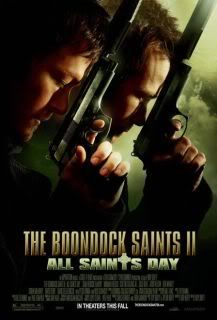
Scooby Doo Meets the Boondock Saints


I've never made any sort of secret out of my hatred for the original Boondock Saints. I've often said it's the worst film I've ever seen, and I stand by that. There may be worse movies out there and I'm sure I've seen some, but all those are widely agreed to be horrible movies. None of them have the stark-raving, drunken, tattooed fanbase that The Boondock Saints boasts. Piranha 2 is dismissive material. It was made with no ideals and no pretensions towards being anything but a quick Italian cash-grab. Calling it the worst movie of all time is par for the course. It's not a serious criticism because it's not a serious film. The Boondock Saints is clearly a labor of love, boasting some really profound morals that cater to peoples' stupidity and base instincts. People were passionate about this film when it was made.

In retrospect, I'm not even really sure why the hell I saw this movie. I suppose for the same reason I saw New Moon. It's the sequel to what is essentially 9/11 with Nickelback playing over it (I wrote that sentence, and then it got me thinking: does such a video exist?), but everyone thinks it's just the bees knees. So much so, in fact, that it's the most advertised film I've ever seen in the way of posters, t-shirts, etc. and The Boondock Saints is probably the film I've most often seen on other peoples' DVD shelves. Even my older brother is a heathen to my cause, and many intelligent, well-spoken men of film honestly defend it as a serious film. I feel like Zorro these days, but without the moral and legal impunity that apparently comes with vigilantism. And without the sword. You guys could use more sword through your chests.

The Boondock Saints II picks up eight years after the original. The MacManus brothers went on a murder spree that gave millions of people worldwide huge murder-boners at the end of the last film and have since been hiding out in Ireland. Then a priest is killed in the same style the MacManus brothers killed people, and they're off to solve the case. Along the way they meet a wacky Mexican comic relief character/sidekick played by Clifton Collins Jr., an actor I was starting to quite like before this, and an FBI agent who is a woman and so therefore must be attractive. She also does things like see clues at a crime scene with her eyeballs and make all the other detectives jealous of her keen deductive intellect (otherwise known as eyeballs). And there's something about Il Duce, who I can't really remember from the first movie, and his past making vests. A noble profession.

So how does it hold up to my expectations? Well, since it's the exact same fucking movie, I'd say "pretty good". World-famous cocksucker Troy Duffy, writer and director of these two films and no others, has spent ten (10) years writing this movie. Ten fucking years. In the time he spent farting and writing jokes about it, I doubled in mass, graduated from high school, dumped a handful of girlfriends, had my first #9 with no tomatoes from Jimmy John's and watched over 1000 movies. Yeah, that doesn't sound like much, but it's more than creating a script out of pure fart and then filming it.

So let's dive into the dicks and docks of what makes this movie horrible, and let's get the easy stuff out of the way first. The acting is horrible across the board, but it's a little less stressful on me this time because they aren't robbing Willem Dafoe, one of my most beloved actors, of his dignity. In particular, Julie Benz is a fucking fever dream as the character with the eyeballs. She's playing exactly the same character that Willem Dafoe played in the original film, and that's a role that not even goddamn Willem "God Damn" Dafoe could manage, let alone an actor who has a hard time maintaining an accent. It's one of those roles where you wonder if, as research, the actor watched footage of air-raids. Though I'm sure she was doing her very best with a script that thinks it's funny to have her say "fuck" because she's a woman and thinks that eyeballs are all it requires to outclass local law enforcement.

Troy Duffy directs this movie like he woke up with his skull cracked and bleeding and a big sack of money attached to a time bomb was laying next to him every morning during production. He applies style simply because it looks cool, never because there's any reason to apply style. This is filmmaking 101 and one of the most important rules of filmmaking that I have yet to see a good excuse for breaking: style depends on content. Similarly, you cannot mate a cat with a dog. Actually, a more apt metaphor here would be "you cannot mate an earthworm with a toaster". So when Troy Duffy suddenly starts shooting the movie like a grindhouse film, is he doing it because he's illustrating the content of the film visually, or is he doing it because he's not exactly sure why Guy Ritchie and Quentin Tarantino do it, but it sure looks cool in their movies? Fuck you, Troy Duffy.

So let's get down to business. I've been putting off revealing why these movies REALLY suck.

I don't flinch at violence, twisted codes of ethics are nothing new (I live in Indiana) and my blood, 2/3s of it greener than...something green and Irish. I don't have to cater to you assholes. Go to hell.

I'd like to point out first of all that Troy Duffy's sadistic philosophies are nothing new. But here's the gist of them: bad guys deserve to be executed. Okay, we already do that. What the fuck else do you want? Oh, yeah, the court system and trial by a jury of your peers thing needs to be removed. And who do we replace them with? Two psychopathic Irishmen. I don't see how this could go wrong.

Look, we all know the court system is flawed. But can you imagine how much more awful things would be if we gave a few men impunity to carry out the law in whatever way they liked? There's a philosophy that says the best form of government is a tyranny, but it's the most easily corruptible, and a corrupt government is the most dangerous and ineffective government of all. The same philosophy argues that a Democracy is the worst form of government, but the most difficult to corrupt, therefore a Democracy is the most effective form of government simply because it's a convoluted mess. The same thing applies to the court system. The system itself is bad, but already so susceptible to corruption. If something as convoluted as the United States justice system is still eminently corruptible, making it more corruptible is not the solution.

The film offers violence and sadistic fantasy (both things I'm fine with--I'm sickened by the context) in lieu of serious discussion about the issues the film tends to just shoot at.

"But Oliver," I'm sure you're asking "how can you condemn a film like this and not The Dark Knight, which you still slobber over like a twelve-year-old girl at a Jason Mraz concert?". Good question, reader I just made up. The difference between the two films are thus: The Dark Knight takes place in a make-believe world, in a make-believe city and featuring make-believe criminals. The Boondock Saints takes place in a world clearly modeled on our own (when Troy Duffy isn't muddling his intentions with retarded stylistic tricks) in a city called Boston which is real, but sometimes seems like an abstraction, and featuring criminals based with no pretense of fiction on real criminals. Not a bullet-proof argument by any stretch of the imagination, but it's something that factors in. Second, Batman isn't a murderer (again, not bullet-proof, but work with me here. This is going somewhere.). Third, and I think most importantly, Batman is portrayed as a mentally ill, flawed human being who knows what he is doing is a throat-jab to the fine men and women who work to bring down the bad guys using entirely legal means. Christopher Nolan never tried to push a one-man judiciary system on us and call it a legitimate philosophy. Troy Duffy has spent two films telling us how cool it would be if we shot mafiosos.

I can't think of another film that's violated my moral code ever. I barely even have a moral code. I could care less if they release a Columbine video game. No one is honestly trying to sell us on Eric Harris and Dylan Klebold's personal philosophies, and if they did no one would fucking buy it. But people talk about The Boondock Saints as if it's a paradigm of moral straightforwardness. People buy this philosophy.

If anything has become clear to me here, it's that maybe I don't hate The Boondock Saints. Maybe I hate that it represents a group of people stupid enough to love it and large enough to demand a sequel.

1/10

Thursday, October 15, 2009

Where is your God now?

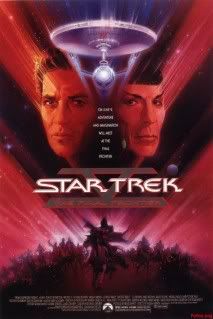
Star Trek V: The Final Frontier has an astonishingly negative reputation. I'm not going to say it doesn't deserve it (it does), but I also refuse to dismiss it as quickly as most people.

To give you some perspective and a visual metaphor to work with, imagine that the Star Trek series is a special ed class. The first film is the normal-looking kid who you don't think has any reason to be in there. The fourth film is the kid who's constantly making jokes and you're sort of smiling at him because you know this is as good as his life will get. The fifth film is some sort of Frankenstein monster assembled from the corpses of the special ed children who have been slowly disappearing over the last month. The principle having a mid-life crisis, is acting out his childhood dream of becoming a biologist using the freest resource available at a school: the special ed children. Now this monster of Frankenstein sits in the classroom trying to color in a picture of the happy family he'll never have, as he watches through the window as his creator is dragged into a cop car.

If I lost you somewhere in there, let me clarify. The Star Trek series is already sort of a middling, bumbling little kid who everyone gives a free pass because he's trying. When the series learned to do some comedy, we all patted it on the back. But now this monstrosity, assembled from various parts of the previous films pops up and no one has any goddamn idea what to do with it. We're content to let it sit there and color, but at some point we're going to have to kill it and dissect it like a crime scene.

And so here I am, with my rubber gloves and blacklight ready to figure out what the FUCK happened here.

We open on a deserted landscape, a single alien toiling. A man rides into view, Lawrence of Arabia style. He gives the alien some sort of vision, lifting some existential pain from his shoulders. The alien swears allegiance to the stranger. That's a pretty good way to open a Star Trek film. We set up a sense of mystery and foreboding right off the bat.

Can't have that, can we? Let's cut to the crew of the USS Enterprise, vacationing in Yellowstone like a bunch of weirdos with no real friends. Kirk is scaling a mountain (yeah, fucking right William Fatner, you're not going to convince us that you are in the shape you once were) and McCoy is getting bent out of shape that Spock doesn't understand campfire songs when a distress signal is received. The crew of the Enterprise are summoned back to respond, but the Enterprise is in a state of disrepair. They must contend with the man in the desert but without a fully operational ship, and when the ship is overtaken and the man is revealed to be Sybok, half-brother of Spock, Kirk, Spock and McCoy must use their superior knowledge of the Enterprise's layout to stop Sybok from taking the ship on an obsessive suicide mission to find God.

Combine that with Sybok giving the crew of the Enterprise visions of their most painful memories and a Klingon captain hunting Kirk for sport, you've got what is surely the most compelling story in a Star Trek film.

It's actually a mind-blowing carnival of weirdness, comparable only to a bunch of midget clowns singing Ring Around the Rosey in slow motion, that derails this film. I don't even know where to begin. I suppose I'll start with the good.

The opening scene is one of the better scenes in the last few films. My first impression was that at least William Shatner, who was irresponsibly given the director's chair (although I don't think it's any more irresponsible than giving Leonard Nimoy the position in the last two films), has an interest in imagery and a desire to give these films a distinguishable look instead of "Are the cameras pointed at the actors? Action."

Also, the whole cast gets a bunch of dynamic things to do. They get into their first real shootout, they're chased around the Enterprise, they explore strange worlds.

And that's where the nice things end. I made an effort to like this movie because it was trying so hard, but I can't even begin to understand why Kirk is being chased by a giant, floating 2-D head shooting lasers out of its eyes. I have no idea why Spock spends the whole movie making retarded puns. It's like a kaleidoscope filled with acid.

The whole sub-plot with the Klingon captain starts with him shooting space garbage and then folding his arms and complaining about how there's nothing to do. He then sees the Enterprise on his radar and decides to kill Kirk as revenge for Kruge two films ago. The subplot ends (I wish I were making this up), with his superior officer making him say he's sorry to Kirk.

In fact, this movie's weirdness is absolutely endearing. The way it sets up a story about finding God, THE metaphysical Holy Grail, and then does absolutely nothing with it is almost avant-garde. I'm tempted to take the whole movie as an avant-garde experiment, and I'm not saying this in a snarky, mean-spirited way. I literally suspect that those involved attempted to make the weirdest Trek film possible. How else can I explain a scene as poignant as McCoy reliving the cruelly ironic death of his father sandwiched between scenes of Scott comically bonking his head and Spock making puns about rocket boots?

I don't understand it, but I can sort of love it.

2/10

Friday, September 25, 2009

A Comedy of Errors

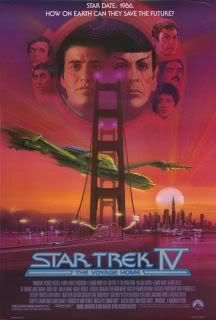
In my critical analysis of Star Trek III: The Search for Spock, I noted that the Star Trek franchise had become a pale shadow of a movie franchise, the last two barely even registering as films. Like a backwoods town attempting to build a restaurant like dem big city folk and ending up with a shack that sells watermelons on Tuesdays. Today we observe Star Trek IV: The Voyage Home, and I have similar things to say about it. The "space epic" thing not working for you? Well, what's popular with the kids? Fish-out-of-water comedies? Great, send the cast back to present day and watch all the wacky hijinks they get into. What will they think of next.

Here we go. The plot:

Picking up where Search for Spock left off, Kirk and co. are on Vulcan with the newly reborn Spock, preparing their Klingon vessel (long story) to travel back to Earth and stand trial for Kirk's latest batch of impulsive murders. The preliminary trial (where, in the future, a bunch of dudes stand around in a courtroom talking about how they're going to hang the defendant who isn't even present) features some surprisingly apt discussions of Kirk's anti-Klingon sentiments and desire to kill everything that moves, but presented as the Klingon council's machinations to further their agenda to kill everything that moves. But we're interrupted by the Giant Floating Plot Device that's evaporating Earth's oceans until SOMEONE GETS ME SOME FUCKING WHALES. Naturally, Kirk and co. travel back in time to San Francisco of 1986 (of course you'd say "Ah, San Francisco", Sulu). There, Kirk and Spock plan to abduct some whales from an overprotective marine biologist and do things like not know what money is. Wacky hijinks ensue.

I feel like I'm selling the comedy bit short. Sure, they're all stock jokes that we've heard a million times (Spock can't get the hang of cussing!), but it's nice to watch the cast loosen up a bit. The series has been in desperate need of some pie-throwing for a while, and the cast has an easy chemistry that makes the film pleasant enough to watch.

In fact, the scene where they go to a 20th century hospital allows DeForest Kelley, the funniest member of the original cast, some really great comic moments.

Leonard Nimoy is back in the director's chair for this one, and his helmsmanship has tightened up considerably. The whole film is far breezier and more fun to watch than Search for Spock (although that's not saying much). But this brings up a question: should Star Trek be this breezy? Personally, I don't think it's a good fit. I really got the feeling that the cast was sort of being dragged around haphazardly in this one in a desperate plea to keep the franchise alive. Between the comedy that makes this feel like only a sort-of-a Star Trek movie to the topical message about saving the whales, the producers really pulled out all the stops to try and make this one relevant.

And the cast is beginning to look very, very old. Obviously they've been old for a while now, but I'm just now beginning to see it, especially considering how many of them look like old lesbians (3). It's almost sad to watch. No one would allow a group of septuagenarians a state-of-the-art vessel like this, they're liable to all go into a diabetic coma and crash into the Bob Evans they were flying to.

And let's not forget the marvelously stupid Giant Floating Plot Device. The thing arrives with no explanation. It just shows up and starts evaporating it some oceans until a whale sings at it. Why is it so angry at all water that doesn't house humpback whales? Will the water more effectively house humpback whales when it's been evaporated? What are its origins? Why is any of this shit happening? No one seems especially concerned with this. They make it seem like they do this every week. Some probe comes and starts evaporating their oceans or disintegrating their rain forests until someone goes back in time and gets it the animal du jour. How strange that would seem to an outsider!

I'd rather the president just call Kirk up and send him to San Fransisco of 1986 on a mission to get into wacky hijinks. At least then you're being honest about how lazy you are.

To wrap things up, I'd say that it's nice to see the cast loosen up, but the story needed to be more Trek-esque. Instead it's a fish-out-of-water story about saving whales in 1986 that really doesn't even feel like it belongs in Trek canon. I actually prefer the thematic and visual ambition of Search for Spock, even if that was arguably a bigger failure. This film isn't as much of a failure because it sticks to such a rigid formula.

5/10

Friday, August 21, 2009

Men on a Mission

Several years ago there was a boy. He had a great deal of interest in a great many things, but none of them offered him that intangible something that he wanted. Perhaps a medium that best suited his tastes or something of significant depth that he could really sink his teeth into. One day, the boy fell ill and stayed home from school. There, bored, he rifled through some cabinets looking for something to do. He fell upon his older brother's DVD of Reservoir Dogs. He had little else to do, so he decided to take a gamble on something that his brother clearly liked, which, of course, doesn't always pay off.

But when that movie ended, that boy couldn't bring himself to move a muscle. Completely transfixed by the power of a medium he had never seen harnessed, he knew at that moment that he must start a blog. In four years.

So as you can imagine, Quentin Tarantino has a very, very special place in my heart. I've never regarded him as a truly Great filmmaker.

Until now.

I always though of him as a great writer who also happened to direct his writing, for he transformed the face of cinema and kickstarted the independent movement essentially based on his scripts.

Kill Bill is a great film(s), but it's not as groundbreaking or genre-bending as Pulp Fiction and it's not as gut-wrenching and visceral as Reservoir Dogs. But Death Proof really dampened my faith in the man. Not only was it overlong and terribly boring, but it somehow seemed to isolate all his worst impulses and leave out any of the things that make those bad impulses work in his other films.

If someone were to have told me a week ago, or five hours ago, that Inglorious Basterds would somehow combine the genre-bending and inspired dialogue of Pulp Fiction with the open gut wound that is Reservoir Dogs and wrap it in a flour tortilla of the loving kitsch that makes Kill Bill so unique, I would likely have declared you mad and had you spend the rest of your days having your hair harvested for wig-makers to practice on.

I would have been wrong. I would have falsely imprisoned you, and I would wear your wigs if I ever went bald so that at least one part of you would be able to glimpse the outside world again.

Inglorious Basterds may well be the perfect alignment of the planets otherwise known as Tarantino's body of work (which is very different from it being his best film). It combines everything that is great about him and rolls up his bad impulses in a rug and heaves it into a deep river where it will be retrieved as treasure by 24th century rug pirates.

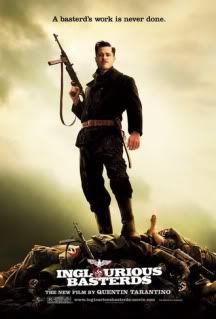
But as is tradition here at Herr Machine, I'm way ahead of myself. Here's the plot for those of you who don't know (for those of you who do know, I'm purposefully insulting your intelligence): Brad Pitt is Lt. Aldo "The Apache" Raine. He is the leader of a squad known as The Basterds, assembled of the finest Jewish-American soldiers and sent deep behind enemy lines to, well, murder the fuck out of the Germans. Why? To strike fear into the hearts of the enemy. When they see the mutilated corpses that they leave in their wake, whether they be scalped, disemboweled or or bludgeoned to death the Germans will talk and fear will spread until the Basterds are the boogieman of the American army. And isn't that just a marvel of anti-history and affectionate kitsch?

Several sub-plots weave in and out of that story, including a famous German actress, a very evil Nazi officer named Hans Landa, a young Jewish woman operating a cinema in Paris and a young Nazi war hero.

The principle actors include Brad Pitt as Aldo the Apache, a role that recalls a seeming phantom of my movie-going history. His cartoonish character is required to smirk at the camera, never deviate from the speech patterns branded to his tongue and blow my mind. If American soldiers were told about a man who kills and scalps hundreds of Nazis and commands a group of soldiers that beat Nazis to death with baseball bats, Brad Pitt's Aldo is exactly the image they would conjure. That doesn't mean he's the least bit realistic, he's every bit as batshit as the mythology and it is a ballsy performance for Pitt, as anyone could easily mistake his performance for a lazy caricature. But the way that Pitt maintains this cartoonish persona at the same time as wrapping his tongue around Tarantino's tricky dialogue every bit as well as the finest actors who have found themselves in front of his lens makes Pitt's performance one of his finest, if not his very finest, performances ever.

But the real stand out is Christoph Waltz as the very evil Col. Hans "The Jew Hunter" Landa. His talent is only something that Tarantino could pull off: he is a wordsmith. Someone who can extract information and get anyone to do anything he wants with his devilish charm. Every second he circles his target, waiting for the exact. Right. Moment. To strike. That doesn't mean that he waits a few minutes, that means he draws his prey in closer and closer for an agonizingly suspenseful period of time, but the deathblow is so quick you could blink and miss it.

Waltz gives a performance so glorious and spectacularly realized, that I may have to call it the best performance ever in a Tarantino film by a significant margin, and let me stress that that includes ALL the great performances in Tarantino's films. Harvey Keitel in Reservoir Dogs. Samuel L. Jackson and John Travolta in Pulp Fiction. Pam Grier and Robert Forster in Jackie Brown. Uma Thurman and David Carradine in Kill Bill. Writing that list of performances, I couldn't help but chortle at how far into the stratosphere Christoph Waltz blows them.

One of the chief pleasures of a Tarantino film is that the man just can't contain himself. His passion is infectious. Passion for film, passion for dialogue, passion for stories. People who complain that his scenes go on too long aren't on the same wavelength and they aren't experiencing the same movie I am. The film I saw was a 150-minute love letter to 100 years of filmmaking tradition. And not just the tradition that the critics fawn over, or even the masses, but the little things. The forgotten films that indulge our basest desires are given more cuddle time than any Citizen Kane, and why not? Tarantino loves the medium unconditionally, and that's why he's a cinephile's director. His films are a greatest-hits compilation of world filmmaking, the kind of greatest hits compilation that makes you proud to watch hundreds of movies a year.

Watch! as Tarantino slowly ratchets up the tension in his dialogue. Watch! as the dialogue sizzles and boils for ten, fifteen, twenty minutes. Watch! as guards go up and tensions rise. Watch! as those tensions catch fire. Watch! as those tensions erupt like a fucking volcano. And let's watch it again. It's a trick I didn't know Tarantino had, and it is glorious. It is glorious for its ballsiness, it is beautiful for its experimental nature. Something this experimental hardly finds its way into 3000 theaters and my pulse quickens at the thought of people seeing something this bold, this sharp, this original, this flippant, this violent, this funny, this complex, this exciting, this visceral, this great.

When I say I love a film, I mean just that. I love the bloody fucking bejeezus out of this movie. I write this only a few hours after having seen the film, and every second that I'm not seeing it again is time wasted. At one point I looked at my phone to check the time and I realized there was only another half hour in the movie. I sighed a sigh of sadness. I could have gone for another two hours of this movie. I loved every frame of this film, every word of dialogue. I fucking loved this movie.

10/10